How to Write a Two Week Notice Letter (Template + Examples)
A two-week notice letter is a formal resignation document that tells your employer you plan to leave your job in two weeks and confirms your final working day.
A two-week notice letter is a short, professional document that formally informs your employer of your resignation and provides your last day of work. While giving notice isn’t always legally required, it’s considered standard workplace etiquette and helps you leave on good terms.
Below, you’ll learn how to write a two-week notice letter that’s professional, and find ready-to-use templates you can copy and paste.
Why Do You Need to Give Two Weeks' Notice?
Giving two weeks’ notice creates a clear record of your resignation and departure date and protects your professional reputation. Employers appreciate advance warning because it allows them to plan for coverage, begin hiring, and transition your responsibilities smoothly.
While no federal law requires you to give notice in most situations, it remains standard professional courtesy. Leaving on good terms increases the likelihood of receiving strong references and keeps the door open for future networking opportunities.
Two Weeks' Notice Letter Templates (Copy & Paste)
Below are ready-to-use two-week notice templates for different situations. Each template includes all the essential elements: your resignation statement, last working day, gratitude, and a transition offer.
Choose the one that best fits your role and relationship with your manager.
Standard Professional Template
Use this two-week notice letter template for a safe, polished resignation.
Example
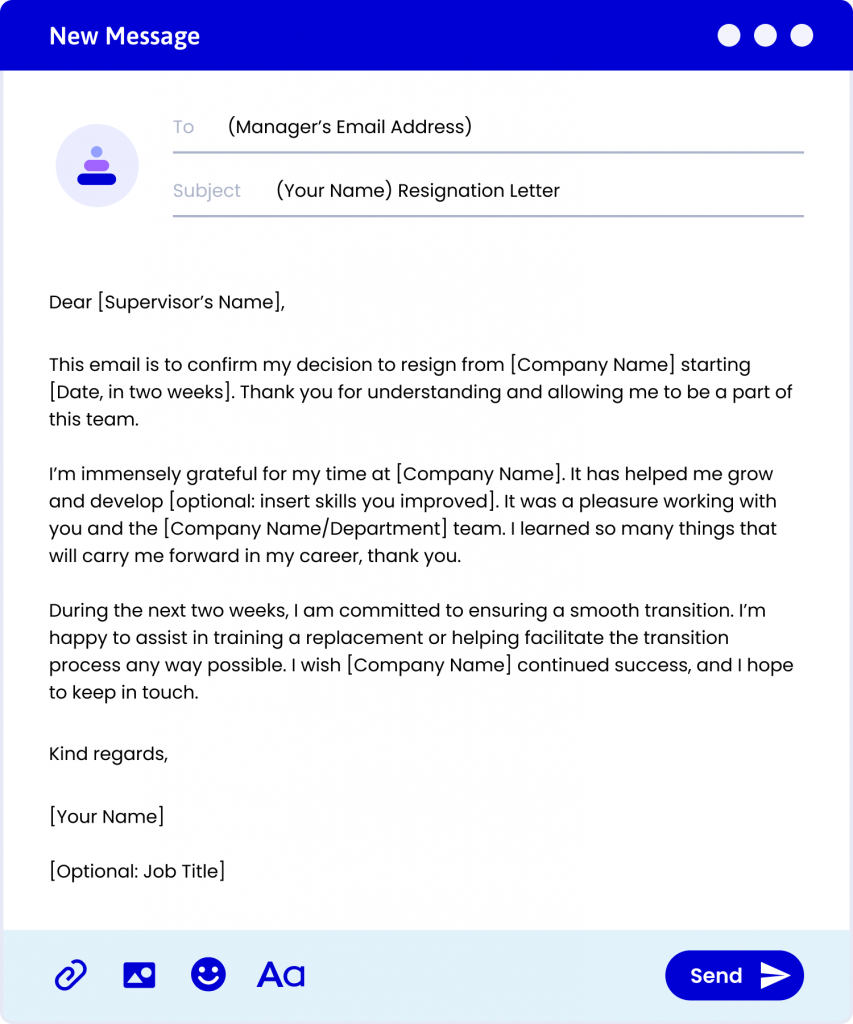
Dear [Supervisor’s Name],
This message confirms my decision to resign from [Company Name], starting [date, in two weeks]. Thank you for understanding and allowing me to join this team.
I’m immensely grateful for my time at [Company Name]. Working with you and the [Company Name/Department] team has been a pleasure. It has helped me grow and develop [optional: insert skill you improved]. I learned so many skills that will carry me forward in my career. Thank you.
I am committed to ensuring a smooth transition during the next two weeks. I’m happy to assist with training a replacement or in any way facilitate the transition. I wish [Company Name] continued success and hope to keep in touch.
Use this if you’ve been at your job for a few years and want to leave a strong professional impression.
Example
Dear [Supervisor’s Name],
This letter is to confirm that I’m resigning from my role as [your job title] at [Company Name] on [last day, typically two weeks from the date of the letter]. I made this decision with a heavy heart as I greatly appreciate working for [Company Name].
Thank you for the growth, support, and guidance you and the [Company Name] family have provided me. The skills and experience I gained here have been invaluable and will carry me forward. I will look back at our time working together with much fondness and appreciation.
Please let me know if there is anything I can do during my final two weeks to ensure a gentle transition. I wish continued success for [Company Name] and hope to keep in touch. Thank you again for everything.
This template is perfect for retaining warm relations with your former employer. Its positivity helps you leave a lasting impression on professional relationships you want to maintain.
Example
Dear [Supervisor’s Name],
I am writing to formally resign from my role as [your job title] at [Company Name], effective [last day, typically two weeks from the date of the letter]. This decision was not made lightly, and I have thoroughly enjoyed working here.
Please understand my immense gratitude for the opportunities and experiences you’ve provided during the past [length of time you worked there]. Many sincere thanks to you and our entire team for creating a positive work environment and for the opportunities for growth and learning. I am incredibly grateful for the chance to: [insert achievement, memory, or skill mastered]. And I hope to remain in touch.
Please let me know how I can foster a smooth transition over the next two weeks. I am happy to help the team plan, train, and prepare for my departure. Thank you for your understanding, compassion, and leadership. It has been a pleasure working with you.
Sincerely, [Optional: Your Signature, if submitting a hard copy] [Your Full Name] [Your Job Title]
This is the briefest two-week letter possible. It gives the employer notice and touches all necessary points. It’s most fitting for a job you haven’t worked at for long or if you had little interaction with your boss.
Example
Dear [Supervisor’s Name],
This notice confirms my resignation from [Company Name]. My last day of employment will be [last day]. Please let me know how I can help make this transition as smooth as possible.
Thank you for the opportunity to work for you; it has helped me develop [one or two skills you learned on the job].
Writing a two-week notice letter is straightforward. Keep it professional, concise, and no longer than one page. Include your resignation statement, final working day, gratitude, and offer to assist with the transition.
Step 1
Start With a Proper Greeting
Begin your two-week notice letter by addressing your supervisor, manager, or HR representative. Use “Dear [First Name]” if you have a friendly rapport, or include the last name if your relationship is formal.
If submitting a hard copy, include the date above the greeting for clarity.
Example:
March 3, 2026
Dear Monica,
Step 2
Write Your Resignation Statement
Your first sentence should clearly state that you are resigning and include your last working day. You may share a positive reason for leaving, such as family, school, or pursuing a dream, but avoid mentioning a new employer—especially a competitor—as it can imply dissatisfaction with your current job.
Example:
“It is with a heavy heart that I write to inform you I am resigning from my position as head chef for Bottom Line Restaurant. My last date will be Sunday, March 3, 2026. After much soul-searching, I’ve decided that it’s time to pursue my dream and open my own food truck. Thank you for allowing me to learn, grow, and reach this milestone in my career.”
Step 3
Express Gratitude
Expressing thanks in your two-week notice letter is key to leaving a positive impression. Be specific about what you appreciated, such as:
Keep your gratitude brief and save any extra thanks for a goodbye gathering or follow-up message.
Example:
“The past eight years at Bottom Line Restaurant have been the highlight of my career. I’ve learned so much about reducing waste, managing costs, and staying ahead of culinary trends. Your guidance and the team’s support have been invaluable. I feel like I’m leaving a family, not just a workplace. I hope to stay in touch and see you enjoying meals from my food truck soon.”
Step 4
Offer to Help With the Transition
End your notice letter by showing you’re willing to make your departure as smooth as possible. This could include wrapping up your work, training a replacement, or transferring your duties.
Offering help reassures your employer that you’re committed to tying up loose ends and supporting the team after you leave. You can phrase it like this:
“Please let me know how I can help transition from my role while wishing [Company Name] continued success.”
“During the next two weeks, I am happy to assist in any way to ensure a smooth handoff.”
“If there’s any way I can help train someone to take over my duties, please let me know.”
Example:
“As I wrap up my tenure as head chef, I’ll do everything possible to ensure my successor is fully trained. You’ve built an exceptional restaurant, Monica, and I hope it continues to thrive. Thank you for allowing me to lead the kitchen. Please let me know how I can make my exit easier. I look forward to staying in touch.”
Step 5
Sign Off Professionally
Use a formal closing and your full name. If it’s a hard copy, you can include your signature.
Example:
Sincerely, Leslie Simoneaux
Common Two-Week Notice Letter Mistakes
Giving notice is about professionalism, not venting. Avoid these common errors to leave a positive impression and protect your future references:
Explaining why you’re leaving in detail: Your letter should focus on your resignation, not the reasons behind it. Sharing complaints or personal motivations can come across as unprofessional. Keep it brief and positive.
Venting about work or colleagues: Avoid criticizing your manager, coworkers, or company policies. This can damage your professional reputation and may be remembered long after you leave. Save feedback for an exit interview if appropriate.
Mentioning a competitor or new employer: Don’t name your next employer, especially if it’s in the same industry. This can imply dissatisfaction with your current company or create tension.
Being overly excited to leave: Even if you’re thrilled to start a new role, your letter should remain professional and courteous.
Writing a lengthy or rambling letter: Keep your two-week notice letter concise—one page maximum. Stick to the essentials: a resignation statement, your last day, gratitude, and an offer to assist with the transition.
Key Takeaways
Here are the most important things to remember if you give your two weeks’ notice:
While not legally required, a two-week notice is a smart career move because it builds work references.
The notice letter should fit onto one page and consist of one to three paragraphs.
Start your letter by saying you’re leaving and listing your last day.
Express gratitude and thanks for the things about your job that served you.
Offer to help make your exit easier.
Optional: Express interest in staying in touch.
If you’re quitting to work for a business competitor, skip mentioning it in your letter.
Submit your document as an email or a hardcopy letter.
With an uncertain economy, it’s always a good idea to have a job lined up before quitting and submitting a two-week notice email.
It’s like having an expert look over your shoulder as you write your resume, guiding you step by step. Plus, it features 25+ professional designs to help you impress employers and land a new job!
You can politely quit your job immediately by being direct and courteous. Speak with your manager in person or via video/phone if in-person isn’t possible, explain that you must leave immediately, and thank them for the opportunity.
Follow up with a brief written notice to confirm your resignation and offer any support to help ease the transition.
How do I start a two-week notice letter?
Start your two-week notice letter by addressing your manager or HR professionally, and include the date if it’s a hard copy.
Begin with a clear statement that you are resigning and include your last working day. You can also add a brief, positive sentence expressing gratitude for the opportunities you’ve had while working at the company.
Can my employer deny my two-week notice?
Generally, your employer cannot legally deny your two-week notice, but they may choose to end your employment immediately. In at-will employment situations, they can ask you to leave before the notice period ends.
It’s best to remain professional, offer to help with the transition, and confirm your final working day in writing to maintain a positive relationship.
Is it better to quit or give 2 weeks' notice?
It’s better to give two weeks’ notice whenever possible. Doing so shows professionalism, maintains positive relationships, and protects your future references. Quitting without notice may harm your reputation and make it harder to get recommendations.
If circumstances require immediate resignation, remain courteous, provide a brief explanation, and offer any help to ease the transition.
Over the past 15 years, we’ve helped more than 10 million job seekers build stronger cover letters, discover their career paths, interview confidently, and boost their chances of finding the right job faster. Review our Editorial Policy to learn more about our process.
Eric is a Certified Professional Resume Writer (CPRW) and member of the Professional Association of Resume Writers & Career Coaches. He focused on helping job seekers improve their professional resumes to highlight their unique skills and experience. Eric holds a BA double major in creative writing and philosophy from Tulane University and brought more than five years of specialized experience to helping candidates navigate the complexities of the online job market, with a strong focus on resume optimization and effective self-presentation. His work has been featured on LiveCareer's Resume Builder, and his career background includes fields as diverse as education, hospitality, journalism, copywriting, and tech.




 Add LiveCareer as a preferred source on Google