Resume Builder » Resources » How to Write a Resume in 8 Simple Steps (2026 Guide With Examples)
How to Write a Resume in 8 Simple Steps (2026 Guide With Examples)
Learn how to write a resume that’s ATS-friendly, highlights your strengths, and stands out in today’s job market. Follow step-by-step guidance with expert tips and examples to land more interviews.
Learning how to write a resume that gets interviews is essential in today’s hiring process. Employers rely heavily on applicant tracking systems (ATS) and AI screening tools to filter candidates.
A strong resume includes ATS-friendly formatting, a clear structure, and quantifiable achievements. These elements highlight your strengths, align with employer expectations, and increase your chances of landing interviews.
Before writing your resume, gather the key details you’ll need to build a complete and targeted document. This helps you create a resume faster and ensures nothing important is missed.
Here’s a quick resume prep checklist:
Work history (job titles, employers, dates, and key achievements)
Skills relevant to the job you’re targeting
Education, certifications, and licenses
The job description for the role you’re applying for
Metrics or results that demonstrate your impact (sales, growth, efficiency, etc.)
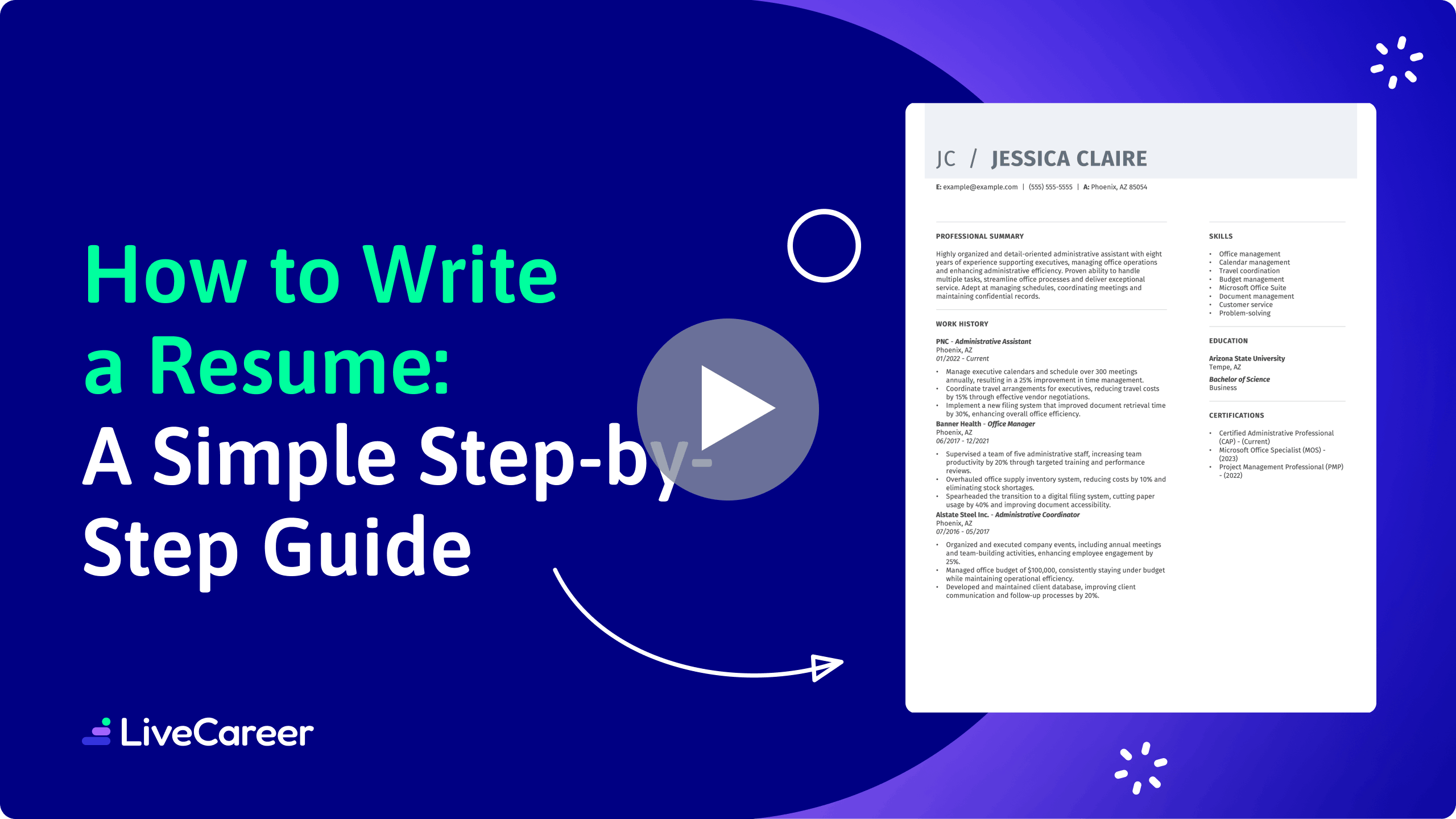
Once you have this information, you can build a targeted, ATS-friendly resume aligned with the job description. Use LiveCareer’s Resume Builder to turn your details into a polished resume in minutes, or watch our step-by-step video to see exactly how to write each resume section from start to finish.
How to Write a Resume in 8 Simple Steps
Learn how to write a resume for a job in eight simple steps, from choosing the right format to polishing your final draft. These steps will help you create a clear, professional resume that highlights your strengths and performs well with recruiters and ATS.
Step 1
Choose the Right Resume Format
Choose a resume format that best highlights your experience, skills, and career goals. The right structure helps present your qualifications clearly and effectively for the job you’re targeting.
There are three common resume formats:
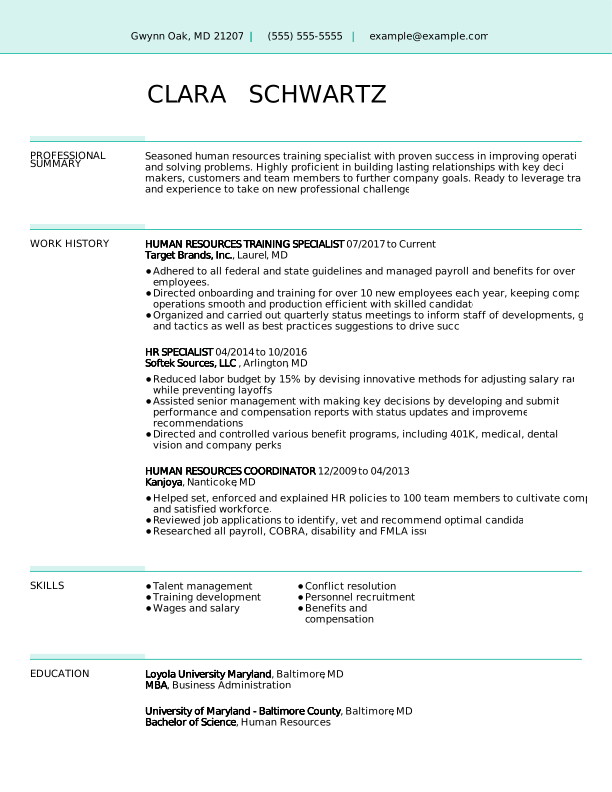
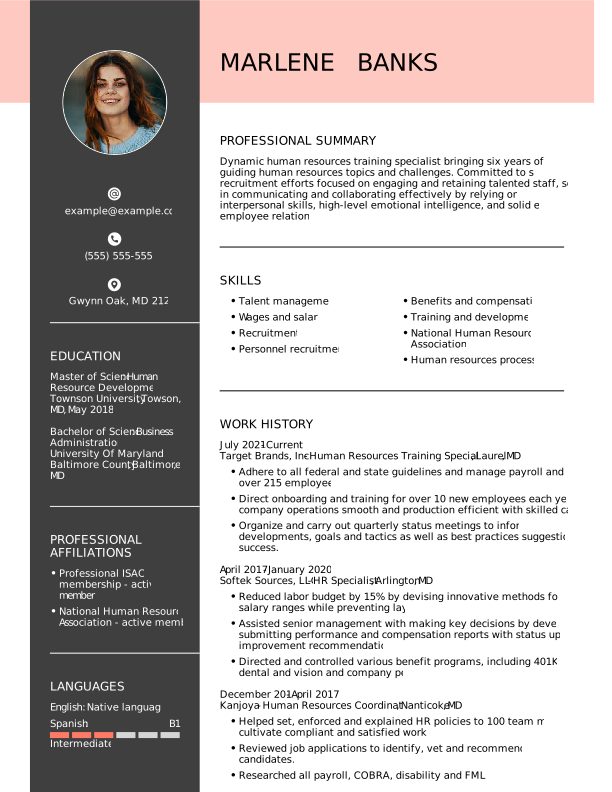
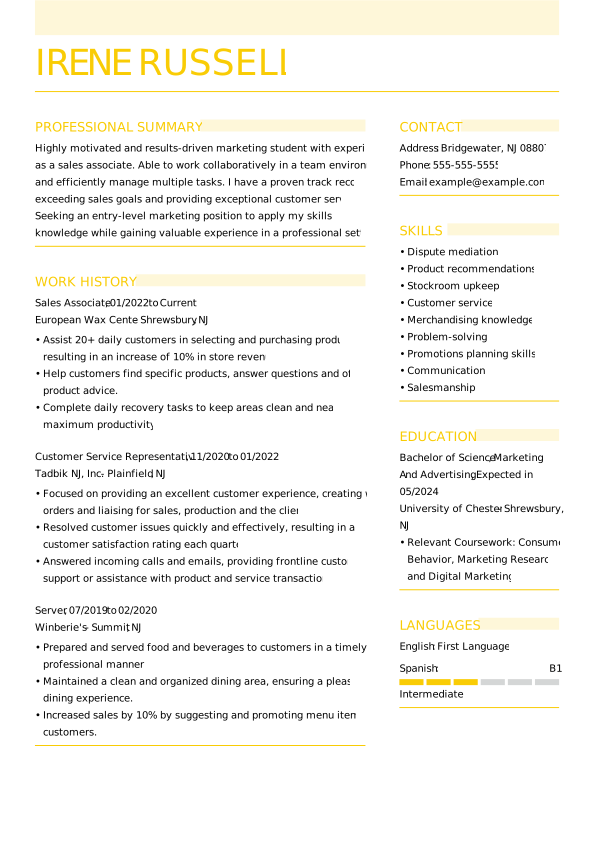
Chronological: Lists work experience in reverse-chronological order, starting with your most recent role.
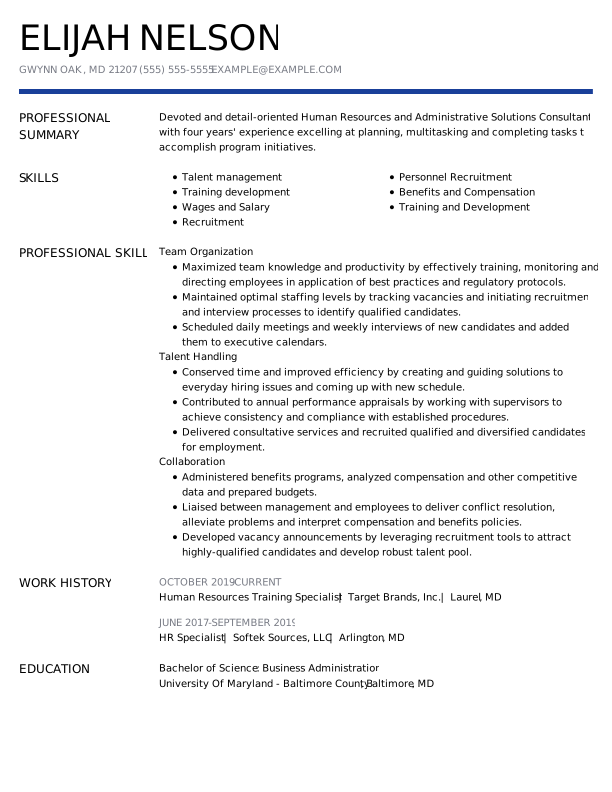
Functional: Focuses on skills and abilities rather than job titles or dates.
Combination (Hybrid): Blends skills-based sections with a reverse-chronological work history.
Career changers aiming to balance career achievements with transferable skills
Mid-level professionals who want to highlight both skills and work history
Job seekers with diverse but relevant experience across multiple roles or industries
1/3
“While preferences can vary by industry, most employers favor chronological resumes because they clearly show career progression and relevant skills. Functional resumes can be effective in certain situations, but they may require extra explanation to highlight experience in a way hiring managers can quickly grasp.”
A resume header should include your full name, phone number, professional email address, location, and—if relevant—a LinkedIn profile or portfolio.
For example:
Jordan Taylor (555) 123-4567 jordan.taylor@email.com Chicago, IL linkedin.com/in/jordantaylor (optional) jordantaylorportfolio.com (optional)
Here’s a closer look at what to include in your resume header:
Full name: Place your name at the top in a clear, prominent format.
Phone number: Use a reliable number where you can be easily reached.
Professional email address: Use a simple, professional email format.
Location: Include your city and state (zip code is optional).
LinkedIn or portfolio (optional): Add a link if relevant to the role.
Resume headline (optional): Include a summary of your key qualifications.
Step 3
Write a Compelling Resume Summary or Objective
Your resume summary or objective is the first section employers see. Also known as your resume profile, it briefly highlights your experience, skills, and career goals to help recruiters and hiring managers understand why you’re a strong fit for the role.
When to Use a Resume Summary
A resume summary is a short paragraph highlighting your experience, skills, and key achievements. It’s best for professionals with relevant work experience and measurable results.
Here’s a resume summary template you can use to write your own:
[Soft skills to describe you as a professional] + [job title and years of experience] in [area of expertise as stated in the job description]. Adept at [two or three of your best, job-relevant hard skills]. [One impressive career accomplishment and any other skills or qualifications.]
Here’s an example of how to write a good resume summary:
Analytical finance professional with 5+ years of experience managing budgeting, forecasting, and financial reporting for midsized and enterprise organizations. Skilled in financial modeling, variance analysis, and process optimization, with a proven track record of reducing operating costs by 15% year over year. Adept at collaborating with cross-functional teams to streamline reporting and support strategic business decisions.
When to Use a Resume Objective
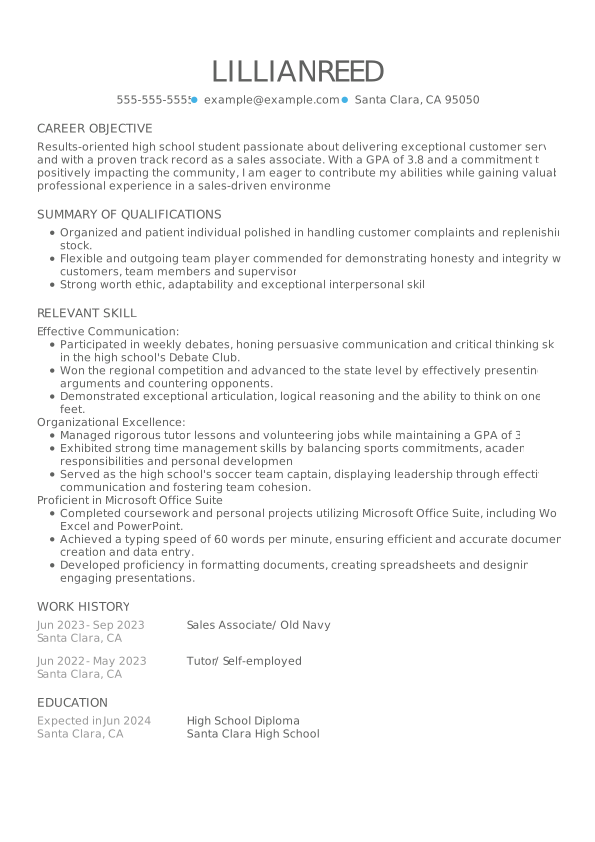
A resume objective is a short statement focused on your career goals and the value you aim to bring. It’s best for entry-level candidates, career changers, or those reentering the workforce.
Here’s a career objective template where you can fill in the blanks:
[Your profession] + [education or experience and top skills] seeking [desired job and company] to [goal you aim to accomplish in the job] with [professional skills and knowledge required in job description]. [Mention two or three soft skills and any additional qualifications.]
Here’s an example of how to create a resume objective:
Customer service professional transitioning into project management, bringing strong organizational, problem-solving, and team coordination skills. Recognized for leading cross-functional initiatives that improved response times by 20%. Seeking an opportunity to support projects through effective planning and execution.
Pro Tip
Use a resume summary if you have relevant experience and measurable achievements. Use a resume objective if you’re early in your career or changing fields.
Step 4
List Your Work Experience & Accomplishments
List your work experience and accomplishments by including your job titles, company names and locations, and dates of employment. Use bullet points to highlight measurable achievements rather than listing job duties.
Include Essential Details
Here’s a checklist of every detail you must include for each job you list in your resume’s work history section:
Job title
Company name
Work location (city and state)
Dates of employment (month and year)
Three to five bullet points detailing key achievements
Here’s an example of how to prepare a resume work history section:
Sales Associate | Target | Orlando, FL March 2020–Present
Assisted 150+ customers daily, providing personalized product recommendations and resolving inquiries to ensure high customer satisfaction.
Managed inventory for over 1,500 items, improving stock accuracy and reducing discrepancies by 25%.
Processed cash and card transactions efficiently, handling $5,000+ in daily sales while maintaining a balanced register.
Pro Tip
If a role is highly relevant to the job you’re applying for, prioritize impact and results. Older or less relevant roles can be summarized more briefly.
Add Examples & Tailor to the Job
Your work experience section should outline your past roles, but it’s not enough to simply list the job title and years of employment. You have to show employers real examples of what you achieved in each position.
To create a work history section that’s informative and helps you stand out, follow this guidance:
List your jobs in reverse-chronological order, starting with the most recent to showcase relevance.
Use concise bullet points instead of paragraphs to describe what you accomplished.
Focus on accomplishments and results that are unique to you, not on generic work responsibilities.
Quantify your achievements whenever possible by adding numbers, percentages, or dollar amounts to demonstrate how your goals were met.
Tailor your work history bullet points to the job by adding keywords from the job ad that prove your fit for the role.
Not every resume follows a perfectly linear career path—and that’s okay. Nearly 1 in 4 job seekers has employment gaps in their resume, according to a recent LiveCareer report.
Pro Tip
If you have employment gaps, briefly explain how you used that time productively through freelancing, volunteering, or skill-building. Keep the details concise and focus on transferable skills or outcomes so recruiters see progress.
Incorporate Keywords From the Job Description
One of the fastest ways to make your work history stand out is to use the same keywords employers include in their job postings. Recruiters and ATS scan for specific skills, responsibilities, and qualifications, so matching that language helps your resume get noticed.
Before writing your bullet points, review the job description and highlight the skills and requirements you already have. Then, work those keywords into your work experience descriptions to show clear alignment with the role.
Here’s a sample job ad that highlights in bold important resume keywords to consider adding:
We are hiring a dynamic and motivated sales associate for our new Altamonte Mall location. You will be responsible for various tasks on the sales floor, at the cash registers, in the fitting rooms, and in the stockroom.
Key Responsibilities
Deliver outstanding customer service.
Offer fashion styling assistance and recommendations to customers.
Replenish the shop floor.
Organize the stockroom and keepaninventory of items.
Process cash and card payments.
Process, restock, label, and tag items delivered to the store.
Greet customers in a friendly manner and inform them of promotions.
Qualifications
Retail experience
Leadership skills
Basic math and computer skills
POS system knowledge
Attention to detail
Once you’ve identified the relevant keywords, select the ones that accurately reflect your experience and incorporate them into your work history.
Here’s a sales associate work history example:
Sales Associate | Urban Outfitters | Tampa, FL November 2021–Present
Unloaded, processed, restocked, labeled, and tagged 300+ items weekly.
Organized stockroom and managed inventory of 2,000+ items, reducing out-of-stock issues by 39%.
Replenished the sales floor and assisted customers with product selection, demonstrating strong attention to detail.
Cashier | AVO Boutique | Tampa, FL August 2019–November 2021
Operated cash registers and processed cash and card payments for 20+ daily transactions.
Managed daily cash flow exceeding $7,000 while maintaining accurate financial records.
Used Clover and Shopify POS systems and trained new employees on register procedures.
Sales Associate | The Gap | Tampa, FL January 2019–August 2019
Greeted customers andpromoted daily offers and in-store specials.
Replenished the shop floor and assisted 250+ customers daily.
Provided styling assistance and personalized fashion recommendations.
Use Strong Action Verbs for Impact
Start each resume bullet point with a strong action verb to clearly show the impact you made. Phrases like “Developed a new social media strategy” are more results-focused than weak openers such as “Was responsible for managing social accounts.”
Use varied, job-relevant action verbs to keep your resume clear, impactful, and ATS-friendly. Check out the action verbs below to start:
Acquired
Analyzed
Assembled
Budgeted
Boosted
Collaborated
Conceptualized
Conducted
Delivered
Debugged
Designed
Edited
Evaluated
Facilitated
Financed
Forecasted
Generated
Handled
Identified
Implemented
Increased
Launched
Led
Leveraged
Managed
Maximized
Negotiated
Outsourced
Planned
Prevented
Prioritized
Remodeled
Resolved
Regained
Simplified
Sold
Staffed
Transferred
Undertook
Updated
Step 5
Add Skills Employers Seek
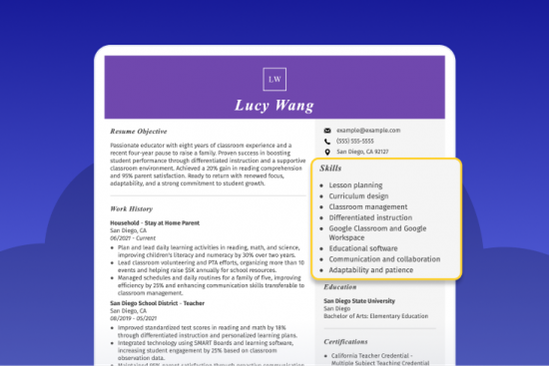
Your skills section highlights your most relevant qualifications. Include six to eight skills that match the job description and reflect your experience.
For example, a skills section might look like this:
Skills
Project management
Data analysis
Leadership
Microsoft Excel
Google Analytics
Collaboration
Problem-solving
Time management
To build a strong skills section, include a mix of skill types:
Hard skills: Measurable, job-specific abilities, such as data analysis, project management, or SEO marketing
Soft skills:Interpersonal strengths that apply across roles, such as leadership, collaboration, and adaptability
Technical skills: Tools and platforms you use, such as Adobe Creative Suite, Google Analytics, or QuickBooks
“As AI takes on more routine tasks in the workplace, employers are increasingly focused on soft skills when hiring. Highlighting transferable soft skills like collaboration, problem-solving, and emotional intelligence can help candidates stand out by showing they can navigate complex situations and work effectively with others.”
Use a mix of hard, soft, and technical skills to create a balanced and effective resume.
10 hard skills examples:
Copywriting
Project management
Data analysis
SEO marketing
Cloud computing
Graphic design
UX design
Computer programming
Foreign languages
Artificial intelligence (AI)
10 soft skills examples:
Leadership
Collaboration
Adaptability
Time management
Active listening
Conflict resolution
Innovative thinking
Empathy
Stress management
Fostering inclusiveness
10 technical skills examples:
Adobe Creative Suite
Programming languages (Python, Java)
Google Analytics
Microsoft Excel
Email marketing tools (Mailchimp)
Project management platforms (Trello, Monday.com)
Microsoft Teams
POS systems (Clover, TouchBistro)
QuickBooks
CAD engineering software
Step 6
Include Your Education
List your education in reverse-chronological order, starting with your most recent degree or diploma.
Include the following details for each program:
Degree or program name
Institution or university
Location (city and state)
Attendance dates (if not graduated)
GPA (if 3.5 or higher)
Here’s an example education section for a high school student:
Lincoln High School, Dallas, TX High School Diploma | GPA: 4.0
Here’s an example education section for a higher education graduate:
PhD in Molecular Biology University of California, Berkeley – Berkeley, CA
Dissertation: “Mechanisms of Gene Regulation in Human Stem Cells”
Bachelor of Science in Biochemistry University of Texas at Austin – Austin, TX
Pro Tip
If you graduated more than 10 years ago, omit graduation dates from your education section to reduce potential hiring bias.
Step 7
Add Additional Resume Sections
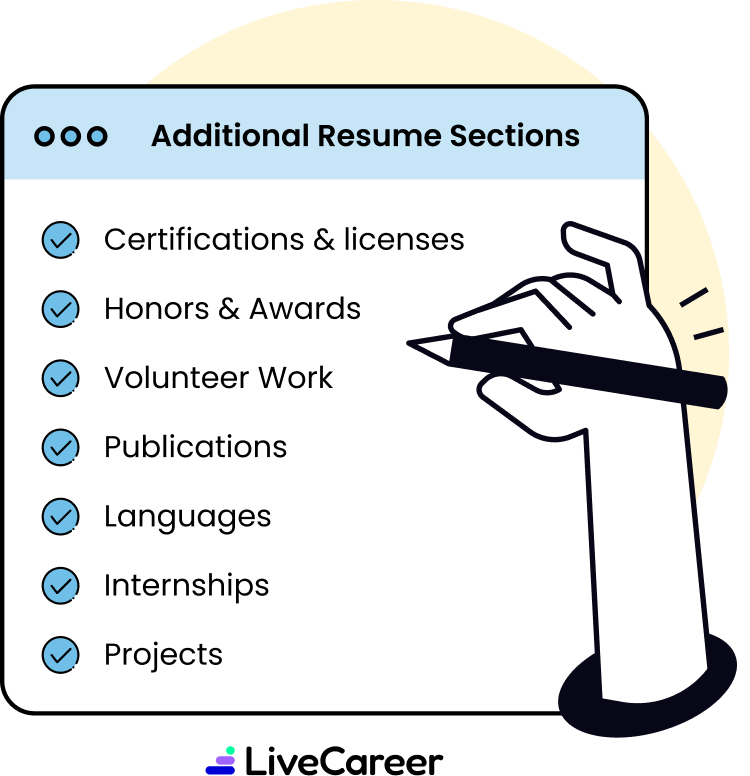
Adding additional relevant sections to your resume helps you showcase skills and qualifications that can set you apart from other candidates and enhance your application.
Certifications & Licenses
Some jobs, like nurses, EMTs, and therapists, require you to possess certain certifications or licenses to legally perform the job.
Here’s an example for a nursing job:
Licenses Registered Nurse – License #000000 Massachusetts Board of Registration in Nursing | Expires: 2027
If you have multiple certifications, add those in a separate section like this:
Certifications
Certified Project Management Professional (PMP), Project Management Institute (PMI), 2023
Google Data Analytics Professional Certificate, Google, 2022
Certified ScrumMaster (CSM), Scrum Alliance, 2021
Honors & Awards
Add an honors or awards section for any academic or professional recognition you’ve received. “Honors” relates to academic achievements, whereas “awards” refer to academic and professional accolades.
Here’s an example section for your resume:
Honors
Dean’s List (2019–2021)
Regents Scholarship – University System of Maryland (2019–2021)
Awards
Cannes Lions Awards (2022)
Clio Awards (2017)
Projects
Include a projects section on your resume to highlight major career initiatives or personal projects you’ve led or contributed to.
Here’s an example:
Projects
Led developers to create an app mapping gas station prices (2023).
Participated as a software engineer on a Microsoft app project (2019–2022).
Volunteer Work
Include volunteer work in your resume to demonstrate cultural fit, transferable skills, and, for inexperienced candidates, relevant experience.
Here’s an example:
Volunteer Work
Digital Marketing Volunteer Habitat for Humanity | East Bay/Silicon Valley, CA | January 2022–March 2023
Languages
List your languages on your resume and, if relevant, note your fluency. Language skills are especially valuable in customer service, retail, and healthcare roles.
For example:
Languages
Spanish: Native
English: Fluent
Portuguese: Conversational
Publications
Writers and researchers can list publications on their resumes. For extensive lists, consider writing a CV instead.
Here’s an example of a publications section:
Publications
Zhang, M. (2019). Breathe in: Holistic coping mechanisms in anxious children during the COVID-19 pandemic. Holistic Health, 13(3),10-12.
Zhang, M. (2016). How acupuncture affects children ages 6-12 with ADHD and other neurodiverse conditions. Journal of Acupuncture and Meridian Studies, 17(8), 21-25.
Step 8
Tailor Your Resume to the Job
The final step in the resume-writing process is to tailor your resume to the job, ensure proper formatting, and proofread it before submitting your application.
Confirm Alignment With the Job
Confirm that your resume is tailored to the job by aligning your skills, experience, and keywords with the specific role and job description.
Here are a few ways you can update your resume to reflect your target job’s requirements:
Match keywords. Review the job description and include skills, qualifications, and industry terms that align with your experience.
Prioritize relevant accomplishments. Move your most applicable achievements to the top of each section.
Adjust your summary or objective. Reflect the role’s goals and highlight how your background meets their needs.
Ensure Proper Formatting
Keep your resume easy to scan by using bullet points, consistent date formats, and standard margins while ensuring it remains ATS-friendly and free of unnecessary design elements.
Follow these tips to make sure your resume appears polished and professional:
Limit your resume to one page. Include a second page only if your career spans more than 10 years and you have lots of relevant experience.
Choose a font size between 11 and 12 points. Your section titles can be 14 to 16 points in size to help them stand out.
Stick to professional resume fonts like Arial, Calibri, Times New Roman, and Georgia.
Set resume margins to 1 inch on all sides. This measurement allows for a balance between text and white space, making the document easy on the eyes.
Adjust line spacing to single-space or 1.15 to fit your content without crowding.
Save your resume as a PDF and include your name in the file name (e.g., “Tom_Jones_Resume.pdf”) for easy identification.
Pro Tip
A resume template that comes pre-formatted with all these guidelines will make it easier to apply for jobs. Our resume templates library has dozens of recruiter-approved designs.
Proofread Before You Apply
Proofread your resume before submitting it to catch errors and confirm it's tailored, properly formatted, and ready for employers.
Here are a few key things to check before you send in your application:
Check for spelling and grammar mistakes.
Ensure clear, professional formatting throughout.
Verify that contact information is accurate and up to date.
Confirm you've incorporated relevant keywords from the job posting.
Highlight measurable achievements using strong action verbs.
Include optional sections, such as certifications, projects, or volunteer work, if relevant.
Keep your resume concise—ideally one to two pages long.
5 Tips for Optimizing Your Resume for ATS
Optimize your resume for ATS by using relevant keywords from the job description, choosing a simple format, and organizing content with clear headings so applicant tracking systems can accurately scan and rank your application.
Here’s how to make a resume stand out to ATS:
Mirror keywords from the job posting. Include relevant skills, qualifications, and industry terms naturally in your summary, work experience, and skills sections.
Keep formatting simple and organized. Use clear headings, bullet points, and a single-column layout. Avoid graphics, images, tables, or any complex design elements that ATS can’t read.
Show measurable impact. Use numbers, percentages, or results to highlight achievements, like “Increased sales by 25% in 6 months.”
Label sections clearly. Stick to standard headings, such as “Work Experience,” “Education,” and “Skills,” to help ATS and recruiters quickly understand your resume.
Use an ATS-friendly template. Our pre-formatted resume templates follow ATS rules, so you can just focus on the content.
“Ensuring that your resume is in the correct format for an ATS to scan and parse the information is the first step. Beyond that, making sure you highlight the key skills you have that are mentioned in the job description will help your resume stand out from other applicants.”
Use our ATS Resume Checker to automatically identify missing keywords, formatting issues, typos, and other areas for improvement to ensure you have a polished, ATS-compliant resume.
Resume Examples to Get You Started
Seeing a completed resume example can help you understand how all the sections—summary, skills, work experience, and education—come together. To get started, we’ve compiled a variety of sample resumes tailored to different career levels, industries, and job types.
Once your resume is polished, strengthen your application by pairing it with a customized cover letter. Resumes and cover letters together give employers a clearer picture of who you are, what you offer, and why you’re a strong fit for the role.
We already covered how important it is to tailor your resume for every job application to increase your chances of getting hired. The same goes for your cover letter—another document you should continually customize to show different employers why you’re a great fit.
A complete, well-written application highlights your skills, accomplishments, and impact, and becomes a powerful tool for opening doors to the opportunities you’re aiming for. You can use our Cover Letter Generator to make a personalized cover letter quickly and easily.
Let’s review the major steps for how to write a resume that stands out and wins interviews:
Pick a resume format that suits your experience level and spotlights your unique strengths.
Ensure your resume has the five main sections: contact information, professional summary or objective, work history, skills, and education.
Introduce yourself to employers with a resume profile that shares your most relevant qualifications for your desired role.
When writing your work experience section, focus on accomplishments instead of responsibilities. Quantifying your accomplishments is a great attention-grabber.
List your education with the necessary details, such as the name of your degree and the school or university. Generally, leave out your graduation date to prevent hiring bias.
Double-check your resume for any grammatical errors and inconsistencies.
Tailor your resume to the job description, and consider having different resumes for each job application, depending on the specific requirements of each role.
Use a resume maker like LiveCareer’s Resume Builder to simplify and speed up the writing process.
To start writing a resume, first identify the job you want and gather your work history, skills, education, and measurable accomplishments. Then, choose a resume format that fits your experience, organize your information into clear sections, and tailor your resume to the job description. This approach helps you create a focused, relevant resume that employers can quickly review.
What is the best resume format?
The best resume format depends on your experience, career goals, and work history. A chronological resume is the best choice for most job seekers because it highlights career progression and relevant experience. Functional and combination resumes may be better options for career changers, candidates with employment gaps, or those who want to emphasize transferable skills.
How do I write a simple resume?
To write a simple resume, include your contact information, resume profile, work experience, skills, and education. Use a clean, easy-to-read format with standard fonts, clear headings, bullet points, and measurable achievements. Avoid unnecessary design elements and focus on the qualifications that are most relevant to the job you’re applying for.
How do I write a resume with no experience?
To write a resume with no experience, highlight transferable skills gained through school, internships, volunteer work, extracurricular activities, or personal projects. Use a resume objective to explain your career goals, emphasize relevant skills, and include education, certifications, awards, or other achievements. Focus on your potential and the value you can bring to the role.
What should a resume look like?
A good resume should look clean, organized, and easy to scan, with clear headings, consistent formatting, and concise bullet points focused on measurable achievements. It should highlight relevant skills and experience tailored to the job, use strong action verbs, and avoid clutter or unnecessary design elements so employers and ATS can quickly understand your qualifications.
What are the three C's of a resume?
The three C’s of a resume are clarity, conciseness, and customization. A clear resume is easy to read, a concise resume focuses on your most relevant qualifications, and a customized resume is tailored to the specific job you’re applying for. Following these principles helps recruiters quickly understand your skills and why you’re a strong candidate.
What are the five golden rules of resume writing?
The five golden rules of resume writing are:
Tailor your resume to each job.
Focus on measurable achievements.
Keep formatting clean and easy to scan.
Use relevant keywords from the job description.
Keep your resume concise.
Following these rules helps ensure your resume is clear, relevant, and effective for both recruiters and ATS software.
Should I tailor my resume for every job?
Yes, you should tailor your resume for every job application. Updating your resume to match each job description helps improve your chances of passing ATS scans and shows recruiters that your experience aligns with the position. Adjust your resume profile, skills, accomplishments, and keywords to reflect the requirements of each role.
What should you avoid putting on a resume?
Avoid putting outdated information, irrelevant experience, personal details, references, and unnecessary design elements on your resume. You should also avoid generic job descriptions that list responsibilities instead of accomplishments. Focus on recent, relevant experience, measurable results, job-specific keywords, and a clean format that helps recruiters quickly understand your qualifications.
How far back should a resume go?
A resume should typically go back 10 to 15 years, focusing on recent and relevant experience that aligns with the job you’re applying for. Older roles can be summarized or omitted unless they’re highly relevant. As a general guideline, your resume length should be one page if you have less than 10 years of experience and no more than two pages for more experienced professionals.
Over the past 15 years, we’ve helped more than 10 million job seekers build stronger cover letters, discover their career paths, interview confidently, and boost their chances of finding the right job faster. Review our Editorial Policy to learn more about our process.
Gabriela is a Certified Professional Resume Writer (CPRW) and member of the Professional Association of Resume Writers & Career Coaches. She focused on helping job seekers improve their professional resumes to highlight their unique skills and experience. Gabriela holds a BA in journalism from the University of Puerto Rico and brought more than four years of specialized experience to helping candidates navigate the complexities of the online job market, with a strong focus on resume optimization and effective self-presentation.



 Add LiveCareer as a preferred source on Google