Congratulations! Earning your MBA is a major achievement. Now it’s time to show it off on your resume. Making a strong, results-driven resume is essential to stand out to recruiters and hiring managers in a competitive market.
In this guide, you’ll learn how to update your resume with a new MBA and optimize all your resume sections to help you land the right role. Use our sample MBA resumes to see how to emphasize your leadership experience, quantify your impact, and showcase the value you bring.
What Makes an MBA Resume Different?
What makes an MBA resume different from other resumes is that it should emphasize your strategic leadership and measurable business impact rather than listing day-to-day responsibilities.
As an MBA student or recent graduate, you want to showcase how you can drive revenue, reduce costs, improve operations, and lead cross-functional teams.
Employers hiring MBA grads expect to see a resume with metrics, examples of business strategy, and your leadership scope—not just participation.
Key Differences in an MBA Resume
- Strategic focus over task lists: Frame your experience around business objectives to show your senior-level management experience.
- Leadership and measurable results: Quantify details such as team size, revenue growth, cost savings, operational improvements, or market expansion to add credibility and impact.
- Business outcomes, not responsibilities: Replace generic responsibilities like “Responsible for managing budget” with impressive goals like “Managed $2M budget and reduced expenses by 12%.”
- Executive-level tone: Use concise, confident language that reflects decision-making authority and strategic thinking.
MBA Resume Example (General Management)
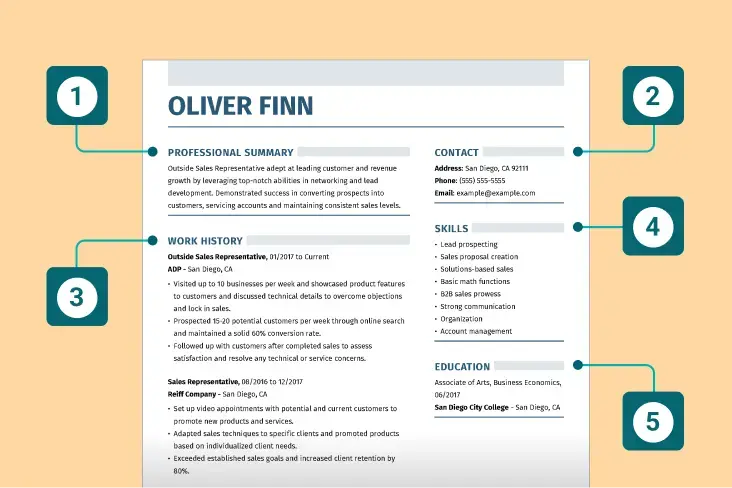
Below is a sample MBA resume tailored for a general management role. Notice how it emphasizes leadership scope, strategic decision-making, and measurable results rather than routine responsibilities.
MBA Resume Examples by Career Path
MBA hiring expectations vary by specialization. Below, you’ll find resume examples with guidance tailored to common post-MBA career paths, including what hiring managers prioritize and how to frame your impact effectively.
MBA Resume Sample – Financial Manager
A financial manager is a top role for MBA graduates. In this role, you safeguard a company’s financial health, oversee financial reporting and investments, and implement long-term strategies.
What hiring managers look for:
- Strong financial modeling and forecasting experience
- P&L ownership or direct budget management
- Data-driven decision-making with clear ROI outcomes
- Experience in presenting insights to senior stakeholders
MBA Resume Sample – Marketing Manager
Marketing managers plan and direct campaigns, analyze market demand, and identify target customers. An MBA in marketing strengthens skills in pricing strategy, growth planning, and profit and market-share maximization.
What hiring managers look for:
- Revenue growth and measurable campaign ROI
- Digital marketing and performance analytics expertise
- Go-to-market strategy and customer segmentation
- Brand positioning and competitive analysis
- Creative project management and cross-functional collaboration
MBA Resume Sample – Investment Banker
Investment banking roles demand a mix of analytical rigor, deal-making insight, and client-facing expertise.
An MBA in finance equips you with advanced modeling, valuation, and strategic thinking skills, helping you navigate complex transactions and provide actionable advice to clients.
What hiring managers look for:
- Proven ability to evaluate companies and create financial models
- Experience supporting or leading deals, IPOs, or mergers and acquisitions
- Strong understanding of market trends, competitor dynamics, and risk factors
- Clear communication of insights to clients and senior leadership
- High attention to detail combined with quantitative problem-solving skills
MBA Resume Sample – Product Manager
Product managers turn ideas into impactful products that solve real customer problems. With an MBA, you can highlight both your strategic insight and your ability to drive results across teams.
This combination shows employers you can manage the full product life cycle while aligning business goals with user needs.
What hiring managers look for:
- Experience leading cross-functional teams to launch products successfully
- Skills in analyzing user behavior and market opportunities to guide decisions
- Ability to set priorities, define features, and track product performance
- Strong collaboration and communication with technical and nontechnical stakeholders
- Demonstrated impact on growth metrics, adoption rates, or customer satisfaction
MBA Resume Sample – Business Analyst
Business analysts turn data into actionable strategies that move a business forward.
An MBA adds a layer of strategic insight, allowing you to not only interpret numbers but also recommend solutions that align with company goals, streamline operations, and support informed decision-making across teams.
What hiring managers look for:
- Strong analytical skills for interpreting complex data
- Experience in process improvement, performance metrics, and operational reporting
- Ability to translate insights into actionable business recommendations
- Collaboration with stakeholders across departments to implement solutions
- Track record of driving measurable impact on cost, efficiency, or revenue
MBA Resume Sample – Operations
Transitioning into business operations after an MBA requires highlighting transferable skills, leadership experience, and measurable results from previous roles.
Hiring managers want to see that you can manage processes, optimize workflows, and drive efficiency, even if your prior experience was in a different field.
What hiring managers look for:
- Process improvement and operational efficiency
- Project and team leadership
- Budgeting, resource allocation, and cost management
- Cross-functional collaboration and stakeholder communication
- Quick learning and adaptability in new business contexts
How to Write an MBA Resume
Write an MBA resume that showcases your academic achievements, relevant professional experience, and in-demand skills, highlighting why you’ll be an asset to the company. The following tips will help you create a resume that effectively showcases your MBA.
Step 1: Start With a Leadership-Focused Summary
Your MBA resume should open with a resume summary that immediately communicates your credentials and most job-relevant qualifications. Highlight your MBA, years of experience, and key achievements, framing them in a way that aligns with the role you’re targeting.
Example:
“Results-driven MBA graduate with 7+ years of experience in finance and operations, passionate about helping teams work smarter and drive real business results. Led cross-functional projects that increased revenue by 18% and cut operational costs by 12%. Thrive on turning complex challenges into actionable solutions.”
Step 2: Quantify Your Achievements
Numbers speak louder than words on an MBA resume. When writing achievements in your work experience, tie your accomplishments to measurable outcomes to show the tangible impact you’ve had.
Examples of quantifiable achievements in a resume could include revenue growth, cost savings, or improvements in operational efficiency.
Examples:
- Led a team of 8 analysts to reduce reporting errors by 25% and accelerate the monthly financial close by 3 days.
- Streamlined procurement workflow, cutting turnaround time by 18% and saving $120,000 annually.
- Optimized supply chain operations across 3 regions, reducing delivery times by 15% and cutting annual logistics costs by $450,000.
Step 3: Showcase Strategic & Transferable Skills
Your MBA resume should highlight the skills that demonstrate both your strategic thinking and your ability to make an impact in any role. Focus on abilities that are relevant to your target position and transferable skills that work across industries.
A great way to find the right resume skills is to use the job ad as a source of resume keywords. Read the job description carefully, and take note of all the hard skills and qualifications you possess—these should be a priority.
Pair those professional skills with equally valuable soft skills like interpersonal communication, leadership, and organization to show you’re a capable candidate.
Step 4: Present Your MBA Education Effectively
Your MBA education should showcase your specialized knowledge and relevant experiences that align with your career goals. Include your degree title, school details, and any honors or distinctions, such as Dean’s List or scholarships, to highlight academic achievement.
Be strategic about the details you include: emphasize coursework, concentrations, or projects that are directly relevant to your target role. For example, if you’re pursuing a career in finance, highlight courses in corporate finance, investment analysis, or mergers and acquisitions.
Example:
Master of Business Administration (MBA), Finance Concentration
Harvard Business School | Boston, MA | 2025
- Relevant Coursework: Corporate Finance, Investment Analysis, Mergers & Acquisitions, Strategic Management
- Honors: Dean’s List, Finance Club Leadership Award
- Key Project: Developed a financial model for a $50M acquisition and presented recommendations to a panel of industry executives
Bachelor of Science in Economics
University of California, Berkeley | Berkeley, CA | 2016
- Leadership: President, Economics Society
- Honors: cum laude
Step 5: Choose a Clean Layout
Even the strongest achievements can get lost if your MBA resume isn’t easy to read. A clean, professional layout ensures that recruiters and hiring managers can quickly scan your credentials, understand your career progression, and see the value you bring.
Tips for a readable MBA resume:
- Use a clean, executive-style layout. Stick to a professional resume template with simple fonts, clear headings, and consistent formatting.
- Follow reverse-chronological order. List your most recent roles first to highlight your current expertise.
- Keep it concise. A one-page resume is ideal, but two pages are acceptable for senior-level candidates.
- Skip the objective statement. Opt for a strong, results-focused summary that immediately communicates your value.
- Use bullet points and white space strategically. Break up text to make key achievements easy to scan.
Key Takeaways
Here are the main takeaways from this article to write a successful MBA resume for any job:
- Start your MBA resume with a strong, results-focused summary that highlights leadership, strategy, and measurable achievements.
- Quantify your accomplishments with metrics and numbers to demonstrate tangible results and business impact.
- Highlight transferable skills such as analytical and leadership skills relevant to your target role.
- Tailor your resume by career path. Customize your work experience, skills, and education sections to align with your role’s requirements.
- Showcase relevant coursework, concentrations, projects, and honors that reinforce your expertise.
- Use a simple resume template, bullet points to break up your work experience and skills, and concise language.
FAQ
How do you write an MBA resume?
Writing an MBA resume requires focusing on leadership, strategic impact, and measurable results. Highlight your MBA, relevant experience, and transferable skills.
Use bullet points to quantify achievements and tailor your resume to the role you’re targeting, showing recruiters how your education and experience drive business outcomes.
How should I list my MBA on my resume?
You should list your MBA under the education section, including your degree concentration and the name of your school. Add relevant coursework, honors, or projects that demonstrate skills aligned with the job you’re applying for, making your degree both credible and actionable.
The best format for an MBA graduate is the reverse-chronological resume format. Include a concise summary, measurable accomplishments in your work experience, a clear skills section, and your MBA education.
One page is ideal—or two pages for senior roles—keeping readability and impact in focus.
What skills does an MBA give you?
An MBA gives you strategic, analytical, and leadership skills. You gain expertise in areas like financial analysis, marketing strategy, operations management, and data-driven decision-making.
Soft skills, such as communication, collaboration, and problem-solving, are also strengthened, making you versatile across industries.
How We Reviewed This Article
Over the past 15 years, we’ve helped more than 10 million job seekers build stronger resumes, discover their career paths, interview confidently, and boost their chances of finding the right job faster. Review our Editorial Policy to learn more about our process.
About the Author
Gabriela Hernandez • CPRW, Career Advice Writer
Gabriela is a Certified Professional Resume Writer (CPRW) and member of the Professional Association of Resume Writers & Career Coaches. She focused on helping job seekers improve their professional resumes to highlight their unique skills and experience. Gabriela holds a BA in journalism from the University of Puerto Rico and brought more than four years of specialized experience to helping candidates navigate the complexities of the online job market, with a strong focus on resume optimization and effective self-presentation.
Ready to
land the job?
Join 28M+ others who’ve built a resume that works.




 Add LiveCareer as a preferred source on Google