Resume Builder » Resources » Resume Language Skills: Examples & How to List Them Effectively
Resume Language Skills: Examples & How to List Them Effectively
Learn how to list languages on your resume so employers can quickly understand your communication abilities and how well they align with job requirements.
Language skills can set your resume apart, especially in roles where communication, collaboration, or global awareness matter.
But simply listing a language isn’t enough to make an impact. How you present those skills plays a big role in how clearly employers understand your abilities.
In this article, you’ll learn how to list languages on your resume in a way that’s professional, consistent, and easy to interpret. You’ll also see how to describe your proficiency so hiring managers can quickly gauge your strengths and match them to the role.
What Are Resume Language Skills?
Resume language skills are your ability to speak, read, write, or understand a language other than your primary language. Many employers value language skills because they improve communication, customer experience, and cross-cultural collaboration.
Benefits of Including Languages in a Resume
Including language skills on your resume increases your marketability, especially in global or customer-facing roles.
According to the report Making Languages Our Business by the American Council on the Teaching of Foreign Languages (ACTFL), 9 out of 10 U.S. employers say they rely on employees who speak a language other than English.
Employers have also reported that the value of multilingual employees is evident in both direct business impact and a richer work culture. Language skills are especially relevant to roles in healthcare, education, customer service, hospitality, sales, and global business roles where interacting with diverse speakers is part of everyday life.
When Should You Include Language Skills on Your Resume?
Include language skills on your resume when they’re relevant to the job or clearly strengthen your candidacy. Generally, you should only include languages when they demonstrate clear, usable proficiency.
If you’re unsure whether your language ability is strong enough, use the job requirements as your guide. Here are the top scenarios where including them is beneficial:
1. They’re Required for the Job
Include language skills on your resume when they’re explicitly required for the job. A language skills section should be a top priority if the role mentions proficiency in one or more languages.
Clearly list languages and proficiency levels for roles such as translators, interpreters, international sales, or customer service, where effective communication in multiple languages is critical.
2. The Role Involves Diverse Customers or Clients
Include language skills on your resume for roles that involve serving diverse customers or clients. Even when they’re not required, language skills add value in roles like nursing, teaching, or customer service.
Multilingual employees can improve customer experiences, resolve issues more efficiently, and help organizations connect with broader communities.
3. The Company Operates Internationally
Include language skills on your resume when the company operates internationally or serves global markets. These skills help demonstrate your ability to communicate across borders and cultures.
Employees with language skills support workplace diversity and inclusion by bringing different perspectives and helping organizations connect with diverse communities.
Listing your language skills shows employers you add value beyond technical abilities and can give you an edge over other candidates.
4. You Have Professional Working Proficiency or Higher
Include language skills on your resume when you have professional-level proficiency or higher. If you can confidently use the language in workplace settings, it adds immediate credibility.
Listing language skills on your resume demonstrates that you can contribute immediately to support cross-cultural communication and handle responsibilities that require multilingual capabilities.
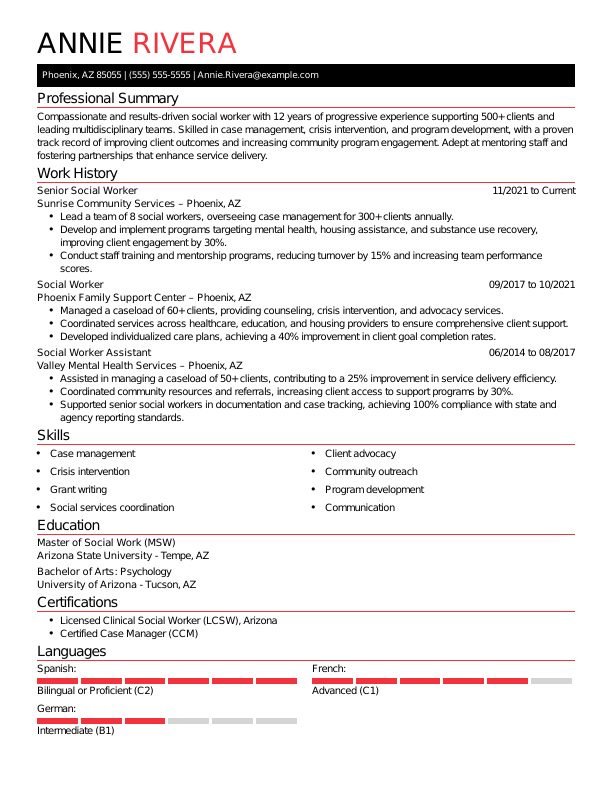
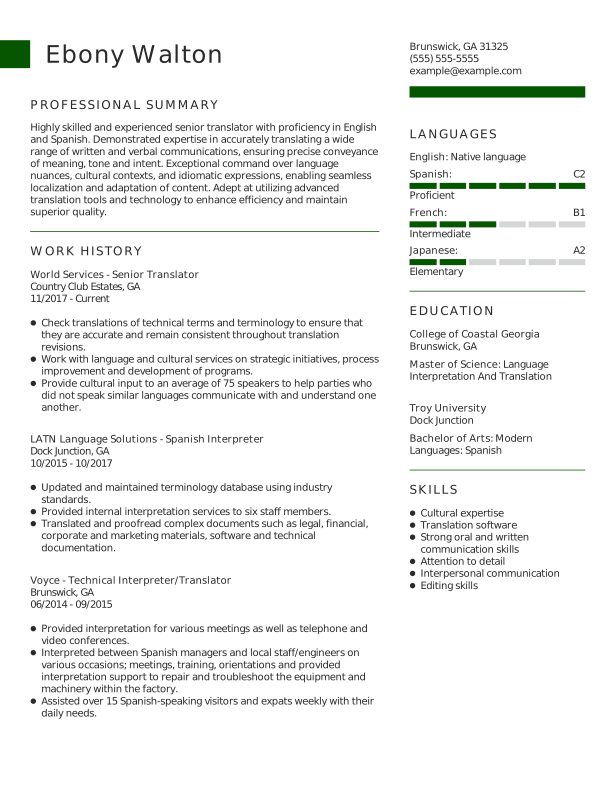
Sample Resume Listing Language Skills
Here's what a resume with language skills looks like:
When listing language skills on your resume, make it easy for recruiters to assess their relevance. As an overview, these are the key steps you need to take when listing resume language skills:
Choose a recognized proficiency scale.
Determine your proficiency level (beginner, intermediate, advanced, etc.).
Decide whether a separate section is needed.
Let’s go into detail about the steps you need to take to write a great resume that effectively showcases your language skills.
Step 1: Select a Language Proficiency Scale
Use a recognized language proficiency scale when listing languages on your resume. This ensures clarity and prevents confusion about your skill level.
The following table organizes the most commonly used nationally and internationally recognized rating systems to help you list levels of language proficiency on your resume:
Scale
Levels
Best for
American Council on the Teaching of Foreign Languages (ACTFL)
Novice to Superior
Education and academic roles
Interagency Language Roundtable (ILR)
0–5
Federal and government jobs
Common European Framework of Reference for Languages (CEFR)
A1–C2
International jobs and study abroad
LinkedIn scale
Elementary to Native/Bilingual
U.S. corporate roles
Step 2: Determine Your Fluency Level
Use official tests, self-assessments, or practical evaluations to determine your language fluency level.
The most definitive method for testing your fluency is nationally or internationally recognized exams aligned with frameworks such as CEFR and ACTFL. Having these official fluency certificates is a must for roles like interpreter or translator, or for international roles.
If an official test isn’t required or necessary for your target role (e.g., if you’re a bilingual nurse or customer service manager), you can back up your claims with self-assessments based on standardized frameworks. For instance, CEFR offers free self-assessment grids that help you determine your fluency level using its scale.
You can also take an informal quiz with a fluent speaker or language teacher, and they can help you determine a more accurate fluency level. Whichever method you use, remember to be honest, as employers may test your abilities.
Fluency Self-Evaluation Checklist
If you’re not taking a formal exam, use standardized frameworks to assess your speaking, reading, writing, and listening skills. Ask yourself the following questions to determine your fluency:
Beginner
Can I introduce myself and ask basic questions?
Can I understand simple phrases and short sentences?
Can I write brief, simple messages?
Intermediate
Can I hold a conversation about work-related topics?
Can I understand emails, reports, or articles on familiar subjects?
Can I write clear messages or participate in meetings?
Advanced
Can I lead meetings or give presentations in this language?
Can I negotiate, explain complex ideas, or resolve conflicts?
Can I write professional documents with minimal errors?
Native/Bilingual
Can I communicate fluently and spontaneously in any setting?
Do I understand cultural nuance, humor, and idioms?
Can I work entirely in this language without difficulty?
If you can confidently answer “yes” to most questions in a category, that’s likely your level. Always err on the side of accuracy because employers may assess your skills during interviews.
Step 3: Decide Where to Put Language Skills on Your Resume
Place language skills in the most relevant section of your resume based on job priority.
In a Dedicated “Language Skills” Section
If you’re fluent in two or more languages, create a separate section on your resume to showcase your language skills. As a recruiter scans your resume, a “Language Skills” section will quickly grab their eye and inform them that you’re multilingual.
A separate “Language Skills” section is also ideal for professionals in translation, as these are core to their role.
Here’s an example of a language skills resume section:
Language Skills
Spanish – C2 (Proficient User)
English – C2 (Proficient User)
French – C1 (Proficient User)
Portuguese – B2 (Independent User)
In Your Resume Skills Section
Include language skills in your resume skills section if you’re a beginner or if it’s not required for the role but is a good-to-have, such as for customer service, healthcare, or a corporate role.
Here’s how to list language skills in your resume’s main skills section:
Skills
Copywriting
Social media management
Content creation
Reels and TikTok
Project management
Spanish (Advanced)
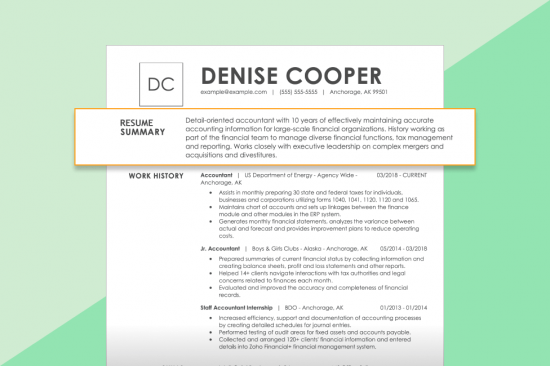
In Your Resume Summary
The resume summary is the ideal section to showcase your language skills for roles that require fluency in a specific language, but it’s not the core of the job.
For instance, a company might hire an SEO expert fluent in Portuguese to expand into the Brazilian market, or a customer service agency may seek bilingual representatives for markets where customers speak multiple languages. If this is your case, clearly state your fluency level in your resume summary along with any other relevant qualifications.
Check out how to list languages in a resume summary:
Professional Summary
Bilingual SEO specialist fluent in English and Portuguese (CEFR C2) with experience helping companies expand into Brazilian and other Portuguese-speaking markets. Skilled in keyword research, content optimization, and cross-cultural digital marketing strategies. Proven ability to analyze international markets, localize campaigns, and drive traffic while maintaining brand voice. Highly adaptable, detail-oriented, and committed to delivering results that connect with diverse audiences and support business growth.
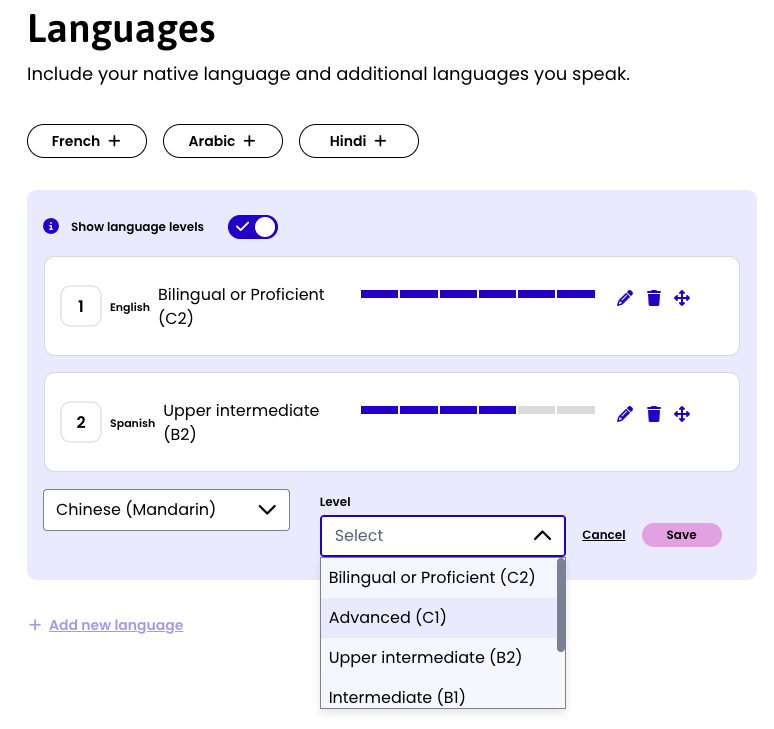
Easily create a professional language skills section with LiveCareer’s Resume Builder. Our auto-formatting feature lets you add fluency levels and a visual skills bar to showcase your proficiency across multiple languages. The builder uses the globally recognized CEFR scale, ensuring your language abilities are clear and credible to employers.
Here are some examples of language skills on a resume featuring various proficiency levels and scales that you can copy and paste onto your resume. Of course, always edit them with your real proficiency.
Examples of Language Skills in a Resume Summary
Customer Service Representative Summary Example (LinkedIn Scale)
Professional Summary
Bilingual customer service representative fluent in English (Native) and Portuguese (Full Professional Proficiency), specializing in supporting diverse client bases. Resolved 95% of customer inquiries on first contact, improving overall satisfaction scores by 20%. Skilled in CRM systems, conflict resolution, and team collaboration. Experienced in handling high-volume calls and live chat support while providing culturally sensitive assistance. Known for building strong client relationships and delivering consistent, high-quality service across international markets.
Customer Success Specialist Summary Example (CEFR)
Professional Summary
Customer success specialist fluent in English (C2) and French (C1), supporting clients across Europe and North America. Managed a portfolio of 50+ high-value accounts, achieving a 25% improvement in client satisfaction scores. Proficient in CRM software, conflict resolution, and data analysis. Experienced in onboarding new clients and delivering tailored solutions to meet business objectives. Known for building strong client relationships and fostering cross-cultural collaboration.
Financial Analyst Summary Example (ILR)
Professional Summary
Financial analyst with ILR 5 proficiency in English and ILR 3 proficiency in Mandarin, specializing in international markets. Conducted financial modeling and risk assessments that helped secure $2M in cross-border investments. Skilled in contract negotiation, data analysis, and strategic planning. Experienced in preparing reports for executive leadership and advising on market-entry strategies. Demonstrates strong analytical skills and the ability to communicate complex financial concepts across languages and cultures.
Marketing Manager Summary Example (ACTFL)
Professional Summary
Bilingual marketing manager fluent in English (Superior-High) and Spanish (Advanced-Mid) with 7+ years of experience leading international campaigns. Skilled in cross-cultural communication, brand strategy, and digital advertising. Successfully increased engagement by 35% for campaigns targeting Latin American markets. Experienced in project management, content creation, and analytics-driven marketing.
Examples of Languages in a Resume Skills Section
Bank Teller (ILR)
Skills
Cash handling and reconciliation
Customer service
Account management
Fraud detection
Banking software proficiency
Problem-solving
Mandarin – ILR 3
Content Creator (ACTFL)
Skills
Content writing and editing
SEO optimization
Video production
Graphic design
Analytics and reporting
Brand storytelling
Italian – Advanced-Mid
Spanish – Intermediate-Mid
Construction Manager (CEFR)
Skills
Project management
Budgeting and cost control
Scheduling and timeline management
Vendor coordination
Risk assessment
Quality assurance
Spanish – B2
Phlebotomist (LinkedIn scale)
Skills
Blood collection and specimen handling
Infection control
Laboratory procedures
EHR documentation
Vital signs monitoring
Cross-cultural communication
French – Professional Working Proficiency
Examples of Languages in a Separate Section
Customer Success Manager (ACTFL)
Languages
English – Superior-High (Native)
Italian – Advanced-Mid
Albanian – Intermediate-Low
Hungarian – Novice-Mid
Foreign Service Officer (CEFR)
Languages
French – B2 (Independent User)
Danish – B1 (Independent User)
English – C2 (Proficient User)
Russian – C1 (Proficient User)
International Sales Manager (ILR)
Languages
English – ILR 5 (Native/Bilingual)
Cantonese – ILR 4 (Full Professional Proficiency)
Mandarin – ILR 3 (Professional Working Proficiency)
Arabic – ILR 2 (Limited Working Proficiency)
International Student Advisor (LinkedIn scale)
Languages
English – Native or Bilingual Proficiency
Spanish – Full Professional Proficiency
French – Limited Working Proficiency
German – Elementary Proficiency
Tips for Adding Language Skills on a Resume
Adding language skills to your resume can set you apart in today’s global job market, but how you present them matters. Follow these tips to make your language section clear, credible, and compelling:
Choose a single rating system. Select one standardized scale, such as ACTFL, ILR, CEFR, or LinkedIn, and use it consistently. This avoids confusion and makes it easy for recruiters to understand your proficiency at a glance.
Label the section clearly. If you create a separate section, use a clear heading like “Languages” or “Language Skills.” Recruiters scan resumes, and a distinct heading ensures your multilingual abilities aren’t overlooked.
List proficiency levels. Pair each language with its proficiency using your chosen scale (e.g., ACTFL: Superior, CEFR: C1). This provides context beyond just naming the language, showing how confident you are in reading, writing, and speaking.
Specify native or bilingual proficiency. Clearly note if a language is your native or bilingual language (e.g., “English – Native”). This immediately signals your highest level of fluency.
Order languages by relevance. List languages most relevant to the role or industry first. For example, if applying to a Brazilian market, put Portuguese at the top even if English is your strongest language.
Include only functional languages. Avoid listing languages you barely know. Focus on languages where you have practical or professional proficiency to maintain credibility and relevance.
Highlight certifications. If you have official language certifications, such as the ACTFL, DELE (Diplomas de Español como Lengua Extranjera), Seal of Biliteracy, or other recognized credentials, include them alongside the language. Certifications provide verified proof of your abilities and can make your resume stand out.
Provide context when needed. For government, federal, or international roles, indicate the scale you’re using (e.g., ILR 5, CEFR C2) so your proficiency is clear and standardized.
Double-check accuracy. Always ensure your listed proficiency matches your real abilities. Employers may test your skills during interviews, so honesty protects your credibility.
Frequently Asked Questions
How do you describe your language skills in a resume?
To describe your language skills on a resume, list each language and your proficiency level using a recognized scale, such as CEFR (A1–C2), ACTFL (Novice to Distinguished), ILR (0–5), or simple descriptors like basic, conversational, fluent, or native.
Include languages either in a dedicated “Languages” section, the skills section, or your summary if the job requires them. Be accurate and list only languages you can comfortably use in a professional setting.
What are the five levels of language proficiency?
The five general levels of language proficiency are beginner, elementary, intermediate, advanced, and proficient (or fluent). These levels describe how well someone can understand, speak, read, and write a language.
Many formal systems, such as the Common European Framework of Reference for Languages, expand these into more precise categories (e.g., A1, A2, B1, B2, C1, and C2) to better measure language ability.
What are five good skills to put on a resume?
Five good skills to include on a resume are communication, teamwork, problem-solving, time management, and adaptability. These transferable skills apply to most industries and show employers you can collaborate effectively and handle workplace challenges.
Pair these with job-specific hard skills, such as data analysis, project management, or technical tools, to demonstrate both your professional expertise and your ability to work well with others.
What skills define language proficiency?
Language proficiency is defined by your ability to speak, read, write, and understand a language. Your proficiency level reflects how well you can communicate in real-world or professional situations, from basic conversations to fluent, work-related communication. Employers use proficiency levels to understand what tasks you can realistically perform in each language.
How do you list programming languages?
Programming languages should be listed in a dedicated technical skills section rather than a language skills section on your resume. Include only the programming languages that are relevant to the role and, if helpful, indicate your proficiency or years of experience. Examples include Python, Java, SQL, JavaScript, and C++.
Should you put a language you’re learning on a resume?
You can put a language you're learning on your resume if it’s relevant to the job and you clearly state that you’re a beginner or currently studying it. Be honest about your proficiency, and avoid implying you can use the language professionally if you’re still learning. If the language isn’t relevant to the role, it’s usually better to leave it off.
How We Reviewed This Article
Over the past 15 years, we’ve helped more than 10 million job seekers build stronger cover letters, discover their career paths, interview confidently, and boost their chances of finding the right job faster. Review our Editorial Policy to learn more about our process.
Gabriela is a Certified Professional Resume Writer (CPRW) and member of the Professional Association of Resume Writers & Career Coaches. She focused on helping job seekers improve their professional resumes to highlight their unique skills and experience. Gabriela holds a BA in journalism from the University of Puerto Rico and brought more than four years of specialized experience to helping candidates navigate the complexities of the online job market, with a strong focus on resume optimization and effective self-presentation.



 Add LiveCareer as a preferred source on Google