A high school resume highlights a student's education, skills, activities, and experience when applying for jobs, internships, or educational opportunities.
Students don't need formal employment to create a strong resume. Babysitting, tutoring, volunteering, school projects, and extracurricular activities can demonstrate relevant skills.
Most high school students applying for jobs should aim for a one-page resume with clear headings and simple formatting.
College application resumes typically emphasize academic achievements, leadership, and extracurricular involvement, while job resumes focus on relevant skills, experience, and accomplishments.
High school resume examples and templates show students how to organize their qualifications, but each resume should reflect the specific job, program, or application.
Writing your first high school resume can feel challenging, especially if you haven't had a formal job yet, but you probably have more experience to share than you realize.
This guide offers resume templates, examples, and writing tips to help you highlight your strengths for a first job, college application, or other opportunity—with or without formal work experience.
High School Resume Example & Template
Use this high school resume example and template to learn how to organize your qualifications for a first job, even if you have limited work experience.
To create your own resume using the template below, replace the bracketed placeholders, reorder sections to highlight your strengths, and remove anything that doesn’t apply.
[Your Full Name] [City, State] | [Phone Number] | [Professional Email] [Portfolio or LinkedIn URL, if relevant]
Resume Objective [High school student with relevant skills, interests, and accomplishments seeking a specific opportunity. Explain what you can contribute.]
Education [High School Name], [City, State] Expected Graduation: [Month Year] GPA: [GPA, if 3.5 or higher] Relevant Coursework: [Courses related to the opportunity] Honors: [Relevant academic recognition]
Skills
[Relevant technical or job-specific skill]
[Relevant communication or organizational skill]
[Additional demonstrated skill]
Experience [Role or Position] | [Organization or Individual] | [City, State] | [Dates]
[Action verb + task or accomplishment + measurable result, if available.]
[Action verb + responsibility demonstrating a relevant skill.]
[Specific contribution, leadership responsibility, or achievement.]
Certifications & Awards (Optional)
[Relevant certification or award]
What Should a High School Resume Include?
A high school resume should include contact information, education, relevant experience, skills, and activities that demonstrate your qualifications. Add volunteer work, certifications, awards, or school projects when they support your application.
Contact Information
Your high school resume should include accurate contact information so employers and admissions representatives can easily reach you. At the top of your resume, add your:
Full name
Phone number with a professional voicemail greeting
Professional email address
City and state
Relevant LinkedIn profile or online portfolio, if applicable
You don't need to include your full street address, age, photo, marital status, or Social Security number. If you're under 18, limit unnecessary personal information.
Education
The education section is often one of the most important parts of a high school student's resume. Include your school's name, location, and expected graduation date.
You can also include relevant coursework, academic honors, and your GPA if they strengthen your application. For example, highlight advanced math for tutoring roles or technical coursework for an apprenticeship.
Experience
Your work experience section can include paid jobs, internships, and informal work. For example, babysitting can demonstrate responsibility, tutoring can show communication skills, and helping with a family business can provide customer service experience.
For each experience, include your role, organization or employer, dates, and two or three accomplishment-focused bullet points. If you've held formal jobs, list them in reverse-chronological order.
Activities, Leadership, & Volunteer Experience
Include school clubs, sports, student government, community service, and leadership roles that demonstrate relevant skills. These experiences can show teamwork, initiative, responsibility, and commitment, especially when you haven't held a formal job.
Instead of simply listing your membership, explain what you contributed. For example, “Organized a school supply drive that collected 200 items for local students” tells employers more than “Member of Student Council.”
Skills, Certifications, & Languages
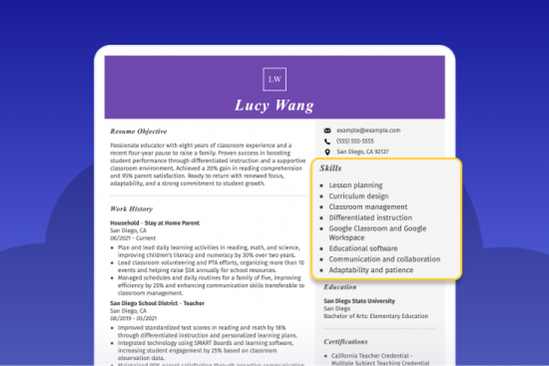
Your resume skills should match the opportunity you're pursuing. Include relevant technical abilities, job-specific knowledge, and soft skills, such as adaptability and teamwork.
Examples include:
Technical skills: Microsoft Excel, Google Workspace, video editing, or coding
Customer service skills: Cash handling, conflict resolution, or customer assistance
Communication skills: Public speaking, tutoring, or written communication
Languages: Spanish, French, or another language, with an accurate proficiency level
Certifications: CPR, First Aid, food-handler training, or other relevant credentials
Avoid listing vague traits without supporting evidence. If you describe yourself as organized or dependable, your experience and activities should help demonstrate those qualities.
Additional Sections
Additional resume sections can highlight accomplishments that don't fit elsewhere. Depending on your goals, you might include honors and awards, academic projects, publications, memberships, or relevant hobbies and interests.
You generally don't need to include references on your resume unless they're requested. Instead, prepare a separate list of teachers, coaches, advisors, volunteer supervisors, or employers who can speak to your abilities. Always ask permission before sharing someone's contact information.
How to Write a High School Resume With Little or No Work Experience: 5 Steps
To write a high school resume without work experience, start with your education, identify relevant skills, and turn school activities, volunteering, and informal responsibilities into accomplishments. Then, customize your resume for the opportunity and proofread it carefully.
Step 1
Write a Resume Objective or Summary
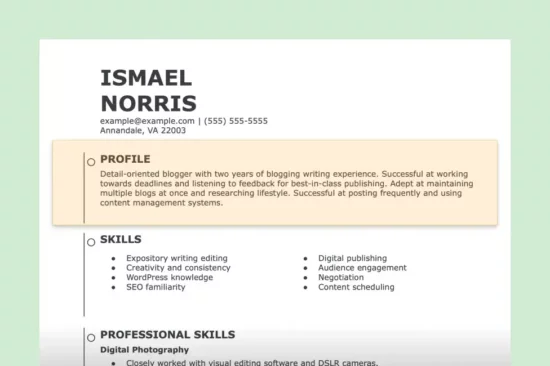
A resume objective briefly highlights your skills, relevant experience, and goals. Keep it to two or three sentences tailored to the position.
Here’s an example of a high school resume objective that identifies a target role, highlights relevant experience, and connects the student's skills to the employer's needs:
Dependable high school junior seeking a part-time retail associate position. Experienced in organizing school fundraisers, assisting community members, and handling cash transactions. Eager to contribute strong communication and teamwork skills in a customer-focused environment.
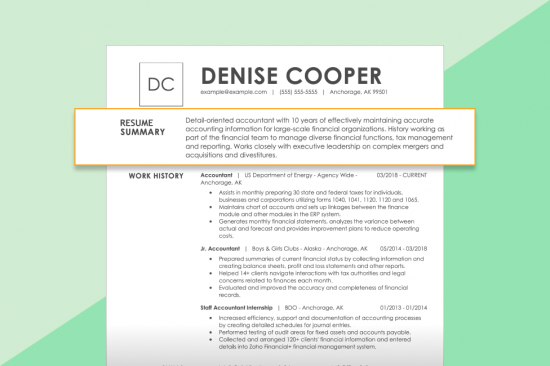
If you've already gained relevant experience, a brief resume summary may work better. Focus on what you've accomplished rather than what you hope to gain.
Step 2
Turn School, Activities, & Informal Work Into Accomplishments
Focus on contributions and results rather than simply listing responsibilities. A useful formula for accomplishment-focused resume bullets is: Action verb + what you did + result or scope.
Compare these examples:
Experience
Basic Description
Stronger Accomplishment
Babysitting
Watched children after school.
Supervised two children three afternoons per week, helping with homework and daily routines.
Student council
Helped plan events.
Coordinated a school fundraiser with 12 volunteers and raised $800.
Tutoring
Helped students with math.
Tutored three middle school students weekly in algebra and homework organization.
Sports
Played on the soccer team.
Coordinated weekly team warm-ups and helped organize practice equipment for a 15-player soccer team.
Volunteering
Helped at a food bank.
Sorted and packed approximately 150 food boxes during monthly volunteer shifts.
Numbers can make your accomplishments more specific, but don't invent metrics. If you don't know an exact figure, describe the frequency, scale, or outcome of your work.
Step 3
Use Strong Action Verbs
Use strong action verbs to describe your contributions instead of repeatedly starting bullets with “helped” or “responsible for.”
Here are useful action verbs for a high school student resume:
For example, “Organized weekly club meetings for 15 students” is more informative than “Responsible for club meetings.”
Choose verbs that accurately reflect your involvement. Don't claim you managed an event if you only assisted with setup.
Step 4
Tailor Your Resume to the Opportunity
Tailoring your resume means selecting the skills, experiences, and accomplishments that are most relevant to the specific job or program. A generic resume may overlook qualifications that an employer is looking for.
Start by reviewing the job description and identifying important resume keywords, then connect those requirements to your actual experience.
For example, a student applying for a restaurant job could emphasize food safety training, teamwork, and reliability. Someone applying to a summer camp might highlight babysitting, coaching younger children, or organizing group activities.
Use the employer's terminology when it's accurate, and don't claim skills you can't demonstrate. For a first job, mention relevant availability or required certifications when appropriate.
Step 5
Proofread Your Resume
Proofreading helps ensure your resume looks professional and gives employers accurate information. Even a small mistake in your phone number or email address could prevent someone from contacting you.
Before submitting, check spelling, grammar, dates, capitalization, formatting, and contact details. Read your resume aloud, use a spelling checker, and ask a teacher or trusted adult to review it.
Make sure your bullet points use consistent verb tenses. Use present tense for ongoing responsibilities and past tense for completed experiences.
High School Resume for College vs a Job: What’s the Difference?
A high school resume for college emphasizes academic achievement, extracurricular involvement, leadership, and long-term commitments. A job resume focuses on relevant skills, reliability, work experience, and an employer's needs.
Resume Element
College Application
Job Application
Education
GPA, challenging coursework, academic honors, and achievements
School name, graduation date, and relevant coursework
Experience
Internships, research, service, and meaningful projects
Paid jobs, informal work, internships, and volunteering
Activities
Leadership, extracurricular involvement, and sustained commitments
Activities that demonstrate teamwork, responsibility, and initiative
Skills
Academic, research, creative, or specialized skills
Customer service, communication, technical, and job-specific skills
Accomplishments
Academic recognition, awards, projects, and community impact
Measurable contributions and responsibilities
Additional details
Test scores when relevant or requested
Relevant certifications when appropriate
For College Applications
For a college application, long-term commitments and significant projects can help admissions teams understand your interests and contributions. For example, instead of listing “Robotics Club Member,” you might write, “Collaborated with a four-student team to design and program a robot for a regional competition.”
Not every college requires or accepts a separate resume, so follow the institution's application instructions and choose experiences that add meaningful context to your application.
For Jobs
For a job application, focus on the qualifications an employer needs. For example, a retail applicant could highlight cash handling at a school fundraiser, while a tutoring applicant could emphasize academic achievements and experience helping classmates.
For Soon-to-Be & Recent Graduates
Soon-to-be and recent high school graduates should tailor their resumes to their next step, whether that's college, trade school, an apprenticeship, workforce training, or employment. For technical programs, emphasize relevant coursework, hands-on projects, and safety certifications.
If you're entering the workforce directly, prioritize practical experience and job-specific skills. Students heading to college can gradually shift their resumes to highlight postsecondary education, internships, and recent achievements.
Popular High School Resume Examples
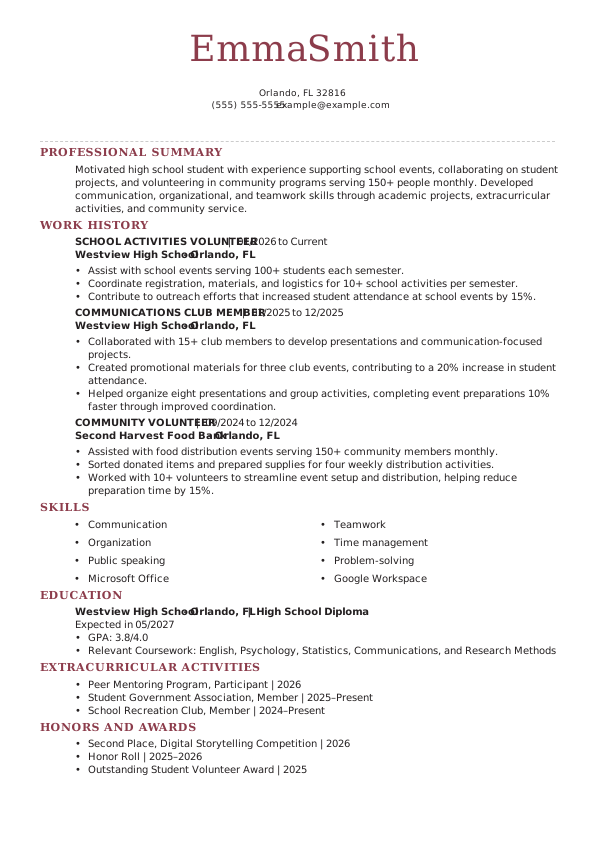
The examples below cover common first jobs and college applications. Choose one that matches your goals, then adapt it to reflect your own skills, accomplishments, and experience.
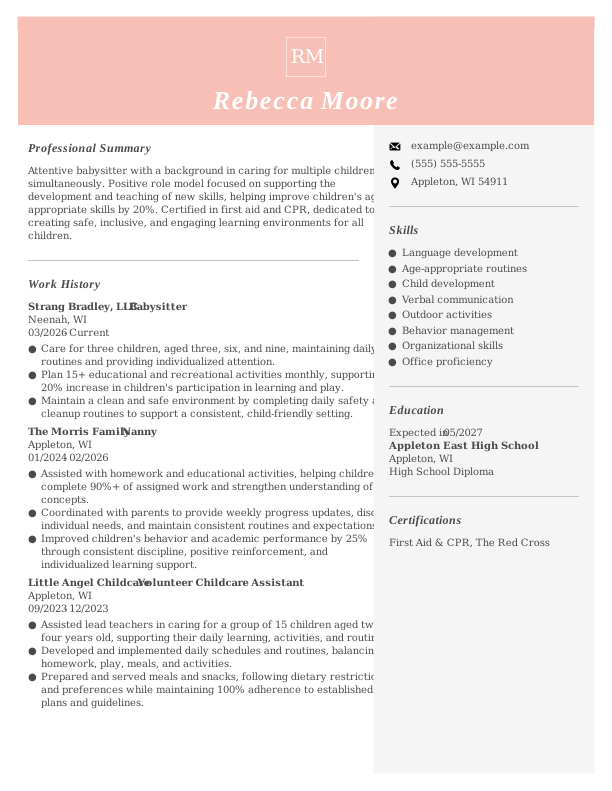
Babysitter Resume Example
A babysitter resume should highlight childcare experience, responsibility, and safety. This example shows how to present babysitting, volunteer childcare, and relevant certifications such as First Aid and CPR.
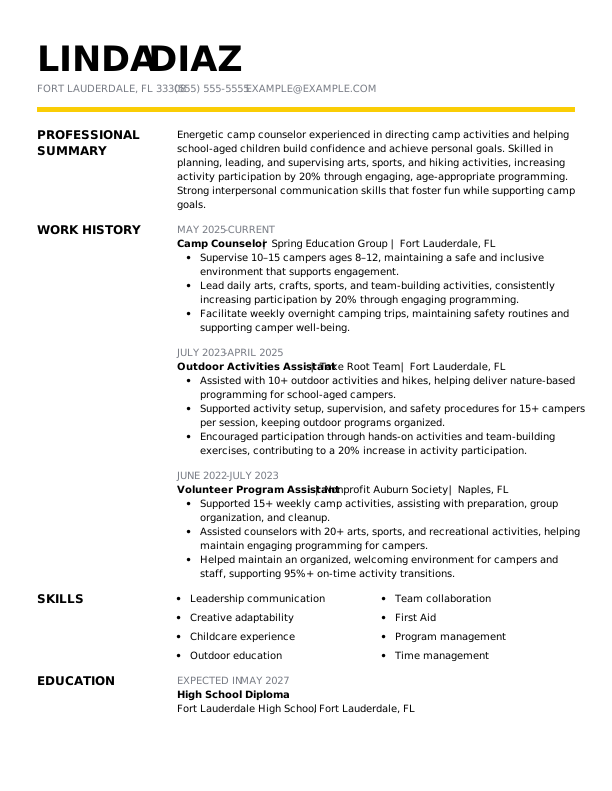
A camp counselor resume should emphasize leadership, teamwork, safety awareness, and experience working with children. Students with limited experience can highlight mentoring, coaching, outdoor activities, and relevant training.
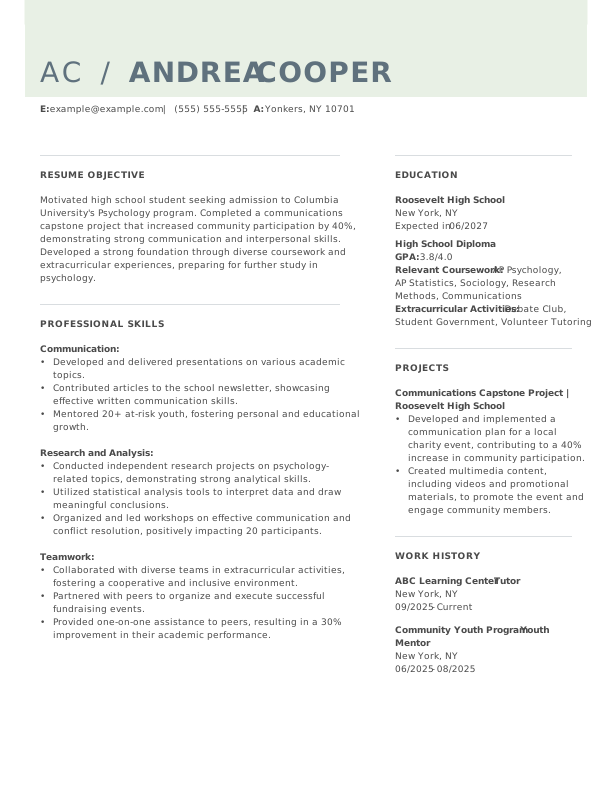
A college application resume should showcase academic achievements, projects, extracurricular activities, and leadership. This example highlights a communications capstone project, tutoring, youth mentoring, and relevant coursework.
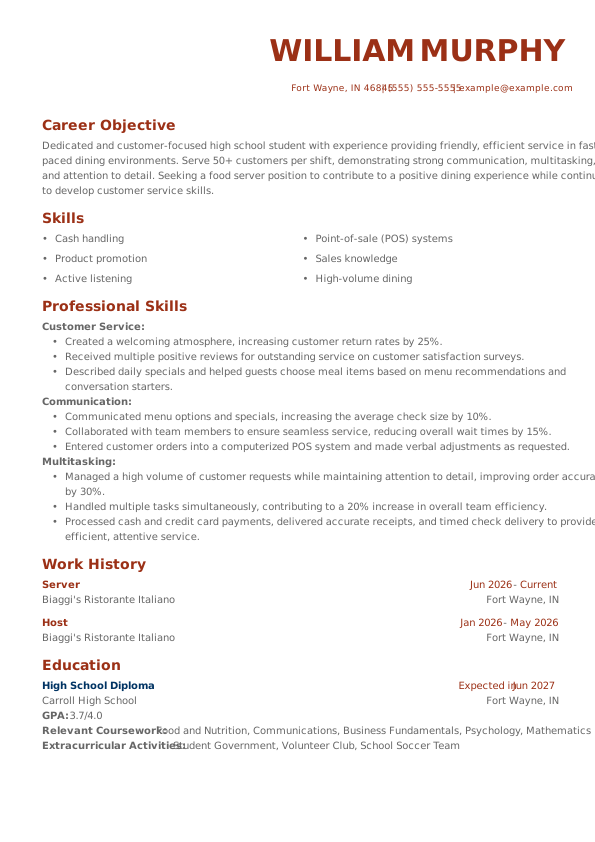
A food server resume should demonstrate customer service, teamwork, multitasking, and comfort in a fast-paced restaurant. This example highlights serving or hosting experience, cash handling, point-of-sale (POS) systems, and measurable accomplishments.
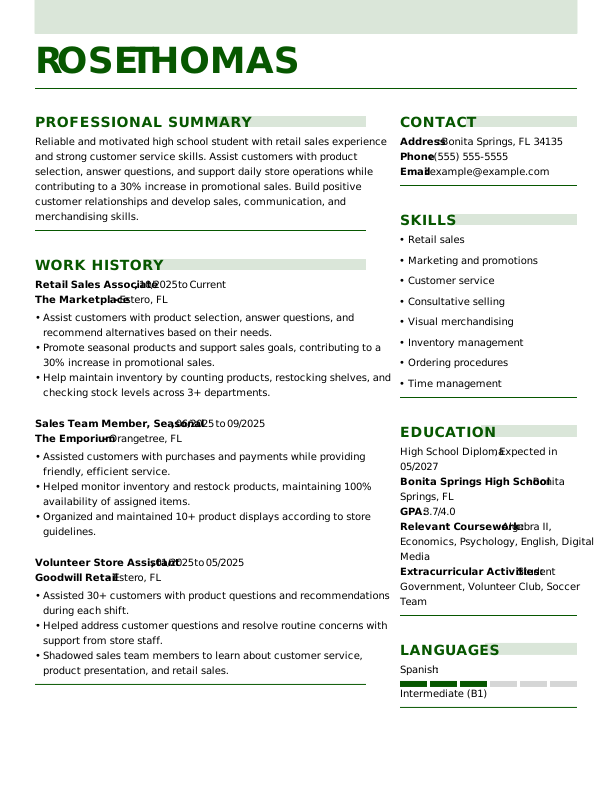
A retail sales associate resume should highlight customer service, communication, sales, and organization. This example shows how to present retail or seasonal work, volunteer experience, sales results, and inventory responsibilities.
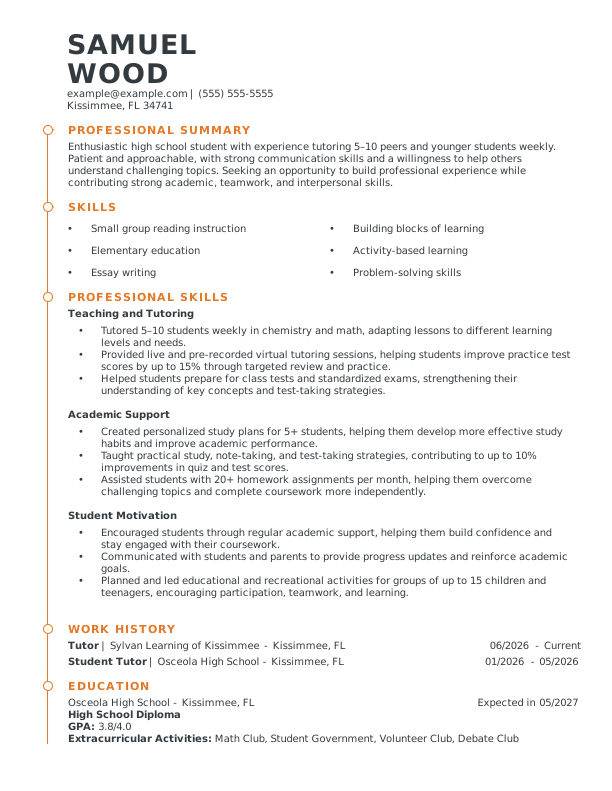
A tutor resume should emphasize subject knowledge, communication, patience, and academic support. This example highlights tutoring experience, personalized study plans, and student progress, alongside relevant coursework and strong grades.
A high school resume should be easy to read, well organized, and tailored to the application. Choose a format that suits your experience and goals. For most high school students applying for jobs, one page is sufficient. Follow any different length requirements specified by a college, program, or employer.
Choose a Resume Format
There are three common resume formats: chronological, combination, and functional. Each organizes your qualifications differently, and LiveCareer's resume templates offer different layouts to help you get started.
Chronological resumes list experience in reverse-chronological order and work well for students who have held part-time jobs, internships, or other relevant positions.
Combination resumes highlight skills while also providing a clear work history, helping you emphasize transferable skills alongside school activities or informal work.
Functional resumes organize qualifications by skills rather than employment history. They can help students emphasize transferable skills, but some employers prefer a clearer timeline of activities and responsibilities.
A chronological resume or combination resume is often a practical choice for high school students. A functional resume may be appropriate in certain situations, but it shouldn't be the automatic default.
Keep the Design Simple & Readable
Use clear headings, a professional font, consistent spacing, and concise bullet points. Avoid unnecessary graphics, icons, skill bars, and complicated tables that could interfere with readability.
Follow the Application Requirements
Always check the employer's or school's instructions before submitting your resume. Some applications request a PDF, while others prefer a Word document or require you to enter information directly into an online form.
Some employers use applicant tracking systems (ATS) to organize and screen applications. Simple formatting, standard section headings, and relevant keywords can help these systems process your resume more easily. If you're applying online, make sure your resume follows the instructions and remains readable when uploaded.
High School Resume Checklist
I've tailored my resume to the job, program, or application.
I've prioritized relevant education, experience, skills, and activities.
My bullet points describe accomplishments, not just duties.
I've used specific action verbs and accurate details.
My contact information and graduation date are correct.
My formatting is simple, readable, and consistent.
I've removed unnecessary personal information.
I've checked spelling, grammar, and punctuation.
I've followed all application instructions.
Creating your first resume doesn't have to mean starting from scratch. LiveCareer's Resume Builder helps students organize their education, skills, and experience with customizable templates and content suggestions. Add your own details, review the suggested wording, and tailor your resume to the opportunity.
Frequently Asked Questions
How do you write a resume as a high school student?
To write a resume as a high school student, start with your contact information, education, relevant skills, and experience. Include school activities, volunteering, internships, or informal work that demonstrates your abilities. Use action verbs to describe your accomplishments, and tailor your resume to the opportunity. Most students should aim for a one-page resume with clear headings, consistent formatting, and accurate information.
What should a 16-year-old put on a resume?
A 16-year-old should include contact information, high school education, relevant skills, and any activities or experiences that demonstrate responsibility. Babysitting, tutoring, volunteering, school clubs, and sports can all provide useful examples. Include academic honors, certifications, or relevant coursework when appropriate. Focus on specific contributions and accomplishments rather than simply listing interests or claiming skills without evidence.
Do you need a resume for a first job?
You don't always need a resume for your first job, but having one can help you present your qualifications professionally. Some entry-level employers use online applications instead of requiring resumes. If a resume is requested or accepted, highlight your education, skills, volunteer work, and informal responsibilities. Even without previous employment, a clear, tailored resume can help employers understand your strengths and why you're interested in the position.
What are good skills for a high school student resume?
Good skills for a high school student resume include communication, teamwork, organization, customer service, and relevant technical abilities. The most useful skills depend on the position. For example, a retail applicant might highlight cash handling and customer assistance, while a tutoring applicant could emphasize subject knowledge and communication. Choose skills you can demonstrate through school activities, projects, volunteering, or work experience.
How do you make a resume with no work experience?
To make a resume with no work experience, highlight your education, relevant skills, school activities, and volunteer responsibilities. Include accomplishments from projects, clubs, sports, or informal work, such as babysitting or helping with a family business. Use specific action verbs and measurable results when possible. Choose a clear resume format, prioritize your strongest qualifications, and tailor your information to the job or program you're applying for.
How We Reviewed This Article
Over the past 15 years, we’ve helped more than 10 million job seekers build stronger cover letters, discover their career paths, interview confidently, and boost their chances of finding the right job faster. Review our Editorial Policy to learn more about our process.
Marla is a career advice writer. She focuses on helping job seekers improve their professional resumes to highlight their unique skills and experience. Marla holds a master's degree in media writing and brings five years of specialized experience to helping candidates navigate the complexities of the online job market, with a strong focus on resume optimization and effective self-presentation.




 Add LiveCareer as a preferred source on Google