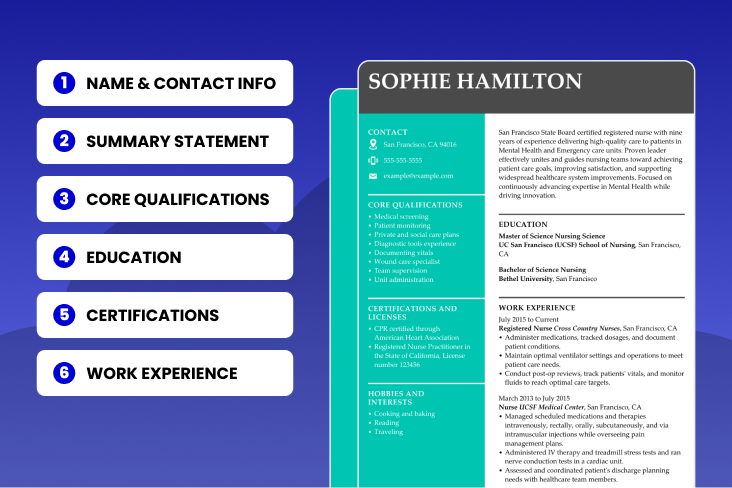
Every CV should include the following sections. Although CVs are highly customizable, you should always include these sections when applying for any job.
- Contact information
- CV Summary Statement
- Core Competencies or Skills
- Education
- Work Experience
Once you have those five key sections, you can customize your resume with additional sections like:
- Certifications
- Publications
- Honors and Awards
- Teaching Experience
- Research Experience
- Volunteer Work
- Internships
- Professional Affiliations
- Conferences
- Presentations
Depending on your field, some of these sections may reflect your qualifications, and some may not. You don’t need to include each of these CV sections on your document.
Writing a CV can take time because it should be tailored to your qualifications and job requirements. However, with our CV Maker, you can generate a custom CV in less than 15 minutes!
What is a CV?
If you found this page, you likely have never written a CV before. Before you begin writing, you should know that a CV (curriculum vitae) is a detailed document that outlines your professional and academic history.
Unlike a resume, which is typically one page long and highlights your most relevant experience, a CV is more comprehensive and often used in academia, research and international job applications. It provides an in-depth look at your qualifications, including your work history, education, skills, publications and other achievements.
CV vs. Resume
Compare CVs vs. resumes to understand the key differences between these documents better and determine the right one for you:
CV Example
- The primary job application document used in many countries outside the U.S.
- Typically longer than a resume, extending up to 10 pages.
- Contains more sections than a resume, offering a more comprehensive overview.
- May include a profile picture, depending on the country’s norms.
- Commonly used for positions in academia, scientific research and entertainment.
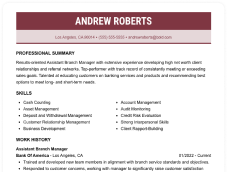
Resume Example
- The typical job application document used in the U.S.
- Generally spans one to two pages.
- Features fewer sections than a CV and is more succinct.
- Can be structured in three different resume formats.
- Profile photos should be excluded except for roles in sales or entertainment.
How to Write a CV
Writing a CV can seem daunting, but breaking it down into manageable steps makes the process easier. Let’s begin:
Step 1: Start With a Strong Summary Statement
Your CV should begin with a summary statement that helps you introduce yourself to recruiters by listing your most relevant qualifications for the job. Aim to keep this section between two to five sentences long to remain concise and compel recruiters to continue reading.
A few qualifications you can include in your CV personal statement, also called CV summary, are:
- Your profession or current job title.
- Your degree(s).
- Your years of experience.
- Top skills required for the job.
- An impressive, job-relevant career achievement.
If you lack career experience, you might even use this section to state your career plans and professional goals within the role. In that case, you’re better off writing a CV objective statement.
Here’s an example of a CV summary:
“Experienced history professor with over 15 years of teaching and research expertise in modern European and American history. Proven track record in curriculum development, publication in peer-reviewed journals and mentoring graduate students. Dedicated to fostering critical thinking and historical analysis in the classroom, with a strong commitment to advancing scholarship through ongoing research and community engagement.”
Now check out this CV objective example:
“Dedicated and detail-oriented research assistant with a strong academic background in Sociology and two years of hands-on experience in qualitative and quantitative research. Proficient in data collection, analysis and report writing, with a keen ability to support faculty-led research projects. Skilled in utilizing statistical software, conducting literature reviews and managing databases. Eager to contribute to impactful sociological research in a university setting.”
Step 2: Highlight Your Core Competencies
In curriculum vitae, it’s common to have a section below the summary or objective titled Core Competencies or Core Qualifications. In practice, this is another name for a Skills section.
Simply list six to eight of your most job-relevant skills, and ensure you have a balanced mix of soft skills and hard skills to prove you’re a well-rounded candidate.
Here’s an example for a lab researcher:
Core Competencies
- Chromatography (HPLC, GC)
- Spectroscopy (NMR, IR, UV-Vis)
- Mass spectrometry (MS)
- Sample preparation and titration
- Data analysis (MATLAB, R, Excel)
- Team collaboration
- Problem-solving and troubleshooting
- Effective communication (written and verbal)
Step 3: Share Details About Your Education
The education section of your CV should provide a clear and concise overview of your academic background.
- Start by listing your highest degree first, followed by other degrees in reverse-chronological order.
- For each entry, include the degree earned, the name of the institution and its location.
- If you're a recent graduate or your education is highly relevant to the job, you may include details like your GPA, honors, relevant coursework and any academic awards.
Keep this section focused and relevant to the position you're applying for. Only highlight the education that best supports your qualifications for the role.
Check out this CV education example:
Education
Juris Doctor (J.D.)
Harvard Law School, Cambridge, MA
- Honors: Cum Laude
- Activities: Harvard Law Review, Moot Court, Student Bar Association
Bachelor of Arts in Political Science
University of California, Berkeley, CA
Activities: Debate Team, Pre-Law Society, Volunteer Legal Services Program
Honors: Magna Cum Laude
Relevant Coursework: Constitutional Law, International Relations, Ethics and Public Policy
Step 4: Outline Your Work Experience.
Your CV work experience is crucial in showing employers you have the skills, knowledge and practice to thrive in the role.
- Organize your work history in reverse-chronological order, starting with your most recent role and working backward.
- For each role you include, list the job title, company name, location, dates of employment, and three to four bullet points describing unique achievements.
- Incorporate skills and quantifiable accomplishments to illustrate your expertise and impact better.
Here’s how a CV work experience entry looks like:
Senior Grant Writer
Global Aid Network, Washington, D.C.
June 2020 – Present
- Spearheaded development and submission of over 50 grant proposals, securing $5 million in funding for humanitarian projects.
- Collaborated with program directors to align grant proposals with organizational goals and donor priorities.
- Conducted comprehensive research on potential funding sources, identifying new grant opportunities that increased revenue by 15%.
As we mentioned above, you can further personalize your CV by adding additional sections. Check out the following CV section examples to learn how to add them to your CV.
Certifications
This section lists any professional certifications or licenses relevant to the job you are applying for.
- Certified Professional Resume Writer (CPRW), Professional Association of Resume Writers, July 2020
- Project Management Professional (PMP), Project Management Institute, May 2018
Publications
Include any research papers, articles, books or other published works you have authored or co-authored.
- Smith, J. & Doe, A. (2022). Social Media's Impact on Public Opinion: A Comparative Study. Journal of Modern Communication, 15(3), 45-67.
- Doe, A. (2021). The Evolution of Environmental Policy in the 21st Century. Environmental Policy Review, 22(4), 89-102.
Honors and Awards
This section highlights any special recognitions, awards or honors you have received throughout your career or education.
- Excellence in Teaching Award, University of Chicago, 2021
- Best Research Paper, International Sociology Conference, 2019
Teaching Experience
Detail your roles as an educator, including the courses you have taught and your responsibilities in each position.
- Assistant Professor of History, University of Texas, Austin, September 2018 – Present
- Taught undergraduate courses in American History and Historical Methodology.
- Developed and implemented new curriculum for the History Department.
- Advised students on academic and career goals.
Research Experience
Outline your experience in conducting research, including the projects you've worked on and your specific contributions.
- Research Fellow, Department of Sociology, University of Michigan, Ann Arbor, January 2017 – August 2020
- Led a multi-year study on urban migration patterns and their socioeconomic impacts.
- Conducted data analysis using SPSS and R, resulting in two peer-reviewed publications.
- Presented findings at national and international conferences.
Volunteer Work
Highlight any unpaid work or community service relevant to the position or demonstrating important skills and values.
- Volunteer Coordinator, Habitat for Humanity, Los Angeles, CA, June 2019 – Present
- Organized and managed volunteer efforts for housing projects in underserved communities.
- Coordinated with local organizations to provide resources and support for construction projects.
Internships
Detail any internships you've completed, focusing on the skills and experience you gained that are relevant to your career goals.
- Legal Intern, ACLU, New York, NY, Summer 2017
- Assisted with legal research and case preparation for civil rights litigation.
- Drafted legal documents and briefs under the supervision of senior attorneys.
- Participated in client interviews and gathered evidence for ongoing cases.
Professional Affiliations
List any professional organizations you are a member of that demonstrate your commitment to staying connected and informed in your field.
- Member, American Psychological Association (APA), 2018 – Present
- Affiliate, Association for Women in Science (AWIS), 2016 – Present
How to Adapt Your CV to Different Roles and Industries
Adapting your CV to fit different roles and industries is crucial to stand out in a competitive job market. A one-size-fits-all approach usually won’t cut it, so here are some strategies you can implement to tailor your CV for various roles, industries and scenarios.
Tailor Your Achievements to the Job
When applying to different jobs, it’s important to tailor your CV’s achievements and measurable results to reflect that role’s needs and requirements. Read the job description carefully and identify keywords like high-priority skills and qualifications. Use those insights to select and elaborate on your achievements.
For example, if you are applying for a marketing role, highlight projects where you increased engagement or led a successful campaign. For a sales role, focus on your savviness with numbers, spreadsheets and negotiation tactics.
Highlight Remote Work Skills
With remote and hybrid work becoming more common, adapting your CV to showcase your remote work experience is essential, especially for roles that explicitly require these skills. Create a dedicated “Remote Work Experience” section or integrate remote accomplishments in your previous roles. Mention specific tools and technologies you’ve mastered for remote collaboration, such as Zoom, Slack, Trello or Microsoft Teams, and emphasize soft skills like self-motivation, communication and digital collaboration. In addition, you can also highlight any remote-specific challenges you’ve overcome to demonstrate your ability to work with little supervision.
Match the Company’s Culture
Understanding a company's culture can help you adapt your CV to show you’re a good fit. First, research the company’s values, mission and work environment. Then, reflect those aspects in your CV by highlighting experiences or qualities that align with their culture.
If you’re applying to a startup that values agility and creativity, emphasize experiences where you’ve worked in dynamic environments or spearheaded innovative projects. For organizations that value environmental causes or community outreach, demonstrate your volunteer work or related projects.
Vary Skills to Match Industry Demands
Different industries prioritize different skills, so be ready to adjust the skills section of your CV accordingly for each job application. For tech roles, emphasize technical proficiencies like coding languages, software or data analysis tools. In creative industries, focus on soft skills like innovation, teamwork, communication and specific creative tools (e.g., Adobe Creative Suite). For management or leadership roles, highlight your leadership style, decision-making abilities and conflict-resolution skills.
Use Industry-Specific Language and Keywords
Each industry has its own jargon and preferred terminology, so adapt your language to fit the job. Incorporating industry-specific keywords can help your CV pass through applicant tracking systems (ATS) and show you are familiar with the field’s terminology. Tailor both the professional summary and the job descriptions using the same key terms in the job posting to increase relevance.
However, recruiters may only be somewhat familiar with that specialized knowledge. When including relevant terms like SEO or EHR, include the complete phrase, like search engine optimization and electronic health records, respectively.
Focus on Transferable Skills
If switching industries, focus on transferable skills that apply across various roles. Leadership, problem-solving, project management and communication are valuable skills in nearly every field. Contextualize these skills to demonstrate how they will benefit the new industry you’re targeting. For instance, project management in marketing might translate into the ability to oversee complex campaigns in a new industry like finance.
A well-formatted CV makes a strong visual impression and helps hiring managers quickly find the necessary information. Below are key tips on how to format your CV to ensure it is polished and effective:
- Fonts
Choose a professional font like Arial or Calibri, using 10-12 points for body text and slightly larger for headings and your name. Keep font styles consistent.
- Margins
Standard margins are 1 inch on all sides but can be reduced slightly if needed. Maintain enough white space for heightened readability.
- Spacing
Use single spacing within each section’s content, but leave a tab space to separate sections. For bullet points, 1.15 or 1.2 line spacing is ideal.
- Length
A CV is typically two to four pages, depending on experience. Focus on highlighting the most relevant information and avoid stuffing unnecessary details.
- Bullet points
Use bullet points to list responsibilities and achievements. Keep paragraphs short and to the point.
- Headers and footers
Include your name and contact information at the top of the first page of your CV. For multi-page CVs, you may add page numbers in the footer.
- File format
Save your CV as a PDF to preserve its formatting. Name the file clearly with your name and “CV” (e.g., “JohnLiveCareer_CV.pdf”).
What Not to Include in a CV
When creating your CV, avoid the following common mistakes:
- Personal Information: Avoid details like age, gender, marital status, religion or your license and social security number.
- Photographs: If applying to a job in the U.S., do not include a photo unless specifically requested or relevant (e.g., for acting or modeling jobs). Anti-discrimination laws protect job seekers from hiring bias because of their appearance.
- References: Don’t include “References available upon request” or actual references on the CV. These can be provided separately if requested.
- Excessive detail: Avoid overly long descriptions; be concise and focused on the most relevant information.
- Unprofessional email address: Before you submit your CV, ensure your email address is professional and straightforward, meaning no nicknames or funny business. Also, use your personal email account, not your work email address.
- Salary information: Do not mention your current or expected salary. You can discuss this later in the hiring process.
- Reasons for leaving previous jobs: There’s no need to explain why you left previous roles on your CV. Stick to the skills and experience you can offer the new role.
- Negative language: Avoid mentioning failures, conflicts or anything negative about previous employers or professional experiences.
- Jargon and abbreviations: Avoid using industry-specific jargon or acronyms exclusively unless they are widely understood. It’s always best to write the full term and add the abbreviation in parentheses.
Frequently Asked Questions
How often should I update my CV?
It’s a good practice to update your CV regularly, especially after acquiring new skills, completing significant projects or achieving professional milestones. Aim to review and update your CV every six months, even if you’re not actively searching, to be prepared if your job status changes.
Should I include volunteer work on my CV?
Yes, include volunteer work, especially if it demonstrates relevant skills, experience or dedication to causes that align with the job you’re applying for. Volunteering can also help fill employment gaps and show commitment to community engagement.
How do I tailor my CV for different jobs?
Tailor your CV to a specific job by emphasizing the skills, experiences and accomplishments most relevant to the role you’re applying for. Adjust your professional summary, reorder bullet points, and highlight achievements that show that you possess the specific qualifications the employer needs for the job.
Should I include links to my portfolio or LinkedIn profile?
Yes, if you have an online portfolio, LinkedIn profile or relevant social media accounts showcasing your work, include links in your contact information section. Ensure these links are up-to-date and professional, and avoid linking personal or social accounts.
How should I handle employment gaps on my CV?
Address employment gaps by briefly mentioning relevant activities during those periods, such as freelance work, volunteer projects or continuing education. Consider including a brief explanation if the gap is significant in your cover letter.
Is it necessary to include a cover letter with my CV?
While not always required, including a well-crafted cover letter with your CV can help you make a stronger first impression by providing additional context, explaining your interest in the position and highlighting specific qualifications.
What should I do if my CV is longer than expected?
If your CV exceeds the typical length, try removing the least relevant experiences and focusing on key achievements that reflect your suitability for the role. Separating information into bullet points is a great way to make the text more concise.
How do I handle references on my CV?
It’s generally not necessary to include references directly on your CV. Instead, prepare a separate reference list that you can provide upon request. Mentioning “References available upon request” isn’t necessary, and it will just take up valuable space you could be using to include relevant details.
Can I include personal projects or side jobs on my CV?
Yes, if personal projects or side jobs are relevant to the role you’re applying for, include them in a separate section like “Additional Experience” or within your primary work experience, ensuring you highlight the right skills and qualifications.
How We Reviewed This Article
Over the past 15 years, we’ve helped more than 10 million job seekers build stronger resumes, discover their career paths, interview confidently, and boost their chances of finding the right job faster. Review our Editorial Policy to learn more about our process.
About the Author
Gabriela Hernandez • CPRW, Career Advice Writer
Gabriela is a Certified Professional Resume Writer (CPRW) and member of the Professional Association of Resume Writers & Career Coaches. She focused on helping job seekers improve their professional resumes to highlight their unique skills and experience. Gabriela holds a BA in journalism from the University of Puerto Rico and brought more than four years of specialized experience to helping candidates navigate the complexities of the online job market, with a strong focus on resume optimization and effective self-presentation.
Ready to
land the job?
Join 28M+ others who’ve built a professional CV.



 Add LiveCareer as a preferred source on Google