Core competencies definition (what are core competencies?)
Core competencies are sometimes called “core qualifications.” The term refers to a list of top attributes and skills that qualify you for a job.
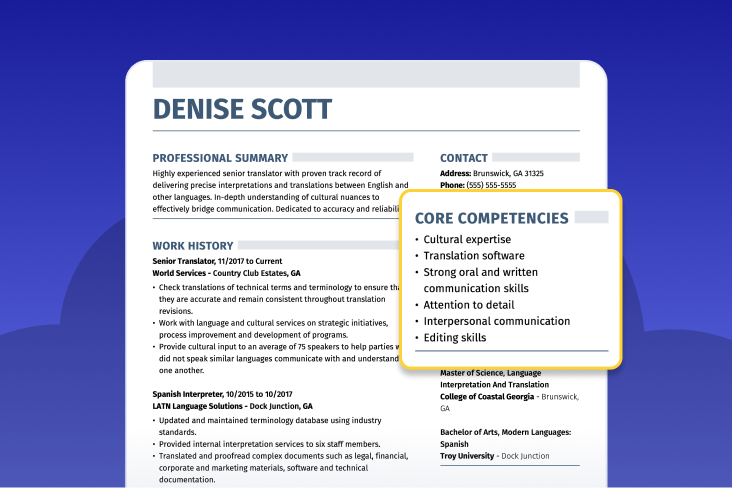
A core competencies resume section should live towards the top of your resume, just underneath the professional summary or objective statement.
Core competencies refer to any combination of soft, hard or technical skills.
These should include the needs mentioned in the job post or ad. If the post has a “required” and “preferred” qualifications list, make your “core” abilities your greatest strengths from each category.
They should be listed in bullet points and not in sentence form.
Why core competencies are important
Core competencies matter because they help you to pass an applicant tracking system or ATS.
Many companies use ATS software to scan the resumes that job candidates send them. A human being may not see your resume if your resume doesn’t pass an ATS scan!
That’s why your core competencies should reflect what’s listed in the job post.
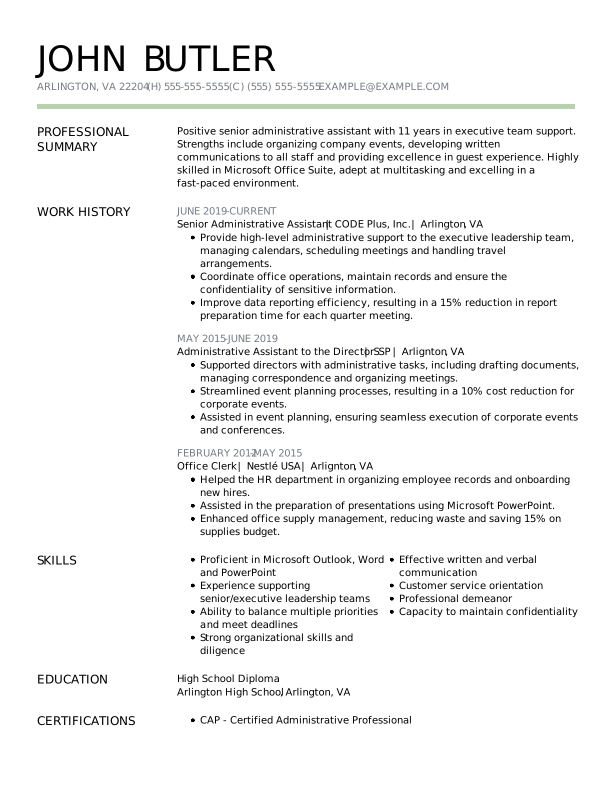
Here’s a good core competencies example of how to copy the job post into your resume:
Core competencies:
Required Qualifications
- High School diploma
- Proficient in Microsoft Outlook, Word and PowerPoint
- Experience supporting a senior/executive leadership team
- Ability to balance multiple or competing priorities and initiatives and prioritize workload to meet deadlines
- Strong organizational skills and diligence
- Effective communication skills, both written and verbal
- Customer service orientation and pleasant, professional demeanor
- Capacity to maintain confidentiality
- Must live within a commutable distance of the Arlington, VA office
Preferred Qualifications
- Experience working in Microsoft Teams
- Demonstrate resourcefulness and time management skills (including proactive thinking such as looking ahead in calendars for conflicts and deadlines before the date arrives)
- Able to work with MS Excel
We’ve got plenty more core competencies resume examples below!
But if you want to cut to the chase and get working on your resume, use a powerful helper, our Resume Builder.
The builder features 25+ resume designs that you can customize!
Best of all, it’s automated, walks you through creating your resume step-by-step and suggests content for you.
You can have your resume ready in just 15 minutes!
Core competencies examples
The key to nailing core competencies is to reflect the same terms the employer uses in the job post or description.
Here are 17 core competencies examples:
- Leadership: Refers to your ability to assemble and guide a team.
- Flexibility: Shows you’re willing and able to adapt to any situation or surprise.
- Communication: Highlights your ability to convey information with coworkers, managers and clients.
- Time management: Indicates your efficiency and ability to get work done on time.
- Problem-solving: Refers to how you evaluate situations and find effective or creative solutions.
- Teamwork: Suggests you work well with others and thrive in team settings.
- Responsibility: Supports the idea that you complete every task and are trustworthy.
- Motivation: Involves your ability to self-manage and inspire other people.
- Focus: Refers to your level of attention and ability to avoid distractions.
- Integrity: Hints that you do high-quality work and can be trusted with important tasks.
- Attention to detail: Illustrates that you care about every part of a task and see it through to completion.
- Career-focused: Shows that you care about your work and are passionate about developing further in your career.
- Ambitious: Indicates that you want to prove yourself by doing incredible work.
- Avid learner: Shows your ongoing commitment to improving yourself and your skills.
- Results-driven: Signifies that you care about the impact of your work and improving business.
- Collaborative spirit: Suggests that you contribute in meetings and have positive relations with coworkers.
- Creativity: Implies that you have unique problem-solving skills or a knack for making inspired or visionary work.
How to write core competencies on a resume
Core competencies are basically just a list on your resume, so they’re straightforward to include.
Here are the three steps to writing a core competencies section on your resume:
- Look at the job post or ad for keywords.Scan down the list of core competencies the employer has requested. Identify the ones that you possess. These are the competencies you want to include on your resume!
- Decide on a title for your section.If “Core Competencies” is what’s cited in the job post, title your section just like that.Otherwise, it’s also acceptable to list these competencies in a section that’s titled “Skills” or “Summary of Qualifications.”
- List the employer-needed competencies in bullet points.Again, employers use AI-driven software that scans resumes called applicant tracking systems or ATS.They search your resume looking for specific keywords and may not identify variations. Bullet points give your core competencies plenty of white space, making it easier for humans to read.
Writing a summary of qualifications is really that simple!
So, if you’re ready to get your document done now, check out our Resume Builder!
The builder automates the resume writing process into a series of prompts that take you through each section. When you’re writing the “Skills” section, the builder will even autosuggest phrases that you can plug into your document targeted to the job title for which you’re applying.
How to choose the best core competencies
The best core competencies are listed in the job post or ad!
Choosing the right ones is a matter of being honest with yourself about whether or not you possess them.
Include core competencies that you feel good about mentioning. If you haven’t fully mastered something, leave it off your resume!
You should avoid fibbing about core competencies because they’re essential to doing the work. Embellishing will come back to bite you later.
So, identify what the employer needs and show what you bring to the table!
Article Summary
As you can see, creating a solid core competencies resume section is easy.
Just make sure you take the following steps:
- Identify the core qualifications you possess
- Create a resume section under your professional summary to list them
- Be honest
So, if you’re ready to create your own resume masterpiece, get started now by using our Resume Builder!
Since it’s automated, it turns the resume-creation task into a simple step-by-step process.
You can have your document ready in just 15 minutes!
How We Reviewed This Article
Over the past 15 years, we’ve helped more than 10 million job seekers build stronger cover letters, discover their career paths, interview confidently, and boost their chances of finding the right job faster. Review our Editorial Policy to learn more about our process.
About the Author
Eric Ciechanowski • CPRW, Career Advice Writer
Eric is a Certified Professional Resume Writer (CPRW) and member of the Professional Association of Resume Writers & Career Coaches. He focused on helping job seekers improve their professional resumes to highlight their unique skills and experience. Eric holds a BA double major in creative writing and philosophy from Tulane University and brought more than five years of specialized experience to helping candidates navigate the complexities of the online job market, with a strong focus on resume optimization and effective self-presentation. His work has been featured on LiveCareer's Resume Builder, and his career background includes fields as diverse as education, hospitality, journalism, copywriting, and tech.
Follow 
Ready to
land the job?
Join 28M+ others who’ve built a resume that works.



 Add LiveCareer as a preferred source on Google