What to Know
- A storytelling resume connects your experience through a clear career theme while still using the concise sections and bullet points employers expect.
- Strong resume stories show context, action, and measurable results, helping employers understand not only what you did, but why it mattered.
- Your professional story should position you as a problem-solver, with challenges providing context and accomplishments showing the resolution.
- Storytelling shouldn’t come at the expense of applicant tracking systems (ATS). Standard headings, relevant keywords, and simple formatting still matter.
- Your resume introduces your story; your cover letter and interview give you more room to expand on the context behind it.
A resume doesn't need to read like a novel to tell a story. Effective resume storytelling connects your experience through a clear theme, shows the challenges you've addressed, and demonstrates how your actions produced results.
The goal is still a concise, scannable resume. The difference is that instead of presenting your jobs as disconnected lists of duties, you show employers how your skills, accomplishments, and career progression fit together.
What Is a Storytelling Resume?
A storytelling resume is a resume that presents your career as a connected professional story rather than a series of unrelated jobs. Also known as a narrative resume, it uses accomplishments, challenges, career progression, and measurable results to show what you've done, how you've grown, and the value you can bring to an employer.
Storytelling resumes can range from creative, narrative-heavy formats to conventional resumes that use storytelling techniques within standard sections.
Key reasons storytelling resumes work:
- Shows progression: Connects roles, promotions, and accomplishments so employers can see how your career has developed.
- Adds context: Explains the problem or opportunity behind an accomplishment instead of presenting a metric in isolation.
- Demonstrates impact: Focuses on the actions you took and the results you produced.
The Building Blocks of Career Storytelling: Protagonist, Theme, & Conflict
Career storytelling connects four basic elements: the person taking action, the challenge they faced, the strength they brought to the situation, and the result they achieved. On a resume, these elements don't need to form a long narrative. Instead, they provide context that makes concise accomplishments more meaningful.
The Protagonist: Positioning Yourself as the Problem-Solver
You're the protagonist of your career story, which means your resume should show you taking action rather than simply being present for results. Strong resume statements clarify your decisions, contributions, and problem-solving.
Compare “Responsible for improving customer retention” with “Redesigned customer onboarding to address early churn, increasing six-month retention by 25%.” The second version shows what the candidate actually changed and what happened as a result.
Strong action verbs help make that role clear. Words like “led,” “created,” “improved,” “redesigned,” and “launched” put your contribution at the center of the statement instead of burying it behind phrases such as “responsible for” or “helped with.”
Setting & Conflict: Giving Your Accomplishments Context
Accomplishments become more meaningful when employers understand the problem you were solving. A little context can show the scale, difficulty, or importance of your work without turning a resume bullet into a paragraph.
Useful context might include declining sales, customer churn, slow processes, staffing shortages, missed deadlines, outdated systems, or another problem you were asked to solve. You don't need to explain every detail. Include only enough context to show why your action mattered.
For example, “Reduced processing time by 30%” shows a result. “Reduced processing time by 30% by redesigning an outdated approval workflow” also shows the problem the candidate solved.
The Career Theme: Establishing Your Professional Superpower
Your career theme is the strength or type of value that appears repeatedly across your experience. It might be improving inefficient systems, growing revenue, building teams, simplifying complex information, or strengthening customer relationships.
That theme should emerge naturally across your resume, not appear as a slogan. Your summary can introduce it, your work experience can prove it through accomplishments, and your skills section can reinforce the expertise behind it.
For example, a marketer whose roles repeatedly show audience research, SEO growth, and conversion improvements might build a career theme around turning customer insights into measurable marketing results.
Resolution & Quantifiable Impact: Proving Value With Data
The resolution shows what changed because of your work. Whenever possible, close an accomplishment with evidence such as revenue generated, costs reduced, time saved, customers retained, projects completed, or another measurable result.
Not every accomplishment needs a dollar amount or percentage. You can also quantify the scope of your work with team size, project volume, turnaround time, customer counts, frequency, or other measures. The goal is to give employers concrete evidence of what changed because of your contribution.
How to Write a Storytelling Resume: 5 Steps
Learning how to write a narrative resume doesn't require changing the basic resume structure. You'll still use standard sections for your contact information, summary, work experience, skills, and education. The storytelling comes from how you connect those sections and frame your accomplishments.
Start with a standard resume header containing the contact information an employer needs to reach you. You can also add a concise resume headline that immediately establishes the professional identity you want the rest of the resume to reinforce.
Include the following in your resume header:
- Your full name
- Phone number
- Email
- Work location (city and state)
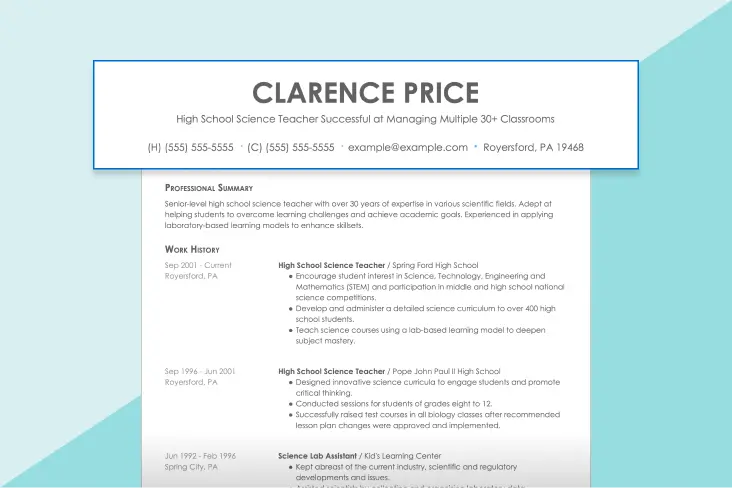
Although optional, consider including a resume headline to help you establish your professional identity and provide a strong thesis statement about who you are.
Here’s an example of a resume headline:
Marketing Manager | Growth-Focused Campaign Strategist Driving 40%+ Engagement Gains
Step 2: Set the Scene in Your Resume Summary
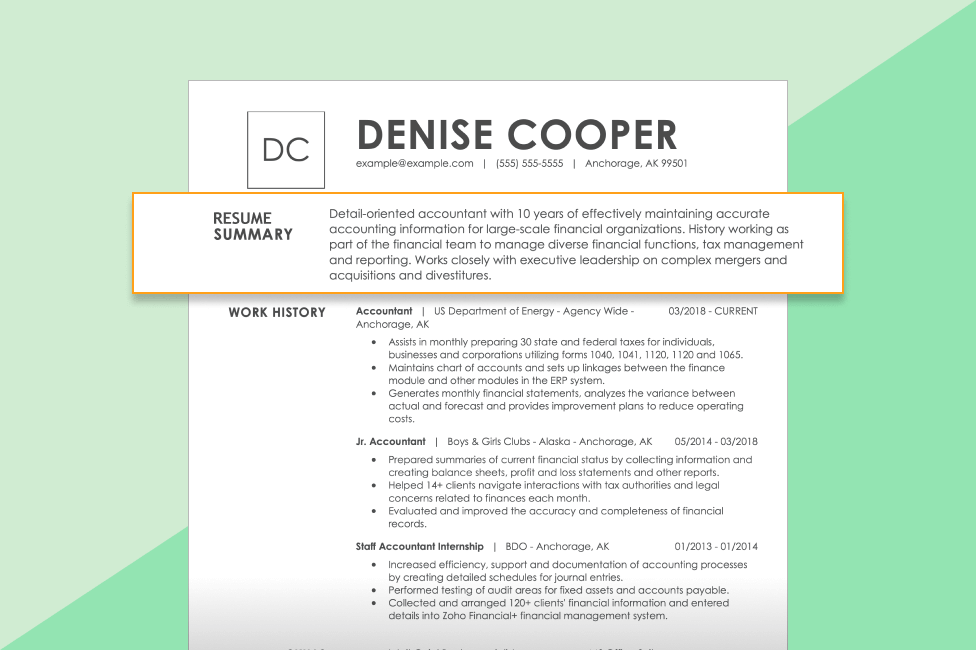
Your resume summary should establish the central theme of your career in two to four sentences. Tell employers who you are professionally, what you specialize in, the results you consistently deliver, and where that experience can take you next.
Example summary for an experienced professional:
Operations manager with 8+ years of experience improving cross-functional workflows and reducing costs. Known for leading process improvements that cut operational expenses by 18% while increasing team productivity. Builds scalable systems that support efficient, sustainable growth.
For entry-level candidates, recent graduates, or career changers, a career objective can help explain the direction you want to take next. Instead of focusing on past results, an objective highlights:
- Transferable skills
- Relevant education or training
- The value you aim to bring to your next role
Example for a career changer:
Detail-oriented customer service professional transitioning into HR, bringing five years of experience in conflict resolution, onboarding support, and employee communication. Seeking to leverage strong interpersonal and organizational skills to contribute to a people-focused HR team.
In both cases, the goal is to position yourself intentionally. Your summary or objective should guide the reader, helping them understand not just what you’ve done, but how your story connects to the role you want next.
Step 3: Tell the Story of Your Accomplishments Through Your Work Experience
Your work experience section is where career storytelling does the most work. Instead of listing responsibilities, write concise accomplishment statements that show the result you achieved, the action you took, and, when useful, the challenge that made the achievement meaningful.
For concise resume bullets, use this structure:
Result → Action → Challenge/Situation
This structure puts your accomplishment at the forefront of your resume statements without sacrificing valuable context, such as the challenge you faced and the actions you took to solve it.
For example:
Increased customer retention by 25% by redesigning onboarding workflows to address high early churn rates.
Tips for strong narrative resume accomplishments:
- Keep bullets concise (one to two lines max).
- Use metrics whenever possible (e.g., percentages, revenue, time saved, growth).
- Focus on achievements, not daily tasks.
- Show progression and growth across roles.
Step 4: Reinforce Your Core Themes Using Your Skills
Your skills section should reinforce your narrative, not just list tools. Focus on abilities that appear throughout your accomplishments and support the type of work you want to do next.
Prioritize a focused selection of skills that:
- Directly support your career direction
- Align with the job description
- Reflect repeated themes in your accomplishments
Choose a balanced mix of hard skills that show your industry expertise and, when useful, soft skills that your accomplishments demonstrate. If you're pivoting careers, prioritize transferable skills that connect your past to your target role.
Step 5: Support Your Career Story With Your Education
Your education section adds context to your qualifications, especially if you're a recent graduate, changing careers, or applying for a role with specific education requirements.
Include the following details:
- Degree title or diploma
- School or university name
- School location (city and state)
If you’re a recent graduate, you can add details such as your GPA (if strong—typically above 3.5), relevant coursework, certifications, projects, or awards and honors.
Here’s how to format a resume education section:
Bachelor of Arts in Communications
University of Central Florida
Orlando, FL
- Honors: Dean’s List (3 semesters)
- Relevant Coursework: Digital Marketing Strategy, Public Relations Writing, Consumer Behavior
- Capstone Project: Developed a multichannel marketing campaign that increased nonprofit event attendance by 35%
If you want to add more detail, you can include sections like certifications, volunteer work, or projects—as long as they support your story and reflect the role’s requirements.
Ready to build your storytelling resume? LiveCareer’s Resume Builder can help you organize your experience, highlight job-relevant skills and accomplishments, and create a professional, ATS-friendly resume.
Complete Storytelling Resume Example
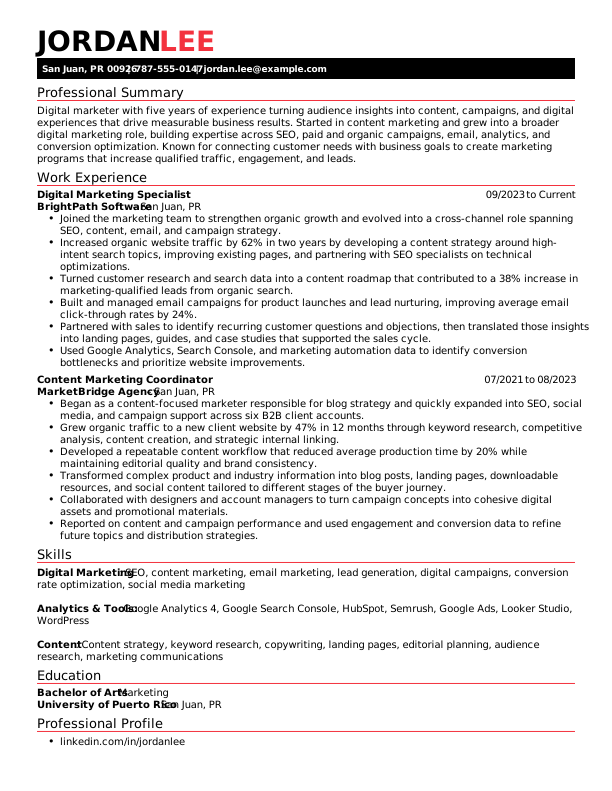
This example uses a standard chronological format while applying storytelling techniques throughout the summary and accomplishment bullets.
Why this example works: Jordan’s career progression tells the story, moving from content marketing into SEO, campaign experience, and broader digital strategy. The summary, work experience, and skills reinforce that growth, while specific results—including a 62% increase in organic traffic and a 38% increase in marketing-qualified leads—keep the story grounded in measurable impact.
How to Make an ATS-Friendly Storytelling Resume
A storytelling resume can still be ATS-friendly. Keep standard section headings, use relevant keywords from the job posting, choose simple formatting, and tell your story through concise accomplishment statements rather than long narrative paragraphs.
The more narrative-heavy your format becomes, the more important it is to preserve recognizable section headings, standard resume structure, and parseable text.
Follow these ATS guidelines to help ensure the software can accurately parse your resume:
- Incorporate relevant keywords from the job description.
- Use concise bullet points that highlight accomplishments and results.
- Avoid overly complex designs and photos, and choose an ATS-friendly template.
You can upload your resume to LiveCareer’s free ATS Resume Checker to scan for common errors like poor formatting, missing skills, and grammatical errors.

Pro Tip
“Given the high use of ATS within companies, ensuring your resume is in the proper resume format is critical for the success of your application. Simple formatting, black font, appropriate margins, and a good mix of white space will help ensure it's easily parsed by an ATS and easy for the hiring team to read. As a job seeker, you can help the hiring decision-maker by crafting a narrative that grabs the reader.”
—
Toni Frana, Career Expert
Bringing Your Story to Cover Letters & Interviews
Your resume introduces your professional story, but your cover letter and interviews give you more room to expand it. Use the same career themes and accomplishments across each stage of your application while adjusting the level of detail to fit the format.
Cover Letters: Expanding on Your Career Backstory
Your cover letter gives you more room to explain the context behind an accomplishment or career decision that your resume can only summarize. Choose one or two stories that are most relevant to the position, then connect what you learned or achieved to the employer's needs.
The 30-Second Pitch: Adapting Your Narrative for “Tell Me About Yourself”
Your answer to “Tell me about yourself” is a spoken version of your career story. In about 30 seconds, establish who you are, briefly connect the experience that brought you here, highlight a relevant strength or result, and explain what you're looking for next.
Here’s a 30-second pitch template:
[Current professional identity] + [relevant background] + [signature strength/result] + [what you're looking for next].
And here’s an example applying the template above:
I’m a digital marketer with five years of experience, starting in content and expanding into SEO, email, and cross-channel strategy. In my current role, I’ve increased organic traffic by 62% and used audience insights to generate more qualified leads. I’m now looking for a role where I can bring that combination of content and performance marketing to a broader growth strategy.
Seeding Conversation Hooks: Inviting Strategic Interview Questions
Strategic details on your resume can give interviewers natural openings for follow-up questions. Include enough context to make an accomplishment interesting, but leave the deeper explanation for the conversation.
- Instead of: Improved onboarding processes.
- Try: Redesigned onboarding after identifying a 30% first-month drop-off, improving six-month retention by 18%.
A statement like this can naturally prompt questions about how you identified the problem, what you changed, and how you measured the result.
Key Takeaways
- Lead with results. Start accomplishment bullets with measurable impact when possible.
- Add just enough context. Briefly show the challenge or situation that made the accomplishment meaningful.
- Build around a career theme. Reinforce the strengths and value that appear consistently across your experience.
- Keep storytelling scannable. Use standard resume sections, concise bullets, and ATS-friendly formatting.
- Expand the story elsewhere. Save deeper context and longer examples for your cover letter and interviews.
Frequently Asked Questions
How is a storytelling resume different from a traditional resume?
A storytelling resume uses the same basic sections as a traditional resume but emphasizes context, career progression, and connections between accomplishments. Rather than treating each job as a separate list of duties, it helps employers understand how your experience has developed and the value you consistently provide. Both approaches should still use concise bullet points, standard sections, and an ATS-friendly format.
Do recruiters want to see a story on a resume?
Recruiters still need resumes that are concise, relevant, and easy to scan. Storytelling can support those goals when it helps clarify your career progression and the impact of your work. Keep the narrative within standard resume sections and use short, accomplishment-focused bullets rather than long paragraphs.
Can a resume be written like a story?
Yes, a resume can use storytelling techniques, but it shouldn't read like a traditional short story. Build your narrative through career themes, challenges, actions, progression, and measurable results while keeping standard resume sections and concise bullet points. Save longer explanations and additional context for your cover letter and interviews, where you have more room to explain the story behind an accomplishment.
How We Reviewed This Article
Over the past 15 years, we’ve helped more than 10 million job seekers build stronger cover letters, discover their career paths, interview confidently, and boost their chances of finding the right job faster. Review our Editorial Policy to learn more about our process.
About the Author
Megan Dawkins • Career Advice Editor
Megan is a career advice editor. She focuses on helping job seekers improve their professional resumes to highlight their unique skills and experience. Megan holds a BA in film studies with a minor in English and brings nine years of specialized experience to helping candidates navigate the complexities of the online job market, with a strong focus on resume optimization and effective self-presentation.
Follow 
Ready to
land the job?
Join 28M+ others who’ve built a resume that works.




 Add LiveCareer as a preferred source on Google