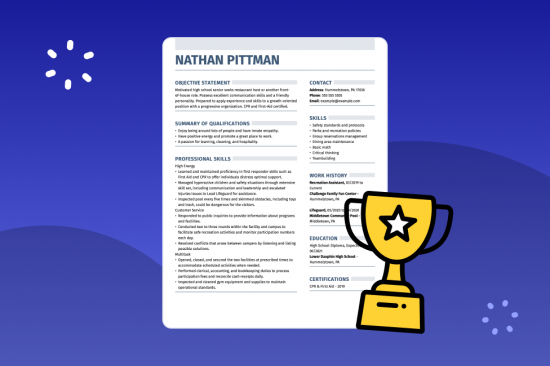
A resume outline helps you determine what information to include in each resume section. Keep reading to see our resume outline examples and learn how to write each section so your qualifications shine.
by Gabriela Hernandez, CPRW, Career Advice WriterLast Updated: January 06, 2025
Hired By:*
A resume outline works like a fill-in-the-blank resume template — it will help streamline your resume-writing process and ensure you’re including all the right information in each section of your resume.
Pick any of our resume outline examples that fit your job or experience level to write a resume featuring the achievements and skills recruiters want to see.
Or, if you’d like to have your resume done in 15 minutes, try our Resume Builder. The builder will create a personalized resume with all the necessary sections in a fraction of the time it would take you to write it on your own!
No matter your experience level, we’ve created three free resume outlines to help you create a resume tailored to your needs.
You can download these resume outlines in Google Docs or Microsoft Word and follow the resume outline instructions to complete each resume section accurately
If you’re a pro at writing resumes and an expert on the different resume formats, a resume outline might not be for you. However, if you can answer yes to the following questions, you should consider utilizing our outline for a resume example.
A good resume outline should provide a clear resume layout, including the five essential sections: contact information, resume profile, skills, work experience and education.
To help you maximize a resume outline’s potential, we’ve gone above and beyond by also offering you the following:
Clear instructions on how to fill in each resume section
Examples of achievements to include in your resume outline
Unique and professionally designed resume outline templates
A step-by-step guide on how to optimize each section of your resume outline with examples
Without further ado, let’s dive into how to write each section in a resume outline:
Contact information
This one’s pretty straightforward. Simply fill in your contact information with:
Your full name
Your phone number
A professional email address
The city, state and ZIP code of your residence
Resume summary
The resume summary serves as a brief introduction to your top skills and achievements.
Here is where you want to grab the employer’s attention by sharing any of the following:
Your job title
Years of experience
Areas of expertise
2-3 soft or hard skills
A unique career achievement that helps you stand out
Any qualification you must have for the job (i.e., a certification, a degree)
Opt for a resume objective if you lack work experience
If you’re a recent graduate or an entry-level applicant, write a resume objective. The resume objective lets you share your career goals and the skills and qualifications to help you achieve them.
You must write a resume summary or objective that hits all the targets to land an interview for your desired job.
If writing is not your strong suit or you’re unsure what to write about yourself, you can get a personalized summary or objective when you put your desired job title in our Resume Builder. It’s that easy!
Work experience
Next, fill out your work experience by listing your previous jobs in reverse-chronological order.
Every job listed in your work experience section should include the following:
Want to sound like a pro? Find hundreds of pre-written sentences like these to include in your resume’s work history when you use our Resume Builder.
Skills
Next on your resume outline should be the skills section, which includes six to eight professional skills.
The key to maximizing your skills section is to include a balanced mix of soft and hard skills. Also, ensure you select skills that accurately reflect your abilities and appear in the job description for the role to which you’re applying.
You can find examples of skills to include on your resume by searching for your desired job title on our resume examples pages.
To complete your education section, list all your degrees in reverse-chronological order.
This is everything you should include in your resume’s education section:
The title of your degree
The college or university you attended
The college or university’s location
The graduation date or expected graduation date (optional)
Additional sections
Most resume outlines will stick to the five essential resume sections; however, you would benefit from customizing your resume with additional sections to showcase all you have to offer as a professional.
Awards
A great way to show your expertise is by sharing any awards you’ve won because of your professional development and excellence.
Certifications
Certifications and licenses validate your professional skills — a huge plus for employers when deciding between candidates. If you’ve completed relevant certifications, add them to your resume.
Languages
Speaking multiple languages can benefit you in the job application, especially in client-facing jobs like customer service and health care. When listing your languages, add your proficiency using the U.S. Foreign Service scale or the CERF levels.
Volunteer Work
Many employers appreciate seeing volunteer work on your resume, especially for nonprofit organizations or communities that value a culture of giving back. If you’ve had two or more volunteering experiences, add them in a separate section.
Hobbies and Interests
Including hobbies and interests can add value to your resume if you know which activities to showcase. You shouldn’t include hobbies that don’t demonstrate skills that will benefit you in the desired role. Instead, use this section to show that you’re committed to developing skills in your personal life that can transfer to your role.
Choose the right format for your resume outline
Did you know you can organize your resume sections to showcase your most impressive accomplishments? There are three resume formats you can choose to modify the order and formatting of your resume: chronological, functional and combination.
Applicants who want to give equal focus to their skills and experience.
Job seekers who have five to eight years of experience.
Those who are changing careers, applying for a promotion or returning to the workforce after a break.
1/3
Key takeaways for resume outlines
A resume outline is a fill-in-the-blank document that helps you write a resume from scratch more efficiently and faster.
Pick a resume outline tailored to your unique situation, i.e., entry-level, mid-level or experienced applicant.
Your resume outline should have a contact information section at the top for your name, phone number, email and basic location.
The second section in a resume outline should be the resume summary, where you share your most relevant qualifications for the job.
Fill in your resume outline’s work experience with a list of your previous jobs in reverse-chronological order and quantifiable achievements.
Feature six to eight professional skills in your resume outline’s skills section.
List your degree(s) in the resume outline’s education section, but leave out graduation dates to avoid hiring bias.
Customize your resume outline with additional sections for certifications, licenses, awards, volunteer work or hobbies and interests.
Consider replacing the resume outline with a Resume Builder like ours that organizes your sections and gives you personalized pre-written suggestions.
Frequently asked questions
How to make a resume outline?
A resume outline consists of a document with the main resume sections: contact information, resume summary, work experience, skills and education. A resume outline should guide you on how to fill in each section.
Therefore, you don’t really need to make an actual resume outline; instead, we’ll provide you with one tailored to your experience level, and you can focus on filling it out with your details.
What is the best resume outline?
The best resume outline will include instructions on each section telling you how to fill in each. Our free resume outlines have detailed instructional content you can use to write each section with the best resume tips.
How far back should a resume go?
Your resume should go as far back as you want to, as long as the information and experiences you’re featuring aren’t outdated and are relevant to your desired role. As a general rule, stick to the last 10 years of experience or your previous three to four jobs.
If you have an extensive career and many accomplishments you want to feature, check if your desired position merits applying with a curriculum vitae (CV).
What is the difference between a resume outline and a resume template?
Resume outlines and resume templates are very similar since they’re both documents that feature the main resume sections for you to fill out.
However, a resume outline aims to teach you how to write each section, so you’ll likely find resume outlines with instructions on each section.
Resume templates show you different design options you can use to personalize your resume. You can find 30+ resume templates designed by professionals in our Resume Builder.
Do resume outlines vary per job title?
A resume outline doesn’t generally vary per job title, but it does vary per your level of experience. You can find resume outlines that organize sections based on the three resume formats, which benefit different types of candidates in various stages of their careers.
If you want more personalized instructions on how to write your resume, you should head to our resume examples page, where you can find an example for your desired job.
Over the past 15 years, we’ve helped more than 10 million job seekers build stronger cover letters, discover their career paths, interview confidently, and boost their chances of finding the right job faster. Review our Editorial Policy to learn more about our process.
☆☆☆☆☆
★★★★★
Rate this article
Share this article:
About the Author
Gabriela Hernandez • CPRW, Career Advice Writer
Gabriela is a Certified Professional Resume Writer (CPRW) and member of the Professional Association of Resume Writers & Career Coaches. She focuses on helping job seekers improve their professional resumes to highlight their unique skills and experience. Gabriela holds a B.A. in journalism from the University of Puerto Rico and offers more than four years of specialized experience helping candidates navigate the complexities of today’s online job market, with a strong focus on resume optimization and effective self-presentation.