Resume Soft Skills: Examples & How to Put Them on a Resume
The right resume soft skills show employers how you communicate, solve problems, collaborate, and adapt at work. Learn which soft skills matter for your target job, where to include them, and how to back them up with examples.
Soft skills describe how you work, including communication, teamwork, adaptability, critical thinking, leadership, and time management.
Choose soft skills that match the job and that you can prove through your experience. A targeted list is stronger than a long collection of generic traits.
Include soft skills throughout your resume, especially in your summary, skills section, and work experience, rather than relying on a standalone list.
Show soft skills through actions and results. Instead of simply claiming you’re a strong communicator or problem-solver, demonstrate when and how you used those abilities.
Soft skills can be harder to present on a resume than technical abilities because simply naming a skill doesn’t show employers how you’ve used it. The strongest resume soft skills are relevant to the job and supported by specific evidence.
In this guide, you’ll learn how to choose, demonstrate, and tailor soft skills to the job, as well as where to include them on your resume and how to avoid common mistakes.
What Are Soft Skills?
Soft skills are personal, behavioral, and interpersonal abilities that affect how you work, communicate, solve problems, and interact with others. Examples include adaptability, teamwork, critical thinking, leadership, emotional intelligence, time management, and communication skills.
These skills matter because employers evaluate more than your ability to perform a technical task. According to the National Association of Colleges and Employers’ 2025 Job Outlook survey, 88.3% of employers look for problem-solving skills on candidates’ resumes, compared with 81% for teamwork and 77.1% for written communication.
Soft skills are sometimes called “people skills,” but that label can be limiting. Skills such as critical thinking, adaptability, organization, and creativity shape how you perform even without direct customer or client interaction.
Soft Skills vs Hard Skills
Hard skills are teachable, job-specific abilities used to perform tasks, such as programming, bookkeeping, or data analysis. Soft skills describe how you apply those abilities and work with others, such as communication, adaptability, leadership, and problem-solving. Most jobs require both.
Hard Skills
Teachable, job-specific skills used to perform tasks
Behavioral and interpersonal skills that shape how you work
Leadership
Resilience
Time management
Organization
Compassion
Creativity
Problem-solving
Adaptability
Examples of Soft Skills
Common soft skills include communication, collaboration, problem-solving, adaptability, organization, leadership, emotional intelligence, creativity, conflict resolution, and digital fluency. The value of each skill depends on the role, so focus on abilities that match the employer’s needs and that you can demonstrate through your experience.
Soft Skill
What It Looks Like at Work
Communication
Listening carefully, explaining information clearly, writing effectively, and adapting your message to the audience
Collaboration and teamwork
Sharing information, contributing to group goals, supporting colleagues, and working across teams
Problem-solving and critical thinking
Evaluating information, identifying causes, considering alternatives, and choosing practical solutions
Adaptability and flexibility
Adjusting to changing priorities, learning new processes, and responding constructively to unexpected problems
Organization and time management
Prioritizing work, meeting deadlines, managing competing responsibilities, and keeping projects on track
Leadership
Guiding others, making decisions, delegating effectively, mentoring colleagues, and taking responsibility for results
Emotional intelligence
Recognizing emotions, listening with empathy, responding professionally, and understanding how your actions affect others
Creativity
Generating original ideas, approaching problems from new angles, and finding new ways to improve processes or results
Conflict resolution
Listening to different perspectives, addressing disagreements constructively, and helping people find practical solutions
Digital fluency and AI judgment
Using digital and AI tools effectively, evaluating their output and limitations, and applying human judgment before acting on results
Digital fluency is increasingly a hybrid skill rather than a purely technical one. As AI and other digital tools become more common, employers may value both the ability to use them effectively and the judgment to evaluate whether their output is accurate, appropriate, and useful.
What Soft Skills Should You Put on a Resume?
The best soft skills to put on a resume are the ones employers ask for and that you can back up with real experience. Start with the job description, identify recurring behavioral requirements, and prioritize the abilities you’ve demonstrated through work, school, projects, or volunteering. Relevance and credibility matter more than quantity.
Match Skills to the Job Description
Use the job description to identify which soft skills the employer values most. Look beyond the qualifications section for phrases describing how the person will work, such as “collaborate across departments,” “manage competing priorities,” “communicate with patients,” or “adapt to changing business needs.”
Pay particular attention to requirements that appear more than once. If a posting repeatedly mentions presentations, stakeholder communication, and cross-functional work, communication and collaboration are probably more important than simply adding a generic skill such as “positive attitude.”
Don’t copy every phrase from the posting. Applicant tracking systems (ATS) may identify relevant keywords, but your resume still needs to accurately represent your experience. The most important skills also vary by field.
Use these examples as a starting point, but confirm the employer’s priorities in your target job description:
Field
Soft Skills That Matter
Tech and software
Critical thinking, collaboration, adaptability, communication
Analytical thinking, attention to detail, communication, judgment
Administrative and operations
Organization, time management, problem-solving, adaptability
Soft Skills by Career Stage
Your experience level can also affect which soft skills you should emphasize. Choose skills that reflect your experience and the level of responsibility you’re targeting.
Students and recent graduates: Communication, teamwork, adaptability, time management, initiative, and learning agility
Entry-level professionals: Collaboration, organization, problem-solving, reliability, adaptability, and receptiveness to feedback
Managers and executives: Leadership, delegation, emotional intelligence, change management, negotiation, decision-making, and stakeholder communication
Career changers: Adaptability, problem-solving, communication, relationship-building, and other transferable skills supported by previous experience
Choose Skills You Can Demonstrate
Only include soft skills you can support with examples from your experience. “Problem-solving” is more credible when your work history shows how you identified an issue, took action, and improved the result. Specific evidence is stronger than simply listing the trait.
Pair soft skills with relevant hard skills whenever possible. For example, a marketing specialist could demonstrate collaboration by describing how they worked with designers and analysts to launch a campaign, while a project manager could show organization through the processes and software they used to keep a project on schedule.
Before adding a skill, ask yourself: “What have I done that proves I have it?” If you can’t think of a credible example, another skill may be a better choice.
Put soft skills in your resume summary, skills section, and work experience, then use projects, education, or volunteer experience when they provide relevant evidence. Listing a skill can help establish relevance, but demonstrating it through an accomplishment gives employers stronger evidence that you can actually use it.
Using the employer’s terminology naturally can make your resume easier for ATS and recruiters to interpret. Don’t repeat the same skill in every section—each mention should add new information or evidence.
Professional Summary
Use your professional summary to connect one or two relevant soft skills to your experience and value. Rather than calling yourself a “strong leader” or “excellent communicator,” give the skill context through your role, experience, specialty, or a meaningful result.
Generic: Results-driven sales professional with excellent communication and leadership skills.
Stronger: Sales manager with 7+ years of experience leading regional teams, strengthening client relationships, and coaching representatives to exceed quarterly revenue targets.
The second version demonstrates communication and leadership without simply listing either one.
Skills Section
Use your skills section for a focused mix of hard and soft skills that are relevant to the job. For many resumes, about six to eight well-chosen skills can provide enough range without overwhelming the section, although the right number depends on the role and resume format.
For instance, a data analyst might show a mix of technical abilities needed to perform the work and soft skills needed to communicate and apply the results, like so:
Skills
SQL
Tableau
Data visualization
Analytical thinking
Presentation skills
Cross-functional collaboration
Use the same terminology as the job posting when it accurately describes your abilities, but don’t copy the employer’s entire skills list.
Work Experience
Work experience is often the strongest place to prove soft skills because you can show them through actions and results. Instead of inserting words such as “leadership” or “communication” into a bullet, describe what you did.
Before: Demonstrated strong leadership and communication skills.
After: Led weekly planning meetings for a six-person project team, resolving scheduling conflicts and helping deliver the client rollout two weeks early.
The stronger version shows leadership, communication, conflict resolution, and time management without naming them directly.
Metrics can strengthen an example when the number adds meaningful context, but not every soft skill needs a percentage or dollar amount. Managing a sensitive customer issue, training a new employee, or coordinating a complex handoff can still demonstrate valuable skills without a numeric result.
If you’re struggling to find examples, use the STAR method as a brainstorming tool—identify the situation, task, action, and result. You don’t need all four parts in every resume bullet, but you can use the framework to identify the most relevant action and outcome and write your bullet concisely.
Education, Projects, & Volunteer Experience
Education, projects, and volunteer work can demonstrate soft skills when your professional experience doesn’t provide the strongest example. These sections are especially useful for students, entry-level candidates, and career changers, but experienced professionals can also use them when the experience is directly relevant.
A recent graduate might show teamwork by describing a semester-long group project. A career changer could highlight leadership through nonprofit board service. A mid-career professional learning a new field might use a recent certification project to demonstrate adaptability, initiative, or digital fluency.
Focus on what you did rather than labeling the trait:
Instead of: Teamwork
Try: Collaborated with four classmates to research, design, and present a semester-long market analysis to a faculty panel.
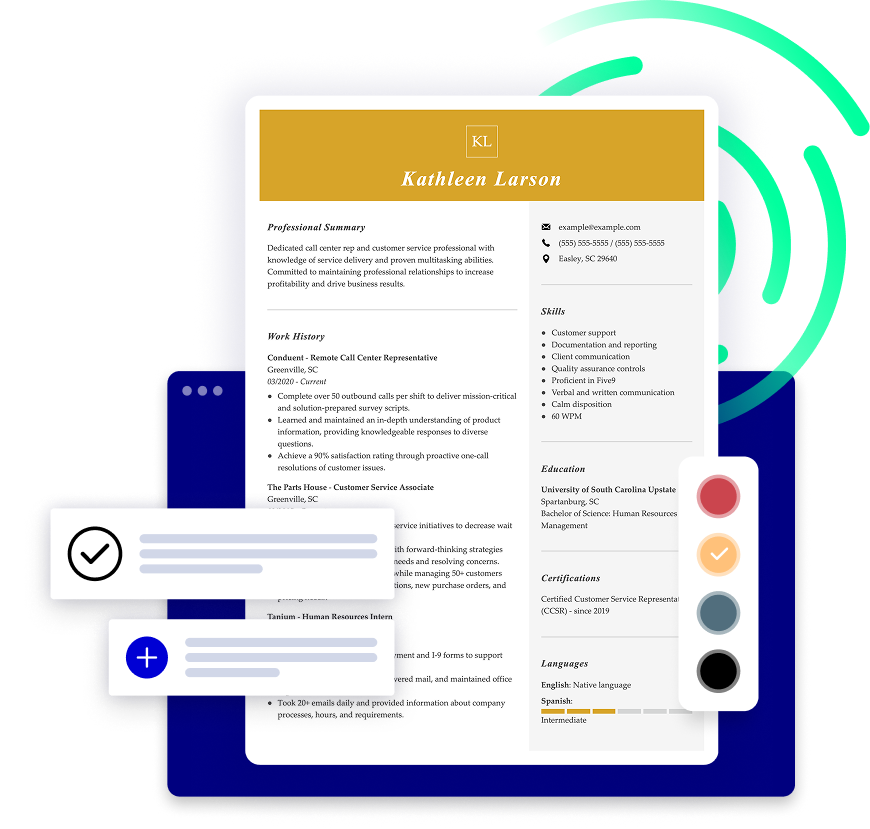
If you need a hand, LiveCareer’s Resume Builder can suggest skills based on your experience and help you organize them into an effective resume.
Content Suggestions The builder provides ready-made text you can select from to add the correct phrases to your resume.
Job-Specific Skills After answering a prompt about the job you’re applying to, our builder targets its suggestions for this role!
Keyword Recommendations Based on our internal research, our builder suggests keywords that will help you land the job.
ATS-Friendly Resume Templates ATS filter out candidates from the job hunt. Use an ATS-approved design to beat the bots!
Customizable Sections You can add custom sections or change the layout of your resume with just a single click.
Tailor your resume soft skills by identifying the employer’s priorities and choosing examples that show you’ve used those abilities in similar situations. You don’t need entirely different experience for every application. The same accomplishment can emphasize different skills depending on what the target role requires.
Identify the Employer’s Priorities
Separate the employer’s required qualifications from the behavioral traits that describe how the work gets done. Required qualifications might include a degree, certification, software platform, or years of experience. Soft skill clues often appear in phrases such as “works independently,” “partners with stakeholders,” “manages multiple deadlines,” or “handles difficult conversations.”
Look for repeated ideas rather than isolated keywords. If collaboration appears throughout the responsibilities, qualifications, and company description, it deserves more attention than a trait mentioned once.
Connect Skills to Your Experience
Choose accomplishments that provide evidence for the soft skills the employer wants. Look for situations where your actions demonstrate the requested ability, then emphasize the part of the experience that’s most relevant to the target role. You can often tailor the same accomplishment to highlight different soft skills without changing the underlying facts.
Suppose you coordinated the launch of a new customer portal. For a project management role, you might emphasize organization and cross-functional coordination. For a customer success role, you might focus on communication and how you incorporated user feedback. For an operations role, you might emphasize problem-solving and process improvement.
The underlying experience stays accurate, but you can change the emphasis to show why it matters for the specific job.
Extend Examples Beyond the Resume
Use the same core soft skill examples across your resume, cover letter, and interview, but vary the level of detail. Your resume might summarize an accomplishment, while your cover letter explains why it matters and an interview gives you room to tell the full story.
If your resume presents collaboration as a key strength, be prepared to explain how you’ve handled disagreements, worked across teams, or contributed to a shared result.
Common Mistakes to Avoid
The biggest mistake with soft skills on a resume is making claims without evidence. Other common mistakes include:
Copying every skill from the job description: Include only abilities you actually have and can demonstrate.
Overloading the skills section: A focused mix of relevant hard and soft skills is easier to scan than a long keyword list.
Repeating the same claims: If “leadership” appears in your summary, skills section, and several bullets, make sure each mention adds meaningful evidence.
Using soft skills instead of required qualifications: Strong communication won’t replace a required license, certification, or technical competency.
Choosing vague resume buzzwords: Replace unsupported labels with actions, accomplishments, and specific examples whenever possible.
Forgetting the target job: The most useful soft skills are the ones that connect your experience to the employer’s actual needs.
Frequently Asked Questions
What are the best soft skills to put on a resume?
The best soft skills to put on a resume match the job and what you can demonstrate through your experience. Communication, problem-solving, teamwork, adaptability, leadership, organization, and critical thinking are useful across many roles. Review the job description before choosing skills, then prioritize the abilities the employer emphasizes and support them with examples in your work experience.
How do I write soft skills on a resume?
Write soft skills on a resume by including relevant abilities in your skills section and demonstrating them through your resume summary and work experience. Instead of simply listing “leadership,” for example, describe how you led a team, trained employees, or managed a project. Connecting a soft skill to an action or result makes the claim more specific and credible.
How many soft skills should you list on a resume?
There’s no universal number of soft skills every resume should include. A skills section might include a focused mix of about six to eight hard and soft skills, although the right number depends on the role and resume format. Relevance matters more than reaching a specific number. Choose the skills that best match the job, and demonstrate additional soft skills naturally through your accomplishments rather than creating an oversized list.
Where do you put soft skills on a resume?
Put soft skills in your resume summary, skills section, and work experience when they’re relevant to the target job. Students, recent graduates, and career changers can also demonstrate them through education, projects, extracurricular activities, and volunteer experience. Your work history is particularly valuable because it lets you show how you used a soft skill instead of simply claiming you have it.
What is the difference between hard and soft skills?
Hard skills are teachable abilities used to perform specific tasks, such as coding, bookkeeping, data analysis, or operating equipment. Soft skills describe how you approach work and interact with others, including communication, adaptability, leadership, and problem-solving. Most jobs require both: Hard skills help you do the work, while soft skills help you apply those abilities effectively.
How We Reviewed This Article
Over the past 15 years, we’ve helped more than 10 million job seekers build stronger cover letters, discover their career paths, interview confidently, and boost their chances of finding the right job faster. Review our Editorial Policy to learn more about our process.
About the Author
Emily March • Career Advice Writer
Emily is a career advice writer and content creator. She focuses on helping job seekers improve their professional resumes to highlight their unique skills and experience. Emily holds a bachelor's degree from Rutgers University and brings seven years of specialized experience to helping candidates navigate the complexities of the online job market, with a strong focus on resume optimization and effective self-presentation.




 Add LiveCareer as a preferred source on Google







![Top Skills for Grads and College Students [50+ Examples]](/lcapp/uploads/2023/02/College_student.webp)