Changing careers can be both exciting and challenging, and your resume plays a critical role in making the transition successful. A strategic career change resume should highlight your transferable skills, relevant achievements, and experiences that demonstrate you’re ready for this pivot to a new field.
In this guide, we’ll walk you through practical tips, examples, and strategies to craft a resume that prepares you for your next professional chapter.
What Is a Career Change Resume?
A career change resume is a job application document that’s tailored to help you transition into a new industry, role, or career path. Instead of focusing solely on your previous job titles, it highlights skills and qualifications relevant to your new job and experiences that demonstrate you can succeed in a different field.
Because hiring managers may not immediately see how your background applies to a new role, a career change resume reframes your experience to make those connections clear. It emphasizes valuable professional abilities you’ve developed, such as leadership, problem-solving, communication, or technical skills, and shows how they translate to the job you want.
A strong career change resume typically includes:
- A targeted resume summary or objective that explains your career transition
- A skills section that highlights transferable and job-relevant abilities
- Work experience descriptions that focus on achievements and applicable responsibilities
- Education, certifications, or training that support your new career direction
When written effectively, a career change resume helps employers understand your value and see how your past experience can contribute to success in a new role.
For most job seekers changing careers, the combination (or hybrid) resume format is the best choice for effectively communicating a career pivot.
A combination career change resume organizes your resume sections to emphasize transferable skills first, while still providing a clear, chronological work history.
Opting for the combination format approach helps recruiters quickly understand how your past experience connects to the new role you’re pursuing.
Among the three standard resume formats—chronological, functional, and combination—the combination format is defined by its versatility and balance. Combination resumes place equal emphasis on skills and work experience, so you can showcase the strengths that matter most for your new career path.
Here’s why the combination resume format works well for career changers:
- Highlights transferable skills first: By placing a strong skills section near the top, you can emphasize abilities that apply across industries, such as project management, communication, leadership, or data analysis.
- Keeps your work history visible: Even if you’re transitioning from a drastically different industry, employers still want to see your employment background. A chronological work history section shows your career progression and adds credibility.
- Connects past experience to new goals: The combination resume format gives you space to demonstrate how your previous roles built the skills needed for your target field.
- Performs well with applicant screening software: Because the combination format still includes a clear work history and standard headings, your career change resume remains easy for applicant tracking systems (ATS) to scan.
Sample Career Change Resume
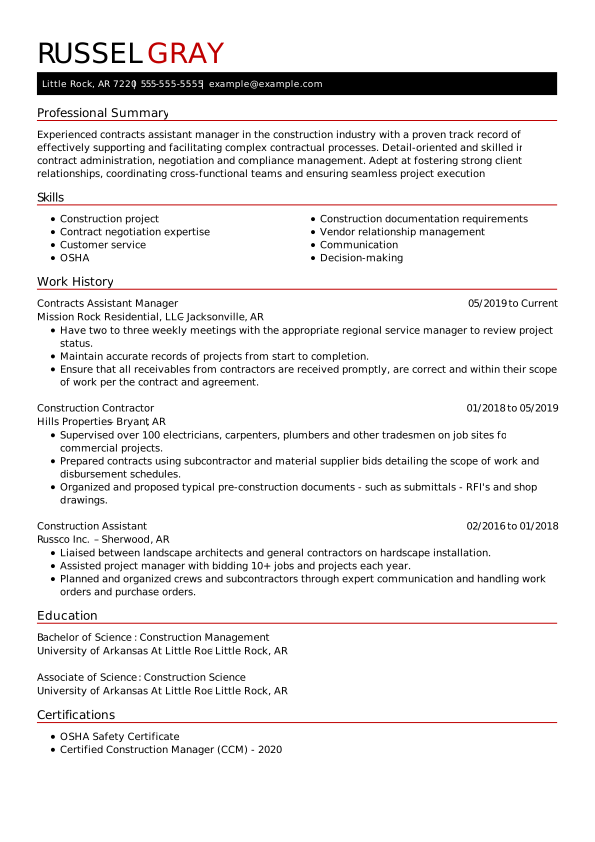
Here’s an example of a career change resume from a contractor to a contracts assistant manager role, highlighting transferable skills and achievements that demonstrate readiness for the new role.
Did you know that over 60% of career changers in the U.S. are experiencing a significant salary increase? The first step to a more fulfilling career and better wages is to update the resume you’ve used for the past few years.
Use LiveCareer’s Resume Builder to quickly generate a personalized career change resume tailored to your target role and experience level, featuring in-demand skills and professional language that impresses recruiters.
6 Steps for Writing a Career Change Resume
Changing careers can feel overwhelming, but a carefully crafted career change resume can make the transition smoother and help you stand out to hiring managers.
The key is to tailor your resume to highlight transferable skills, relevant achievements, and experiences that demonstrate you’re ready for a new role—even if your past work is outside your target industry.
This step-by-step guide walks you through how to write a resume for a career pivot:
Step 1: Research Your Target Career & Identify Keywords
Before writing your career change resume, it’s essential to understand the career you’re aiming for. Start by studying the industry, role, and job openings to determine what employers are looking for. This research will guide how you present your skills, experience, and achievements.
Key actions for keyword and career research:
- Analyze job postings. Review multiple listings for your desired role to identify common requirements, responsibilities, and skills.
- Pinpoint transferable skills. Compare your experience with the target role and note which skills overlap. You should emphasize these skills throughout your resume.
- Extract keywords from the job posts. Identify terms and phrases frequently mentioned in job ads to incorporate in all your resume sections.
- Highlight gaps and opportunities. Notice skills or experiences you may need to strengthen through courses, certifications, or volunteer work.
By completing this research first, your career change resume becomes a strategic tool, tailored to the specific role and optimized for both hiring managers and ATS. This ensures every section—from your profile to your education—demonstrates relevance and readiness for your new career path.
Step 2: Craft a Career Change Resume Profile
The resume profile is often one of the first resume sections hiring managers read, so for a career changer, it sets the tone for your transition and immediately communicates your goals.
A well-written career change resume profile should clearly communicate your desire to pivot careers and highlight your qualifications and motivations.
You can opt for a resume summary approach, which emphasizes experience and achievements, or a career objective, which highlights your professional goals and motivations.
To create an effective career change resume profile, make sure it:
- Captures attention with enthusiasm for your new career path
- Connects your past achievements to future goals
- Highlights the most relevant transferable skills for the target role
- Establishes a narrative that you are ready, motivated, and capable of excelling in the new field
While the resume summary and career objective are valid approaches to a career change resume profile, they differ in key ways, making each ideal for different types of candidates.
Career Change Resume Objective Example
"Enthusiastic professional seeking to transition from financial analysis to cybersecurity. Equipped with experience in data protection and regulatory compliance, eager to apply analytical skills and attention to detail to strengthen cybersecurity measures. Motivated by the challenge of staying ahead in a fast-paced technological environment."
This career objective shows why it's great for inexperienced career changers: it clearly signals a career pivot, highlights applicable skills, and demonstrates how the candidate can add value in the new industry.
Career Change Resume Summary Example
"Dynamic marketing professional transitioning to content development, bringing 5 years of experience creating compelling digital campaigns. Proven track record in storytelling and strategic content creation, with a passion for elevating brand narratives. Eager to apply digital marketing expertise to drive engagement and growth in the publishing sector."
This resume summary emphasizes the candidate’s advanced transferable skills and ample relevant experience while clearly stating the candidate’s career transition goal.
Step 3: Highlight Your Strengths in a Summary of Qualifications
For a career change resume, a summary of qualifications is a powerful tool to showcase your most relevant skills, achievements, and experience at the top of your resume. Think of it as a highlight reel that quickly demonstrates why you’re a strong candidate for your new role.
This section allows you to bridge the gap between your previous experience and your target career by emphasizing transferable skills and accomplishments that matter most to hiring managers. A well-crafted summary:
- Presents your top achievements and abilities in a concise, scannable format
- Aligns your past experience with the needs of the new industry
- Highlights the skills that make you an immediate asset in your target role
For example:
Summary of Qualifications
- Managed a team of 10 in a fast-paced retail environment, improving overall customer satisfaction by 20%.
- Proficient in HTML, CSS, and JavaScript; developed multiple high-traffic eCommerce websites.
- Oversaw projects valued at over $500,000, consistently delivering on time and under budget.
Step 4: Highlight Your Most Job-Relevant Skills
In a career change resume, a dedicated skills section is essential. While your summary of qualifications gives an overview, the resume skills section clearly shows hiring managers and ATS the specific abilities that make you a strong fit for your new role.
Focus on both hard and soft skills:
- Hard skills are technical abilities and knowledge directly applicable to the job, such as proficiency with software, industry-specific tools, and job-specific tasks.
- Soft skills are interpersonal and problem-solving abilities, such as communication, teamwork, and leadership, and are valuable across virtually every industry.
How to choose the right skills for a career change:
- Reference job postings for your target role to find in-demand skills.
- Highlight transferable skills from previous roles that are relevant to the new position.
- Balance hard and soft skills to demonstrate both technical ability and workplace adaptability.
- Use keywords strategically to improve ATS visibility and match the language hiring managers expect.
Here’s an example of a career change resume skills section from a previous administrative assistant pivoting to realtor jobs:
Skills
- Client relationship management
- Calendar coordination
- Contract preparation and document management
- Market research
- Negotiation
- CRM software proficiency (Salesforce, HubSpot)
- Attention to detail
- Organizational skills
- Written and verbal communication
- Time management
Step 5: Spotlight Transferable Skills in Your Work Experience
Even when your past roles don’t perfectly align with your new career, your work experience remains a critical part of a career change resume.
A strategic work experience section allows you to demonstrate transferable skills and show hiring managers the impact you can have on the job.
Follow these tips for writing a career change resume work experience:
- Tailor examples to your target industry to show how your past work translates to success in your new career.
- Focus on achievements that demonstrate the skills employers care about, not just your responsibilities.
- Use action verbs to describe accomplishments, such as “led,” “implemented,” “improved,” or “coordinated.”
- Quantify achievements wherever possible using percentages, dollar amounts, or measurable improvements to make your impact tangible.
Career Change Work Experience Example
Customer Service Manager, Demo Electronics
June 2015 – August 2020
- Managed a team of 15 representatives, fostering collaboration and improving team satisfaction scores by 30%.
- Implemented a new ticketing system that reduced average customer resolution times by 25%.
- Developed and conducted monthly training sessions, enhancing communication and efficiency.
- Led a cross-department project to redesign the customer service interface, boosting customer satisfaction ratings by 40%.
This example demonstrates how skills from a seemingly unrelated field—customer service—can transfer to industries like IT, sales, operations, or project management. By aligning your past achievements with the needs of your new career, you show employers that your experience is valuable and actionable from day one.
Step 6: Make Your Education Section Work for Your Career Change
Your education section can play a key role in a career change resume, especially when it highlights relevant degrees, certifications, or specialized training.
Even if your formal education isn’t directly related to your new career, it still demonstrates discipline, learning ability, and commitment to professional growth—qualities employers value across industries.
How to optimize your education section for a career change:
- Highlight relevant degrees, certifications, or courses that directly support your target role.
- Include noteworthy projects or capstone experiences that demonstrate applicable skills, such as research, problem-solving, or leadership.
- Emphasize academic achievements, including honors, awards, or GPA (if strong), to showcase excellence and commitment.
- List degrees, even if they’re unrelated to your target role, to illustrate transferable skills, such as analysis, communication, or project management.
Here’s an example of a career change resume education section:
Education
The University of Iowa | Iowa City, IA
Master of Business Administration
- Focused on strategic management and innovation
- Capstone Project: Developed a comprehensive business plan for a startup with an emphasis on sustainable business practices
The University of Iowa | Iowa City, IA
Bachelor of Science: Business Administration
- Graduated magna cum laude
- Coursework included extensive research and writing-intensive projects, building strong analytical and communication skills
Career Change Resume Examples by Role
These career change resume examples demonstrate how different candidates showcase their transferable skills and qualifications to land a role in a brand-new industry. Use these career change resume examples as inspiration when building yours in our Resume Builder.
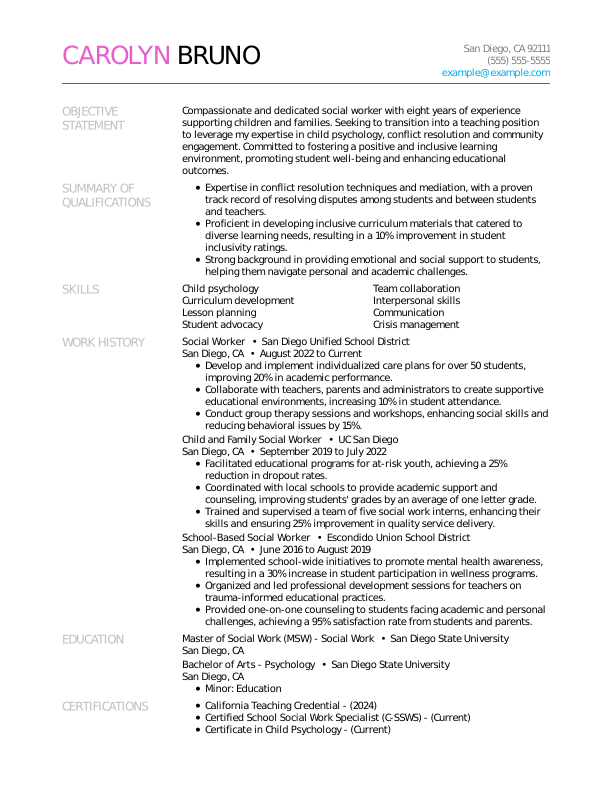
Social Worker to Teacher
Why this resume works:
- Showcases a social worker’s transferable skills (interpersonal skills, communication, and crisis management skills) that are relevant to a teaching role
- Focuses the summary of qualifications on relevant experience in educational settings, such as schools and after-school community centers
- Mentions certifications in child psychology and special education that boost their academic preparation
Accountant to Software Engineer
Why this resume works:
- Emphasizes experiences that showcase key transferable skills like strong analytical skills, problem-solving abilities, and precision
- Mentions a background in accounting while emphasizing additional education in software engineering, like coding bootcamps and relevant online courses
- Includes relevant technical skills acquired through self-study, coursework, or experience, such as proficiency in programming languages (Python, Java) and tools (Git, Jenkins)
UX Designer to Web Developer
Why this resume works:
- Highlights the UX designer’s skills in user interface design, prototyping, and user testing, which are highly relevant to web development
- Details specific projects where the candidate used front-end development technologies such as HTML, CSS, and JavaScript, which are foundational to web development
- Provides metrics and outcomes of the candidate’s UX and development projects, such as increased user engagement or improved website load times, reinforcing their web development knowledge
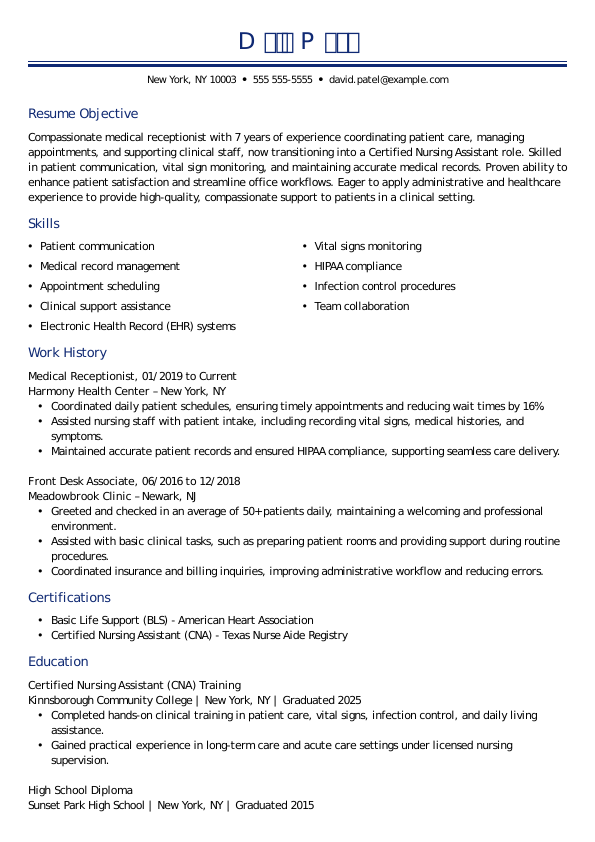
Medical Receptionist to Certified Nursing Assistant
Why this resume works:
- Highlights the medical receptionist’s relevant skills, such as patient communication, understanding of medical terminology, and proficiency in handling medical records and scheduling systems
- Features the candidate’s completed Certified Nursing Assistant program, including hands-on clinical practice
- Lists CPR and first aid certifications, which are often required for CNAs
Copywriter to Social Media Manager
Why this resume works:
- Highlights transferable skills crucial to social media management, including content creation, strong writing and editing, and audience engagement
- Features a summary of qualifications that emphasizes experiences directly related to social media, such as content strategy, managing brand campaigns, and overseeing digital content across various platforms
- Prominently features additional training and skills, such as Google Analytics Certification and Hootsuite Social Media Certification
Common Mistakes to Avoid With a Career Change Resume
Avoiding common mistakes can help you present your skills, experience, and potential in the best possible light and increase your chances of landing interviews in your new field. Here’s what not to do when writing a career change resume:
- Focusing too much on past job titles: Hiring managers care less about your previous titles and more about how your skills and accomplishments translate to the new role. Emphasize transferable skills and relevant achievements rather than job names.
- Using a one-size-fits-all resume: Tailoring your resume for each application by using keywords from the job description and highlighting the experiences most relevant to the position.
- Ignoring transferable skills: Skills like communication, project management, problem-solving, and client relations can apply to many industries, and they become the heart of your career change resume. Include these skills in your summary, skills section, and work experience.
- Overloading with irrelevant details: Remove outdated, unrelated, or minor tasks and skills that don’t support your career change. Keep your resume concise and focused on what matters to your new industry.
Career Change Tips to Ace the Job Search
Changing careers is an exciting step toward fulfilling your professional goals, but it can also be daunting without the right strategies in place. Here are some essential tips to help you navigate your career transition smoothly and effectively:
- Network in your desired industry. Attend industry-related events and join professional associations to meet experts and gather insights that can aid your career transition.
- Use LinkedIn to search for opportunities. Update your LinkedIn profile to reflect your new career direction, and actively engage with industry groups and job postings to increase your visibility and work opportunities.
- Volunteer or intern in roles related to your new career. Gain practical experience and demonstrate your commitment by volunteering or interning in your new field, which can also help you build valuable professional connections.
- Update your resume for each job application. Tailor it to highlight relevant skills and experiences and ensure it resonates with the specific demands of the position.
- Write a cover letter to explain your career change. Use a cover letter to narrate your career change journey, explaining why you’re shifting fields and how your past experiences provide unique value to potential employers. Try our Cover Letter Generator to generate a personalized letter in minutes!
Key Takeaways
Successfully changing careers requires a strategic approach to showcase your transferable skills and make your experience relevant to your new role.
- Tailor your resume for each application. Highlight transferable skills, relevant achievements, and industry-specific keywords to demonstrate your fit.
- Craft a strong resume profile and summary. Use these sections to clearly communicate your career transition goals and show how your experience aligns with your new field.
- Showcase transferable skills in your work experience. Focus on accomplishments and responsibilities that translate to the target role, and quantify results whenever possible.
- Highlight relevant education and certifications. Even if your degree isn’t directly related, emphasize coursework, projects, and certifications that support your career change.
- Leverage networking and practical experience. Attend industry events, engage on LinkedIn, volunteer, or intern to build connections and gain relevant experience.
- Avoid common resume mistakes. Don’t overemphasize past job titles, omit transferable skills, or ignore ATS optimization; each section should support your new career goals.
FAQ
What is a resume for a career change?
A resume for a career change is designed to highlight your transferable skills and experiences relevant to a new industry or role, emphasizing how your previous job history prepares you for a new career path.
How do I highlight transferable skills on a career change resume?
Highlight transferable skills on a career change resume by focusing on abilities that apply across industries, such as leadership, communication, problem-solving, project management, and teamwork.
Incorporate these skills throughout your resume sections (summary/objective, skills, experience), and contextualize them with experiences that demonstrate you’re prepared to take on the new role.
Can I use the same resume for different career changes?
No, you shouldn’t use the same resume for different career changes. Each target role requires a tailored approach that highlights the skills, achievements, and qualifications most relevant to that industry or position.
Always customize your resume for each application by reviewing the job description and incorporating the keywords, responsibilities, and accomplishments that align with the employer’s needs. This ensures your career change resume resonates with hiring managers and passes ATS.
How long should my career change resume be?
A career change resume should be one page long because it’s easiest for employers to scan. A two-page resume, however, is acceptable when you need extra space to highlight relevant skills, achievements, certifications, or projects that demonstrate your fit for the new career.
Focus on including only information that supports your transition, prioritizing relevance over length to make a strong, targeted impression on hiring managers.
Should I include my entire work history on a career change resume?
Yes, don’t remove past jobs just because they aren’t directly related to your new career. Aim to present a continuous work history in reverse-chronological order, but focus on achievements and transferable skills that demonstrate value in your target role.
What are some common mistakes to avoid in a career change resume?
Common mistakes include overloading the resume with irrelevant experiences, using a generic resume for multiple job applications, and failing to clearly articulate the connection between past experiences and the new career.
How do I handle gaps in employment on a career change resume?
Briefly acknowledge employment gaps in your resume, using a simple note like “Career development from 06/2025 to 08/2025.” Then, expand in your cover letter by explaining how you spent that time productively—learning new skills, completing certifications, volunteering, or managing personal responsibilities.
This approach shows growth, resilience, and intentional preparation for your career change without drawing undue attention to the gap.
How We Reviewed This Article
Over the past 15 years, we’ve helped more than 10 million job seekers build stronger cover letters, discover their career paths, interview confidently, and boost their chances of finding the right job faster. Review our Editorial Policy to learn more about our process.
About the Author
Gabriela Hernandez • CPRW, Career Advice Writer
Gabriela is a Certified Professional Resume Writer (CPRW) and member of the Professional Association of Resume Writers & Career Coaches. She focused on helping job seekers improve their professional resumes to highlight their unique skills and experience. Gabriela holds a BA in journalism from the University of Puerto Rico and brought more than four years of specialized experience to helping candidates navigate the complexities of the online job market, with a strong focus on resume optimization and effective self-presentation.
Ready to
land the job?
Join 28M+ others who’ve built a resume that works.




 Add LiveCareer as a preferred source on Google