What to Know
- Transferable skills are abilities you can apply across different jobs, industries, and situations, including communication, leadership, problem-solving, and adaptability.
- A transferable skills cover letter should connect your previous experience to the skills and qualifications required for the new role rather than simply listing your strengths.
- The strongest examples show how you applied a transferable skill in a specific situation and what the experience demonstrates about your qualifications, ideally with a measurable result when one is available.
- Your transferable skills can come from many experiences, including previous jobs, education, internships, volunteer work, extracurricular activities, and personal projects.
Transferable skills can help you demonstrate your qualifications even when your experience comes from a different industry or career path.
In this guide, you’ll learn how to identify relevant transferable skills, highlight them with specific examples, and demonstrate your qualifications when changing careers or entering a new field.
What Are Transferable Skills?
Transferable skills are abilities you can apply across different jobs, industries, and situations. They can come from previous jobs, education, volunteer work, internships, or other experiences, making them especially valuable when you’re changing careers, entering a new field, or applying for a role with a nontraditional background.
Transferable skills generally fall into two categories:
- Hard skills are specific, teachable abilities or technical knowledge you can develop and demonstrate. Examples include foreign language fluency, data analysis, project management, and industry-specific technical expertise.
- Soft skills are interpersonal and professional abilities that influence how you work and interact with others. Examples include written and verbal communication, teamwork, leadership, adaptability, and problem-solving.
Why Are Transferable Skills Important?
Transferable skills are important because they help employers recognize relevant qualifications, even when a candidate hasn’t worked in the same industry or held the same job title. They demonstrate that an applicant already has abilities that can contribute to the role.
Employers value transferable skills because they show a candidate’s adaptability, problem-solving abilities, and potential to succeed in a new position. For example, someone who has managed teams, budgets, or projects in another industry may already have the skills the employer needs, reducing training time and resources while giving employers greater confidence in their ability to handle similar responsibilities.
Transferable skills also strengthen your job application. Your resume can highlight these abilities through relevant accomplishments, while your cover letter explains how your experience prepares you for the new role. This is especially helpful when changing careers, returning to the workforce, or applying for an entry-level position.
How Do You Show Transferable Skills in a Cover Letter?
Show transferable skills in a cover letter by connecting abilities you developed in previous roles or experiences to the needs of the job you want. Instead of simply listing skills, use specific examples that demonstrate how you applied them and the results you achieved. This helps employers understand how your background can translate to success in a new role.
Follow these four steps to highlight transferable skills in your cover letter:
1. Identify Your Transferable Skills
Start by identifying skills you developed through previous jobs, education, volunteer work, internships, or extracurricular activities. Focus on abilities that can apply to the position you want, even if you developed them in a different industry or role.
Common transferable skills for a cover letter include:
- Adaptability: Adjusting to new responsibilities, environments, technologies, or priorities
- Communication: Conveying ideas through writing, presentations, or conversations
- Data analysis: Collecting, organizing, interpreting, and communicating insights from data
- Interpersonal skills: Building relationships and working effectively with different people
- Leadership: Guiding, motivating, or supporting others to achieve a shared goal
- Problem-solving: Identifying challenges and developing practical solutions
- Project management: Planning projects, coordinating people and resources, tracking progress, and meeting deadlines
- Teamwork: Collaborating with colleagues or contributing to group projects
- Time management: Prioritizing tasks and consistently meeting deadlines
2. Consider Your Experience Level
Choose transferable skills that reflect your experience level and the job you’re applying for. Experienced professionals can draw on previous roles, while students and recent graduates may highlight relevant coursework, internships, volunteer work, or extracurricular activities.
These examples show how to present transferable skills at different career stages:
Example of Transferable Skills in an Entry-Level Cover Letter
As a student volunteer for our campus fundraising committee, I strengthened my communication and organizational skills by coordinating outreach to 100+ students and helping plan three fundraising events. This experience taught me how to manage competing priorities, collaborate with a team, and communicate with diverse audiences—skills I’m excited to bring to an entry-level marketing position.
Example of Transferable Skills in a Mid-Career Cover Letter
As a retail manager, I led a team of 15 employees, managed staffing schedules, and implemented a new inventory process that reduced stock discrepancies by 20%. These experiences strengthened my leadership, organization, and process-improvement skills, which I’m prepared to apply to an operations coordinator role.
Example of Transferable Skills in an Experienced Cover Letter
Throughout my journalism career, I’ve managed complex research projects, coordinated interviews with multiple sources, and translated technical information into accessible content for broad audiences. Managing deadlines, evaluating information, and developing audience-focused stories have strengthened the research, communication, and project management skills I’d use in a content strategy role.
3. Match Your Transferable Skills to the Job
Once you’ve identified your transferable skills, compare them with the requirements in the job description. Look for skills, qualifications, and responsibilities that overlap with your experience, then use the employer’s terminology naturally when it accurately describes your abilities.
The goal isn’t to include every transferable skill you have. Choose the two or three skills that best connect your experience to the position, then demonstrate them with examples.
For example, a restaurant server applying for a customer service representative position could write:
In my role as a restaurant server, I assisted dozens of customers per shift, resolved concerns promptly, and coordinated with kitchen staff to ensure accurate orders. These experiences strengthened my communication, problem-solving, and customer service skills, which I’d bring to supporting customers and resolving inquiries in your customer service representative role.
Don’t overlook transferable technical skills. Software, tools, and technical abilities you’ve used in previous roles may also apply to a new position. For example, experience with Microsoft Excel, customer relationship management (CRM) software, data reporting, or project management tools could be relevant across several industries.
Compare the tools and technical requirements in the job posting with your previous experience. If you’ve used similar software or performed related tasks, explain that connection without overstating your proficiency.
For example, an administrative assistant applying for a data analyst role might write:
In my administrative role, I used Excel to track department expenses, identify spending trends, and prepare monthly reports for management. This experience strengthened my spreadsheet, data organization, and reporting skills, which I’m eager to apply to a data analyst position.
4. Prove Your Transferable Skills With Examples
Show employers how you’ve used your transferable skills rather than simply claiming you have them. Describe a specific situation, explain what you did, and highlight the result. This gives employers evidence that you can apply your existing abilities successfully in a new role.
A useful formula is:
Previous role or experience + transferable skill demonstrated + specific result or relevance to the new job
Strong action verbs can help you describe how you’ve applied your transferable skills. Choose verbs that reflect your experience and the qualifications the employer wants, such as:
- Leadership: Led, supervised, mentored, delegated, directed
- Communication: Presented, explained, negotiated, collaborated, persuaded
- Organization: Coordinated, scheduled, prioritized, organized, streamlined
- Problem-solving: Analyzed, resolved, improved, identified, developed
- Technical skills: Created, implemented, automated, configured, maintained
Use these verbs to introduce specific accomplishments rather than simply listing responsibilities:
- Weak example: My retail experience has prepared me for any project management role because I’m hardworking and adaptable.
- Stronger example: As a retail supervisor, I coordinated staff schedules, managed inventory deadlines, and resolved operational issues, developing planning and problem-solving skills I can apply to project coordination.
Here’s how to apply the formula to different career changes:
Student to Entry-Level Marketing
As a student volunteer, I coordinated social media promotions for three campus events, created digital flyers, and helped increase student participation. This experience strengthened my communication, organization, and content creation skills, which I’m excited to bring to your entry-level marketing team.
Educator to Data Entry
As a teacher, I maintained accurate student records, tracked attendance and academic progress, and organized information using spreadsheets and school databases. These responsibilities strengthened my attention to detail, data management, and organizational skills, which I’d apply to maintaining accurate records and processing information efficiently in a data entry role.
Sales to Project Management
In my sales role, I managed multiple client accounts simultaneously, coordinated deliverables across internal teams, and consistently met time-sensitive deadlines. This experience strengthened my organization and project coordination skills, which I’m excited to apply to a project management position.
Administrative Assistant to Human Resources
In my administrative role, I regularly handled confidential employee information, coordinated schedules, and communicated with employees across departments. These responsibilities strengthened my organization, communication, and confidentiality skills, providing a strong foundation for transitioning into an HR coordinator role.
Cover Letter Examples With Transferable Skills
The examples below show how candidates at different career stages can highlight relevant skills, explain how they used them, and demonstrate why their experience prepares them to succeed in a new position.
Career Change Cover Letter
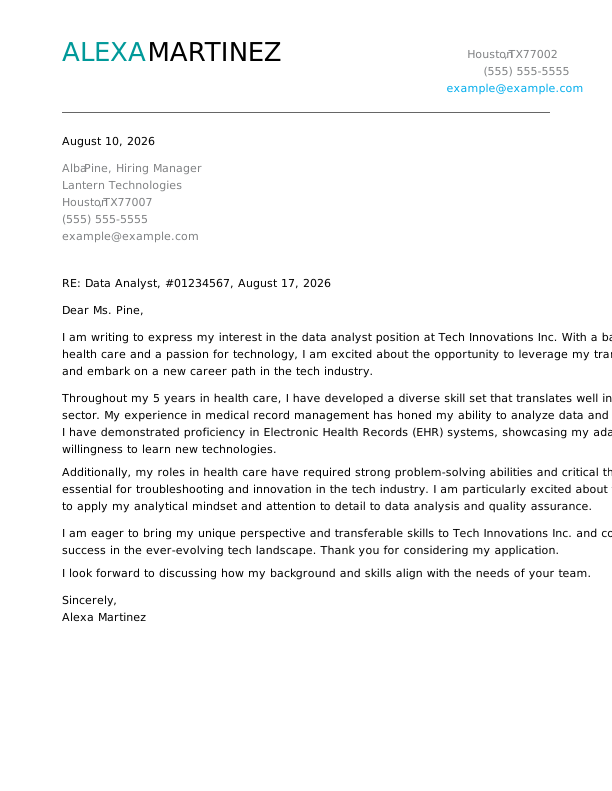
A career change cover letter should emphasize two or three transferable skills that connect your previous experience to your target role. Use relevant accomplishments to demonstrate how your background meets the employer’s needs, even if you haven’t worked in the same industry.
Here’s an example:
Why This Cover Letter Works
- Connects previous experience to the target role: The opening establishes the career change from healthcare to technology, while the body paragraphs explain how the candidate’s experience with medical records, data accuracy, and technology translates to the data analyst position.
- Highlights relevant transferable skills: The body paragraphs identify specific skills, including data analysis, adaptability, problem-solving, critical thinking, and attention to detail, and connect them to responsibilities in data analysis and quality assurance.
- Reinforces the candidate’s value: The closing emphasizes how the candidate’s healthcare experience and analytical abilities could contribute to the new role, rather than focusing on their lack of direct technology experience.
Recent Graduate Cover Letter
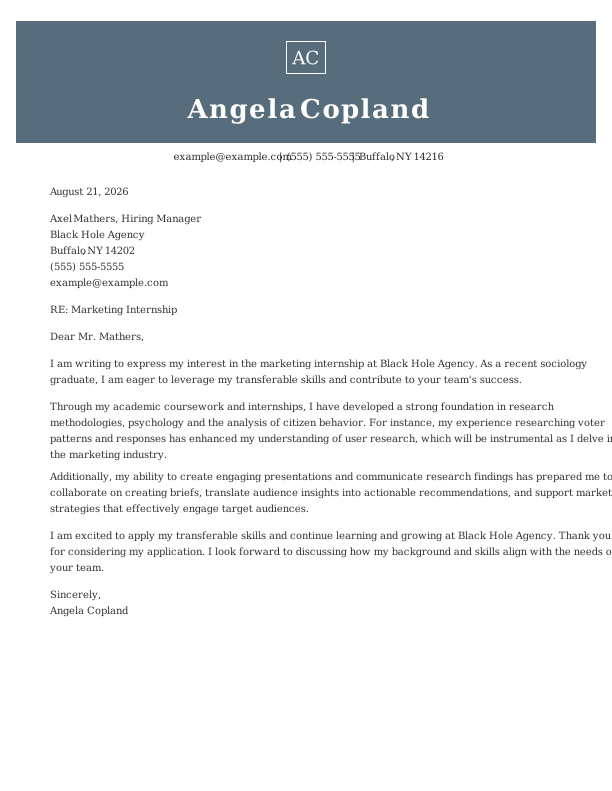
A recent graduate can highlight transferable skills gained through internships, part-time jobs, coursework, volunteer work, and extracurricular activities. Focus on skills such as communication, teamwork, and problem-solving, and show how you applied them.
Here’s an example:
Why This Cover Letter Works
- Connects academic experience to the target role: The opening establishes the candidate’s interest in the marketing internship, while the first body paragraph connects their sociology coursework and internship experience researching voter patterns to user research and understanding audience behavior.
- Provides specific evidence: The body paragraphs give concrete examples of how the candidate applied research, presentation, and communication skills, showing how those abilities could support marketing briefs, audience insights, and marketing strategies.
- Shows potential without extensive work experience: The candidate uses academic and internship accomplishments to demonstrate qualifications for the marketing role, showing that relevant skills don’t have to come from full-time employment.
How to Send a Cover Letter by Email
When emailing a cover letter, use a clear subject line, a professional greeting, and a concise message that introduces your qualifications. Follow the employer’s application instructions and attach your cover letter and resume in the requested formats.
Use these tips when submitting your application:
- Write a specific subject line. Include the job title and your name, such as “Project Coordinator Application – Jordan Lee.”
- Use a professional greeting. Address the hiring manager by name when possible. Otherwise, use “Dear Hiring Manager.”
- Keep your email brief. Introduce yourself, identify the position, and highlight one or two relevant transferable skills.
- Attach the correct documents. Include your resume and cover letter as separate attachments unless the employer requests otherwise. PDF is generally a good choice, but follow any specified file format requirements.
- Name files clearly. Use descriptive names, such as JordanLee_Resume.pdf and JordanLee_CoverLetter.pdf.
Here's a cover letter email template you can use to customize your own email:
Subject: [Job Title] Application – [Your Name]
Dear [Hiring Manager’s Name],
I’m applying for the [Job Title] position at [Company Name]. My experience in [previous field] has strengthened my skills in [skill 1] and [skill 2], which align with this role's requirements.
I’ve attached my resume and cover letter for your consideration. Thank you for your time, and I look forward to discussing how my experience could benefit your team.
Best regards,
[Your Name]
Tips for Highlighting Your Transferable Skills Effectively
Highlight your transferable skills by choosing relevant examples, emphasizing accomplishments, and explaining how your experience applies to the new role.
These tips can help make your cover letter more specific and persuasive:
- Turn skills into proof. Rather than writing that you have “strong leadership skills,” describe a situation where you led a team, project, or initiative and explain the result. Specific examples make your transferable skills more credible.
- Explain the connection when it isn’t obvious. Employers may not immediately recognize how experience from another industry applies to their position. Briefly explain how a skill from your previous career translates to the responsibilities of the new role.
- Prioritize accomplishments over duties. Focus on what you achieved rather than providing a list of tasks you performed. Whenever possible, include measurable results such as revenue increased, time saved, customers served, or projects completed.
- Include skills from outside the workplace. If you’re a student, recent graduate, or career changer, valuable transferable skills may come from coursework, volunteer work, community involvement, internships, or personal projects.
- Keep the focus on what you can contribute. A career change is about more than explaining why you’re leaving your previous field. Use your cover letter to show what your existing experience enables you to bring to the new position.
- End by reinforcing your value. Your cover letter closing should leave the reader with a clear sense of what you bring to the position and why you’re interested in the opportunity. Keep it confident, specific, and forward-looking.
Common Mistakes to Avoid When Highlighting Transferable Skills
Avoid listing skills without explaining how they qualify you for the job. Employers need to understand how your previous experience matches their requirements, especially when you’re changing careers.
Common mistakes include:
- Listing skills without evidence: Instead of claiming you’re organized or adaptable, describe a situation where you demonstrated those abilities.
- Using the same cover letter for every job: Tailor your examples to the specific qualifications and responsibilities in each job posting.
- Focusing on unrelated experience: Don’t include every skill you’ve developed. Prioritize the two or three that best demonstrate your fit for the position.
- Apologizing for limited experience: Avoid emphasizing what you haven’t done. Focus on relevant accomplishments, strengths, and your ability to learn.
- Overstating your qualifications: Be accurate about your technical skills and experience. If you’ve used similar software or tools, explain that connection without claiming expertise you don’t have.
Key Takeaways
- Review the job description and identify two or three transferable skills that match the employer’s requirements.
- Choose specific accomplishments that demonstrate how you’ve applied those skills, using measurable results when available.
- Explain how your previous responsibilities prepare you for the new position, especially when changing careers.
- Include relevant technical skills, software experience, and qualifications alongside your interpersonal strengths.
- Tailor each cover letter to the position, focusing on what you can contribute rather than what experience you lack.
Frequently Asked Questions
What are good transferable skills to put in a cover letter?
Good transferable skills to put in a cover letter are communication, leadership, problem-solving, adaptability, teamwork, organization, and project management. The best choices depend on the job requirements and your previous experience. For example, a retail manager applying for an operations role might highlight scheduling, staff supervision, and inventory management. Focus on two or three relevant skills and provide specific examples of how you’ve used them.
How do you highlight transferable skills in a cover letter?
Highlight transferable skills in a cover letter by connecting your previous accomplishments to the requirements of the job you want. Identify two or three relevant skills, explain how you’ve applied them, and describe the results when possible. For example, a teacher applying for a training position could emphasize experience developing instructional materials, presenting information, and adapting lessons for different audiences.
How do you write a cover letter when changing careers?
To write a cover letter when changing careers, explain your interest in the new field and focus on transferable skills that demonstrate your qualifications. Highlight accomplishments from previous jobs, education, or volunteer experience that relate to the position. Rather than emphasizing your lack of direct experience, show how your existing abilities, industry knowledge, and willingness to learn could benefit the employer.
Do employers care about transferable skills?
Employers care about transferable skills because they show how candidates can apply previous experience to new responsibilities. Skills such as communication, problem-solving, leadership, and adaptability are useful across many industries. For career changers, these abilities can demonstrate potential even without direct experience in the field. Employers still consider role-specific qualifications, so connect your transferable skills to the job’s requirements.
How do you demonstrate transferable skills without direct experience?
You can demonstrate transferable skills without direct experience by highlighting relevant accomplishments from school, internships, volunteer work, personal projects, or previous jobs in other fields. Focus on specific responsibilities and results that show your abilities. For example, organizing a community fundraiser can demonstrate budgeting, communication, teamwork, and project-coordination skills that may apply to an administrative or event planning position.
How We Reviewed This Article
Over the past 15 years, we’ve helped more than 10 million job seekers build stronger cover letters, discover their career paths, interview confidently, and boost their chances of finding the right job faster. Review our Editorial Policy to learn more about our process.
About the Author
Elizabeth Muenzen • CPRW, Career Advice Writer
Elizabeth is a Certified Professional Resume Writer (CPRW) and member of the Professional Association of Resume Writers & Career Coaches. She focuses on helping job seekers improve their professional resumes to highlight their unique skills and experience. Elizabeth holds a BA in English and a Technical and Professional Communication Certificate from Cal Poly, San Luis Obispo, and offers three years of specialized experience helping candidates navigate the complexities of today’s online job market, with a strong focus on resume optimization and effective self-presentation. She has had her work featured on LiveCareer’s resume builder and in these online publications: NASA, Buzzsprout, ZeroHedge, BenefitsPRO, and Stacker.
Follow 
Ace your
job search!
We’ve helped job seekers create strong applications for 15+ years.




 Add LiveCareer as a preferred source on Google