How to list education on a resume
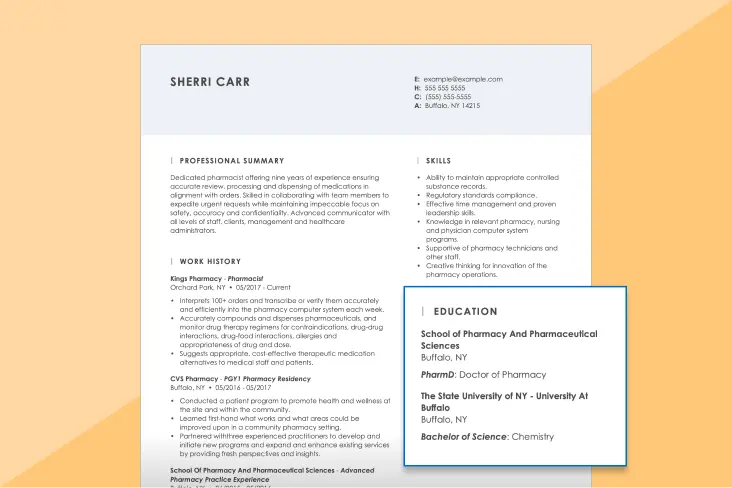
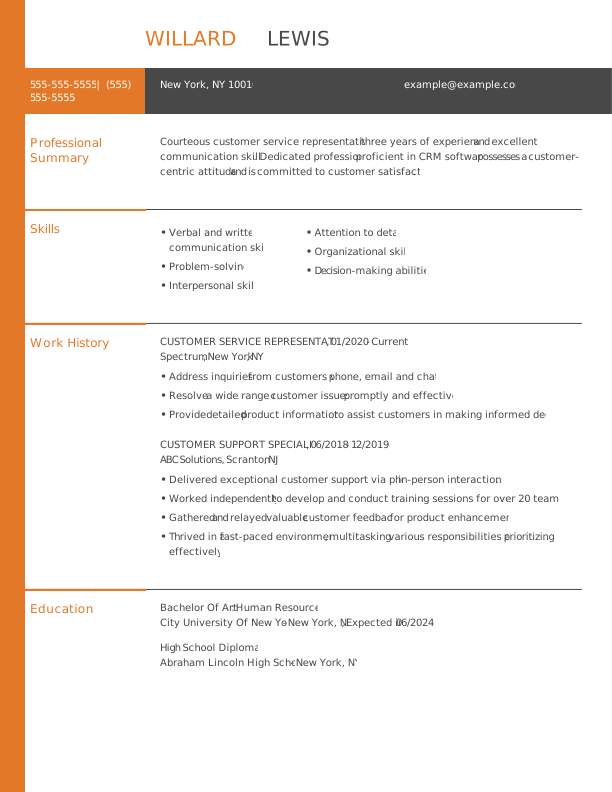
The education section of your resume is a dedicated space to list all of your formal schooling. Its goal is to show employers that you have the education and training necessary to do the job.
Overall, the process of listing your education is always the same. You’ll list each school you attended in reverse-chronological (most recent first) order.
You need these details in each entry:
- The degree or certificate earned.
- Name of the school that you attended.
- The city/state location of the school.
- The major(s) or focus of your study.
You should include the expected graduation year if you’re working on a degree but have yet to graduate.
Here are some education section examples based on degree level:
High school only:
- High School Diploma | George F. Baker High School | Tuxedo Park, NY
If you graduated high school and have an associate degree, list only the associate unless you are currently attending college:
- Associate of Science: Nursing Administration – Expected in May 2025 | Fox University | Newberg, OR High School Diploma | Habersham Central High School | Mount Airy, GA
Associate and bachelor’s:
- Bachelor of Arts: English – May 2020 | University of California – Los Angeles | Los Angeles, CA
- Associate of Arts: Communication Studies – May 2017 | Foothill College | Los Altos, CA
Bachelor’s only:
- Bachelor of Arts: American and English Literature | Boston College | Chestnut Hill, MA
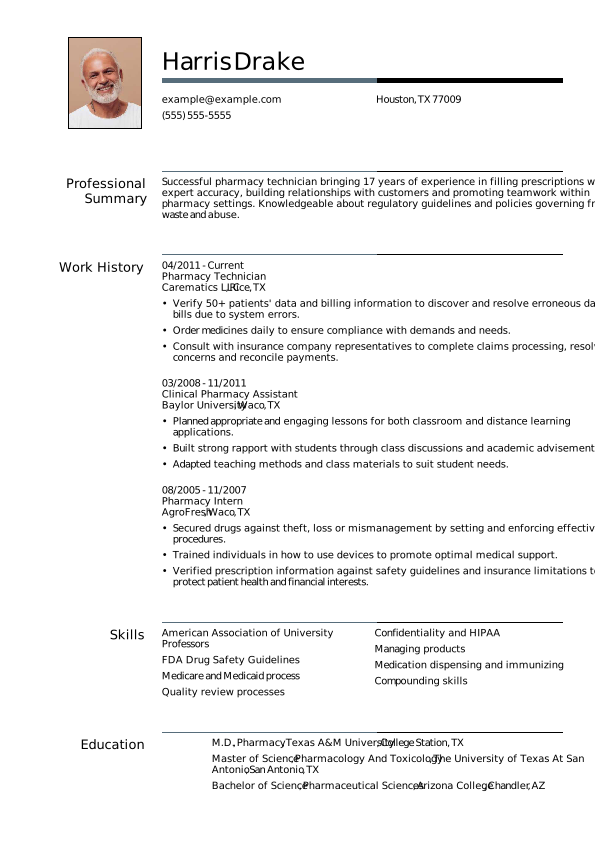
Bachelor’s and master’s:
- Master of Science: Library And Information Science | Texas A&M University | College Station, TX
- Bachelor of Science: Library Sciences | University of Texas at Austin | Austin, TX
Bachelor’s, master’s and Ph.D.:
- Ph.D.: Literature | Massachusetts Institute of Technology | Cambridge, MA
- Master of Arts: English Language and Literature | University of California – Santa Cruz | Santa Cruz, CA
- Bachelor of Arts: English | University of North Carolina at Chapel Hill | Chapel Hill, NC

Pro Tip
Including the year you graduated and earned your degree is
optional and highly discouraged. Adding the year hints at your age, which can lead to hiring bias issues. If
using ChatGPT to write your resume, ensure you remove the graduation date before submitting your job application.
Where to list education on a resume ?
The upper portion of your resume should be dedicated to your work history, showcasing the accomplishments that align most closely with the job you’re seeking.
Ask yourself: Is your education the most pertinent accomplishment for this role?
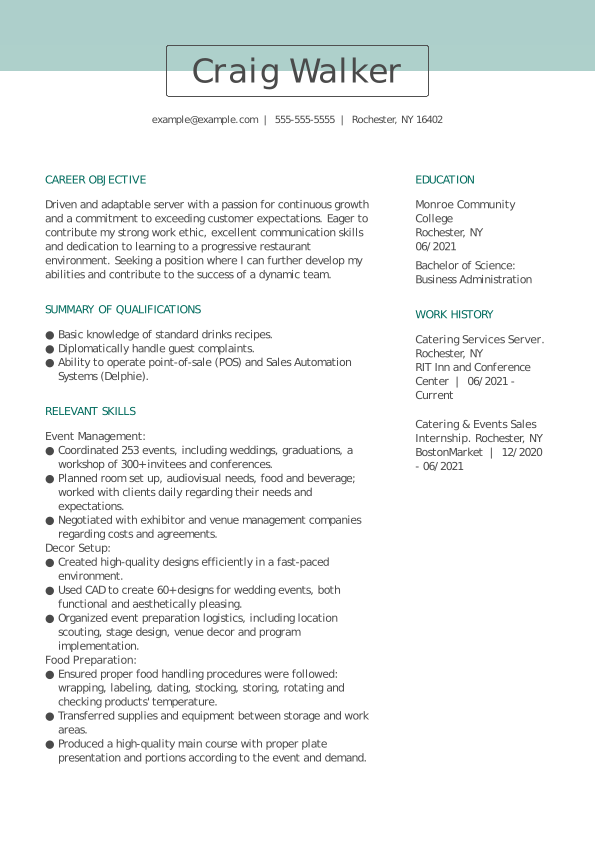
More often than not, the answer will be no. Work experience typically holds greater significance for positions beyond entry-level jobs. In this case, education would appear at the bottom of your resume, like in the chronological format.
However, there are instances where education takes precedence.
Education should lead if you’ve recently graduated from college and lack relevant work experience.
Additionally, prioritize education over work experience if you’ve recently returned to school to pursue a degree relevant to your desired job via a functional resume format.
In the case that you’re a student preparing for college admissions, you might want to prioritize the education section when writing your college resume, especially if you have plenty of academic achievements to highlight.
For instance, if you’re transitioning to a career in human resources after completing a related program but primarily possess experience in marketing, highlighting your new education at the forefront is advisable.
Pro Tip
Exercise caution if you’re applying for an academic position and
writing a CV rather than a resume. In such cases, education consistently precedes work experience.
Write your education section fast with our Resume Builder
Using our professional Resume Builder removes the guesswork of formatting your education section. It’s a tool that makes writing your resume fast, easy and flawless.
Our builder speeds up the writing process because it features 30+ resume designs you can use in all three formats!
It also has these features, helpful for the education section:
- Proper degree formatting
- Ability to add minors and academic recognitions
- Auto-populates school names and location
- Spelling and grammar check
Awards & honors section
If you lack much work experience, your education may be your best case for why you deserve a job.
So, it can be a good idea to bulk up your education history by including a special section titled “Awards & Honors.” You can list your academic achievements here to show employers you’re smart, talented and hard-working.
Some examples include:
- AP Scholar with Honors
- DoDEA AP Scholar
- International Scholarship Award
- National AP Scholar
- National Student Volunteer Award
- President’s Award for Educational Achievement
- President’s Award for Educational Excellence
- President’s National Service Award
Certifications & training section
In some cases, you may wish to include educational experience that wasn’t at a formal school or university to beef up your education section.
This may include:
- Specialized programs
- Company courses
- Relevant workshops
- Certified online or offline experience
If you earned a certification or did training, you should include it in its own section called “Certifications and Training.” Keep it separate from the more formal experience in your education section.
Here are examples of different certifications or training candidates might choose to highlight based on their education level:
High school diploma & an internship or apprenticeship:
- Welding Technology certification
- EMT Paramedic certification
- Business Administration and Management training program
- FAA Certificate
High school diploma and associate degree:
- Registered Nursing Certification
- Single Subject Credential
- Marketing Management certificate
Bachelor’s only:
- Human Resources training
- HRIS technologies certification
- UX customer certification
Bachelor’s and Masters:
- CCSP Network Security
- Novell Certified Linux Professional 10 (NCLP10)
- Certified Information System Security Professional
Bachelor’s, Master’s and Ph.D.:
- EKG-ECG certificate
- HIPAA Compliance
- Secondary Education credential
Education section do’s and don’ts
Do:- Provide industry specifics (especially if you’re in a famous program).
- Include your anticipated completion year if you’re in a current program.
- Cite the degree earned and any major(s) or academic focus.
- Mention any academic honors or valuable coursework to the job.
Don’t:- Lie or exaggerate! Employers regularly do background checks, and this will hurt your chances.
- Add your GPA unless you graduated less than two years ago, and it’s higher than 3.0.
- Include your graduation date if it was over 10 years ago.