94% of Men Feel Pressure to Provide Financially for Themselves & Their Dependents


Hired By:*

 Add LiveCareer as a preferred source on Google
For many men, providing for themselves and those who depend on them comes with pressure that shapes the jobs they stay in, the demands they accept, and what they sacrifice outside of work.
LiveCareer’s Pressure to Provide Report found that nearly all men surveyed (94%) feel pressure to meet these financial responsibilities, including 56% who describe that pressure as significant or intense.
Based on a survey of 700 employed U.S. men, the report also found that 54% have sacrificed sleep and 38% have sacrificed physical health because of pressure to earn more.
Key Findings
- Pressure to provide is universal. 94% feel pressure to financially support themselves and those who depend on them, including 56% who feel significant or intense pressure.
- Earnings shape men’s sense of worth. 74% say how much they earn affects how successful they feel as a man.
- Job loss feels personal. 78% say losing their job would feel like a personal failure, not just a financial setback.
- Responsibilities keep men in difficult working conditions. 37% have tolerated inadequate pay, 37% an unreasonable workload, and 35% a toxic workplace culture because they felt financially responsible for themselves or others.
- Earning pressure comes at a personal cost. 54% have sacrificed sleep, 48% time with family or friends, and 38% physical health because of work or pressure to earn more.
- Workplace expectations leave little room for vulnerability. 80% worked while sick or exhausted in the past year because they didn’t want to appear weak.
Pressure to Provide
Earning enough to support themselves or those who depend on them is a widespread source of financial pressure on men. Nearly all (94%) feel some degree of pressure, with more than half (56%) describing it as significant or intense.
When asked how much pressure they personally feel to meet these financial responsibilities:
- 24% – Intense pressure
- 32% – Significant pressure
- 28% – Some pressure
- 10% – Little pressure
- 6% – No pressure
What this means: Financial pressure is a common concern for working men, and its intensity matters. For most, earning enough to support themselves and those who depend on them is a major source of pressure.
Earnings Shape Men’s Sense of Success
Almost three-quarters of men (74%) agree with the statement, “How much I earn affects how successful I feel as a man.” The finding highlights how closely many men connect their earnings to their sense of success.
- 29% – Strongly agree
- 45% – Somewhat agree
- 18% – Somewhat disagree
- 8% – Strongly disagree
What this means: Tying salary to success can make it easier to overlook other important factors, like building skills, professional recognition, and building a fulfilling life outside of work.
Men Take Job Loss Personally
Nearly 8 in 10 men (78%) agree with the statement, “Losing my job would feel like a personal failure, not just a financial setback.” For these men, losing work carries an emotional weight beyond the loss of income.
- 39% – Strongly agree
- 39% – Somewhat agree
- 17% – Somewhat disagree
- 5% – Strongly disagree
What this means: Taking job loss personally can lead men to blame themselves for circumstances beyond their control. Business decisions like layoffs can feel like a verdict on their abilities, even when their performance was never the issue.
Men Put Up With More to Keep Providing
Men also reported tolerating difficult working conditions because they felt financially responsible for supporting themselves or others.
When asked which conditions they’ve tolerated:
- 37% – Inadequate pay
- 37% – An unreasonable workload
- 35% – A toxic workplace culture
- 30% – Poor treatment by a manager
- 27% – Long or unpredictable hours
- 26% – Limited advancement opportunities
- 18% – Work that negatively affected their health
What this means: Pressure to provide for themselves and their dependents can leave men feeling stuck in jobs with difficult working conditions. Leaving may feel like a financial risk they can’t afford.
The Personal Cost of Providing
Pressure to earn more can come at the expense of men’s health, relationships, and personal time. Nearly 9 in 10 men (88%) have sacrificed or neglected at least one aspect of their lives, with sleep and time with family or friends at the top of the list.
When asked what they’ve sacrificed or neglected because of pressure to earn more:
- 54% – Sleep
- 48% – Time with family or friends
- 38% – Physical health
- 36% – Vacation or personal time
- 36% – Hobbies or personal interests
- 24% – Romantic relationships
- 18% – An opportunity to pursue more meaningful work
Only 12% say they haven’t sacrificed or neglected any of these.
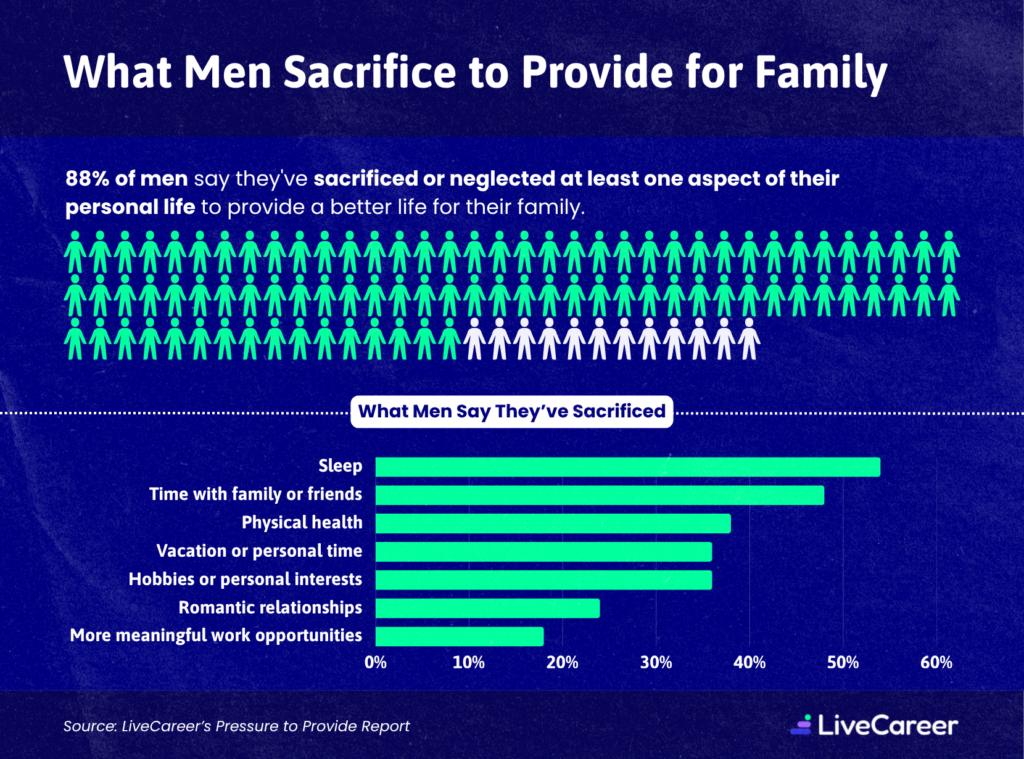
What this means: Trying to provide a better life can leave men with less room to enjoy the life they’re working to support. Time to rest, maintain relationships, and pursue personal interests can start to feel expendable when earning more takes priority.
Pushing Through to Appear Strong
To avoid appearing weak, 80% of men have worked while sick or exhausted in the past year. For more than 1 in 5 (22%), this happened frequently.
When asked how often they worked while sick or exhausted for this reason:
- 22% – Frequently
- 48% – A few times
- 10% – Once
- 20% – Never
What this means: Men’s concerns about appearing weak suggest that workplace cultures may leave little room for them to show vulnerability. Taking time to recover shouldn’t feel like a professional risk for men.
Fear of Appearing Less Committed
Concerns about appearing less committed to their careers have led 71% of men to avoid taking leave, requesting flexibility, or setting limits at work. Taking sick leave is the most commonly avoided action, cited by more than 1 in 3 (37%).
When asked what they’ve avoided because they worried it could make them appear less committed to their career:
- 37% – Taking sick leave
- 22% – Asking for a reduced workload
- 21% – Leaving work for a family responsibility
- 20% – Requesting a flexible schedule
- 19% – Turning down overtime
- 19% – Asking for help at work
- 13% – Declining an after-hours request
- 12% – Taking parental leave
Only 29% say they haven’t avoided any of these actions for fear of appearing less committed.
What this means: Breadwinner pressure on men can come at the expense of their own needs, both on and off the clock.
Financial Security Defines Success
Ultimately, men want financial security. Nearly 6 in 10 (58%) place it among their three most important markers of success, well above earning a high salary (25%).
When asked which three factors are most important to how they personally define success:
- 58% – Financial security
- 28% – Owning a home
- 28% – Being able to support others financially
- 26% – Maintaining good health and well-being
- 25% – Earning a high salary
- 25% – Raising a family
- 25% – Having work-life balance
- 20% – Having a strong marriage or romantic relationship
What this means: This is not about men wanting sky-high salaries. It’s the desire to have enough financial security to provide for themselves and others without sacrificing their own well-being.
For press inquiries, please contact Elizabeth Buccianti at elizabeth.buccianti@bold.com.
Methodology
This report's findings are based on a nationally representative survey conducted by LiveCareer using Pollfish on September 15, 2026. The survey collected responses from 700 U.S. men who are currently employed and explored their experiences with financial security and providing for dependents. They answered different types of questions, including yes/no, open-ended, and scale-based questions in which respondents indicated their level of agreement with statements, as well as multiple-choice questions from which they could select an option.
Participants represented a broad cross-section of employed men. Age-wise, the distribution was also balanced: 23% were aged 18–28 (Gen Z), 28% were aged 29–44 (millennials), 25% were aged 45–60 (Gen X), and 24% were aged 61–79 (baby boomers).
All participants were screened to ensure they were currently residing in the U.S. and actively employed at the time of the survey. Data collection followed Pollfish’s quality control standards to ensure accurate, reliable results.


Ready to
land the job?
Join 28M+ others who’ve built a resume that works.