What to Know
- Don’t put references directly on your resume unless the employer specifically requests them.
- Skip “References available upon request.” Employers already expect candidates to provide references when needed.
- Create a separate professional reference page with three to five contacts who can speak to your skills, experience, and work ethic.
- Ask each person for permission before sharing their contact information with an employer.
Strong references can provide additional evidence of your skills and past performance when an employer checks them, but they don’t belong on your resume. Listing names, phone numbers, and email addresses there takes up space you could use to show employers why you’re qualified.
Instead, keep a separate page ready for employers who request one. This guide explains why references matter, who to ask, and how to format and share a professional reference page.
Do You Put References on a Resume?
No, you generally shouldn’t put references on your resume. Use the space for your skills, experience, and accomplishments instead, and keep a separate reference page ready to provide when needed.
Space on your resume is valuable. Listing references, or even including the phrase “References available upon request,” takes up room that’s better spent showcasing your skills, experience, and achievements. Employers already know references are available if needed, so there’s no need to state it. Instead, focus your resume on information that shows you’re qualified for the role.
The exception is when a job posting or application specifically tells you to include references on your resume. In that case, follow the employer’s instructions exactly; otherwise, provide a clean, well-organized reference page as a separate document.
How Important Are References on a Resume?
References can be an important part of the hiring process, even though they usually shouldn’t appear on your resume. A strong reference gives an employer additional perspective on your skills, work habits, accomplishments, and professional relationships.
A former supervisor, colleague, professor, or client may provide specific examples of how you work, solve problems, communicate, or contribute to a team. These insights can give employers context that may not be apparent from your resume or interview alone.
Reference checks typically happen later in the hiring process, often after interviews, but timing and importance vary by employer, industry, and role. They may be more routine in fields such as academia, healthcare, and government, where credential or background verification is common, while other employers may rarely conduct formal checks or may not contact every reference.
That’s why it’s worth preparing your references in advance. Choose people who know your work well, confirm that they’re comfortable serving as references, and keep their current contact information ready to share when an employer asks.
Who Should You Include as a Resume Reference?
The best resume references are people who know your work well and can give specific examples of your skills, accomplishments, and professional qualities. Former supervisors are often strong choices, along with colleagues, professors, academic advisors, long-term clients, and other professional contacts.
Ideal references are individuals who can confidently speak to your:
- Work ethic and reliability
- Skills and strengths
- Contributions and accomplishments
- Communication and teamwork
- Professional attitude
Choose three to five people who can offer different perspectives on your work. For example, a former manager might speak to your performance and growth, while a colleague or cross-functional partner could describe how you collaborate and solve problems.
Avoid listing friends or family members unless you’ve worked together professionally and they can provide relevant examples of your performance. If your job search is confidential, you may also want to avoid using your current manager unless you’ve discussed your search with them.
Most importantly, always ask permission before giving someone’s contact information to an employer. Confirm that they’re comfortable serving as a reference and have up-to-date information about your experience and job search.
How Do You Ask Someone to Be a Reference? (Email Template)
Ask someone to be a reference before sharing their contact information with an employer. A short email or conversation is usually enough. Explain the role you’re pursuing, ask whether they’re comfortable recommending you, and give them enough information to speak specifically about your qualifications.
When asking someone to serve as a reference:
- Give them context. Explain the type of position you’re applying for and why you think they’d be a helpful reference.
- Share your current resume. This gives them an updated view of your experience, skills, and accomplishments.
- Refresh their memory. Mention a few projects, responsibilities, or achievements from your time working together that may be relevant to the role.
- Give them an easy way to decline. Asking whether they feel comfortable providing a positive reference lets the person say no if they don’t feel they’re the right choice.
You can adapt this email template when asking a former manager, colleague, professor, or other professional contact:
ExampleSubject: Reference Request
Hi [Name],
I hope you’re doing well. I’m currently applying for [type of role/position] and wanted to ask if you’d feel comfortable serving as a professional reference for me.
Since we worked together on [project/team/company], I thought you could speak to my experience with [relevant skill, responsibility, or accomplishment]. I’ve attached my current resume and would be happy to send the job description or any other helpful information.
Please don’t feel obligated if the timing isn’t right. I appreciate your consideration either way.
Best,
[Your Name]
If they agree, thank them and let them know when you share their information with an employer. If possible, send the job description as well so they understand what the employer is looking for and can prepare for a potential call or email.
Build Your Resume
How to Make a Reference Page for a Resume
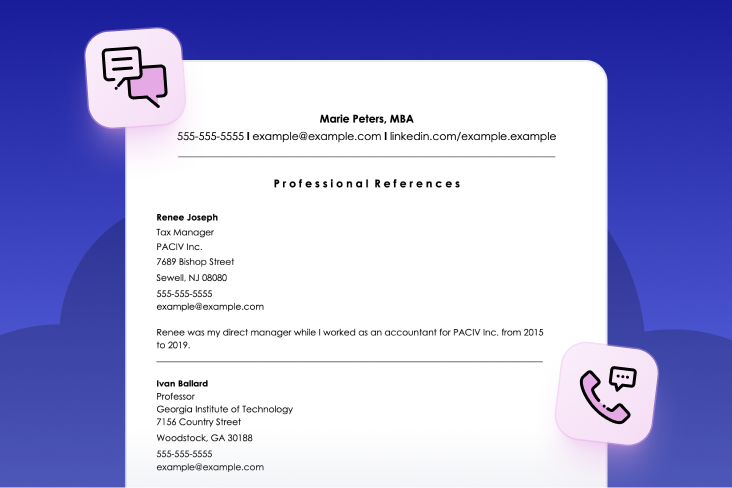
To make a reference page for your resume, create a separate document with the same basic header and formatting as your resume, then list three to five professional references with their contact information and relationship to you. Keep the page simple, consistent, and easy for an employer to scan.
Title the document “Professional References” and use the same name, phone number, email address, font, and basic design as your resume. This makes your application materials look like a coordinated set.
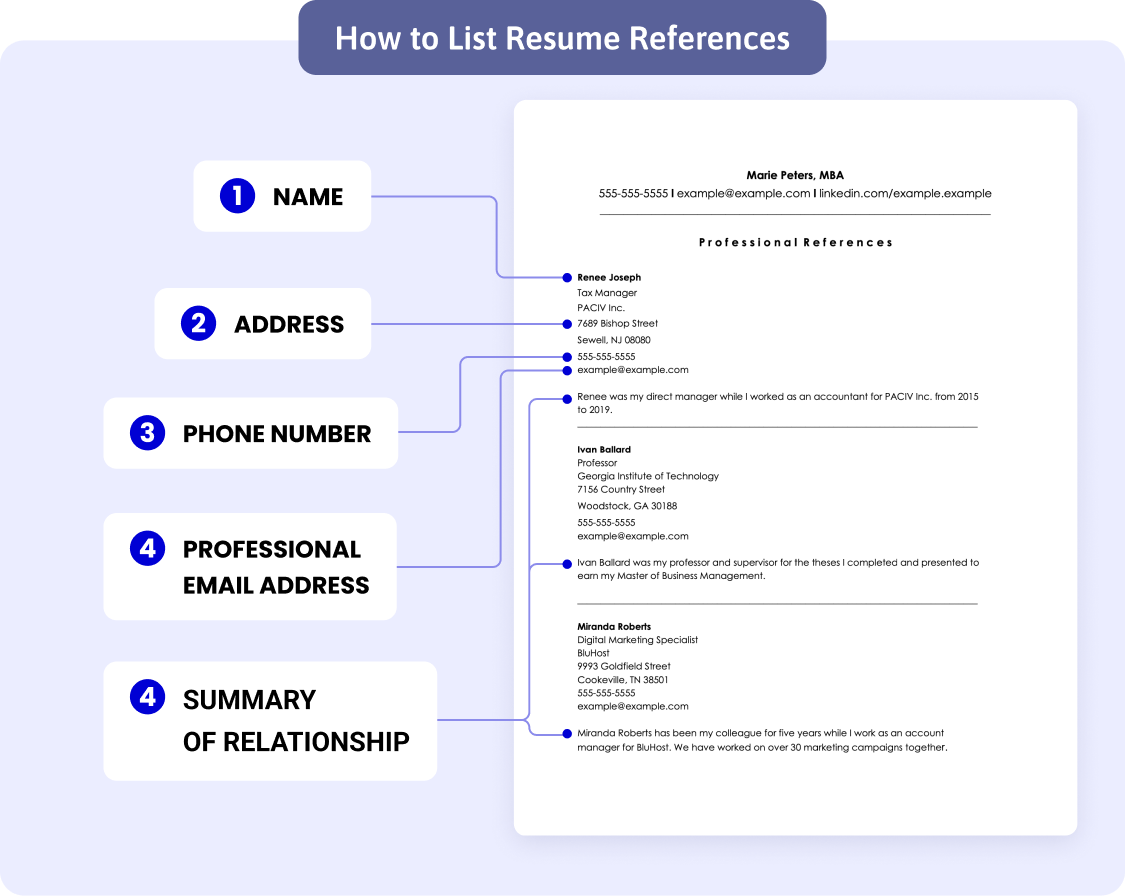
For each reference, include:
- Full name: List the person’s first and last name.
- Professional title: Include their current job title when applicable.
- Company or organization: Add the name of their current employer or organization.
- Phone number: Use the number your reference has given you permission to share.
- Email address: Include the email address your reference has approved for professional contact.
- Work address, if requested: A full mailing address usually isn’t necessary unless the employer or application specifically asks for one.
- Relationship description: Briefly explain how you know the person, such as “Former supervisor at Leff Lighting for three years.”
Here’s a diagram of how to list your resume references:
List your strongest and most relevant references first. If several are equally relevant, list them in reverse-chronological order, with the most recent professional contacts first. Before sending the page, double-check names, titles, phone numbers, and email addresses for accuracy.
Save your reference page as a PDF when submitting it electronically unless the employer requests another format. This helps preserve the formatting when you send or upload it.
Copy-Paste Reference Page Template & Example
A professional reference page should be simple, easy to scan, and match your resume's formatting. Use the template below as a guide, then copy and customize it with your own references.
Example[Your First and Last Name]
[Your phone number]
[Your email address]
Professional References
[Reference First and Last Name]
[Professional Title]
[Company or Organization]
[Phone Number]
[Professional Email Address]
[Relationship: Briefly explain how you worked together and for how long.]
Repeat the reference entry for each person on your list. Prepare three to five references, unless the employer specifies a different number, and place your strongest or most relevant references first.
Customize Your Letter
Reference Page Sample
Using the template above, here's an example of what a filled-out reference page might look like:
Emory Crandall
(123) 456-7890
e.m.crandall@email.com
Professional References
Tamara Jones
Head Librarian
Peyton Community Library
(555) 555-5555
t.jones@example.com
Former supervisor for four years while I worked as a resident archivist.
Coreen Hubert
Librarian
Riverdale Public Library
(555) 555-5555
c.hubert@example.com
Supervised my work for three years as a library assistant.
Keep your reference page separate from your resume and cover letter unless the employer gives different instructions. If you’re preparing the rest of your application, review cover letter examples or use our Cover Letter Generator to create a letter that complements your resume.
Key Takeaways
To handle professional references correctly during your job search:
- Remove references and the phrase “References available upon request” from your resume unless an employer specifically asks for them.
- Create a separate Professional References document with three to five strong contacts.
- Ask each person for permission, then send them your current resume and information about the role you’re pursuing.
- Keep your reference page updated and save it as a PDF so it’s ready when an employer requests it.
Build My Resume Now
Frequently Asked Questions
Can I lose a job offer because of a reference?
Yes, a negative reference can affect a job offer if an employer uses reference checks in its hiring decision. Reduce that risk by choosing people who know your work well and can speak positively and specifically about your qualifications. Always ask permission first, so you know the person is comfortable serving as your reference.
Is it okay not to put references on a resume?
Yes, it’s usually best not to include references on your resume unless the employer specifically asks you to. Your resume should focus on your qualifications, including your skills, experience, education, and accomplishments. Keep your references on a separate document so you can provide them when requested during the hiring process.
Where do references go on a resume?
References generally don’t go anywhere on your resume. Instead, create a separate page titled “Professional References” that matches the basic formatting of your resume. Include three to five contacts along with their professional information and a brief description of your relationship. Send the page when the employer requests references or follow any specific instructions in the job application.
Do employers still look for references?
Yes, some employers still check references as part of the hiring process, although practices vary by employer and role. A reference can help an employer learn more about your previous work, skills, professional relationships, and performance. Because you may not know whether an employer will contact your references, choose them carefully and make sure their contact information is up to date.
At what stage do employers call references?
Employers often contact references later in the hiring process, after interviews and when they’re seriously considering a candidate. But there’s no single stage when every employer checks references, so be prepared to provide your list whenever an employer requests it, and let your references know when you’ve shared their information so they can be ready for a call or email.
How We Reviewed This Article
Over the past 15 years, we’ve helped more than 10 million job seekers build stronger cover letters, discover their career paths, interview confidently, and boost their chances of finding the right job faster. Review our Editorial Policy to learn more about our process.
About the Author
Marla Figueroa • Career Advice Writer
Marla is a career advice writer. She focuses on helping job seekers improve their professional resumes to highlight their unique skills and experience. Marla holds a master's degree in media writing and brings five years of specialized experience to helping candidates navigate the complexities of the online job market, with a strong focus on resume optimization and effective self-presentation.
Follow 
Ready to
land the job?
Join 28M+ others who’ve built a resume that works.