Ghosting Consequences: 48% of Candidates Won’t Apply Again After Employer Ghosting


Hired By:*

 Add LiveCareer as a preferred source on Google
Communication has become a defining factor in how job seekers evaluate potential employers, and silence during the hiring process can leave a lasting impression.
The Ghosting Consequences Report from LiveCareer, based on a survey of more than 1,000 U.S. workers, examines how employer ghosting shapes candidate perceptions, trust, and future interest in job opportunities. The findings reveal that a lack of follow-through during recruitment can influence far more than a single application, affecting how workers view an organization long after the hiring process ends.
Key Findings
- Many candidates won't give employers a second chance. 48% wouldn’t apply to a company again after being ghosted.
- Ghosting hurts employer reputations. 42% would trust a company less after the experience.
- Employer ghosting is widespread. 45% of workers say they’ve been ghosted during the hiring process.
- Workers think the problem starts with employers. 45% believe employers ghost candidates more often than candidates ghost employers.
Ghosted Candidates Don't Come Back
Employer ghosting can have lasting consequences for companies. Nearly half of workers say they wouldn’t apply to a company again after being ghosted during the hiring process.
- 48% wouldn’t apply to a company again after being ghosted.
- 42% would trust the company less after the experience.
- 37% would share the experience with others.
- Only 17% say it wouldn’t affect their perception or behavior.
What this means: Leaving job candidates in the dark about where they stand in the hiring process can have lasting consequences. Hiring teams that fail to communicate may lose the chance to reconnect with these candidates in the future.
Hiring Teams Go Silent at Every Stage of the Process
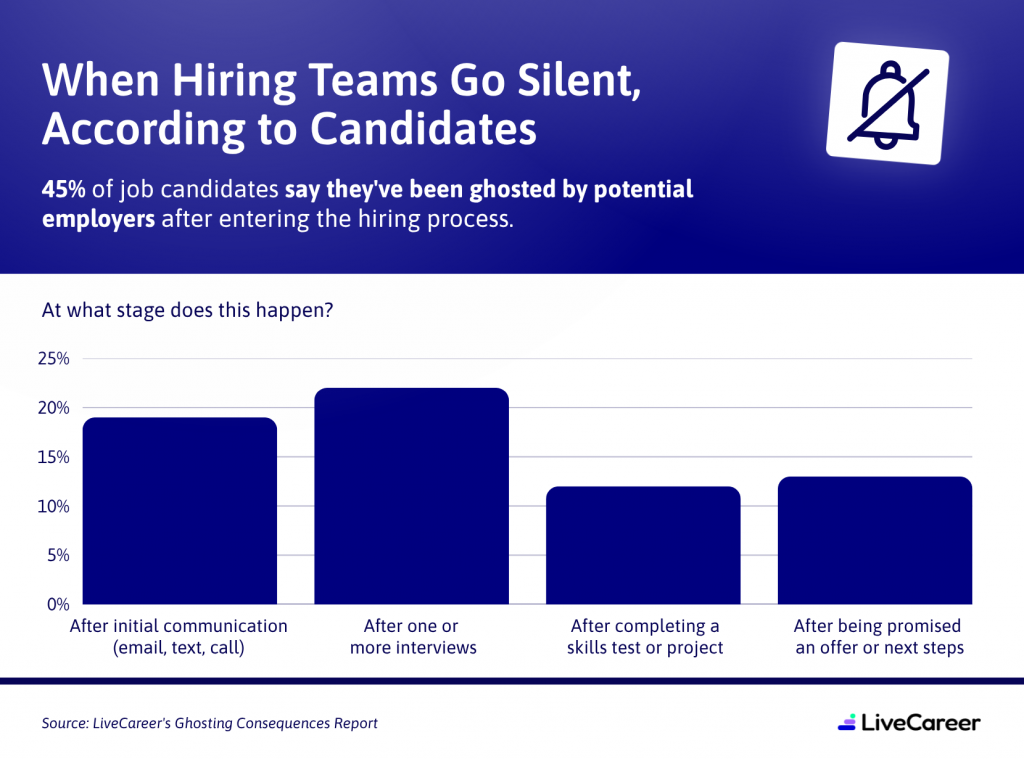
Nearly half of workers (45%) say a potential employer has stopped communicating with them after they’d already entered the hiring process.
- Ghosted after an initial communication, such as an email, text, or phone call: 19%
- Ghosted after one or more interviews: 22%
- Ghosted after completing a skills test or project: 12%
- Ghosted after being told an offer or next steps were coming: 13%
The majority of workers also give potential employers considerable time before assuming they’ve been ghosted.
- Assume they’ve been ghosted within one to three days: 10%
- Four to seven days: 25%
- One to two weeks: 26%
- More than two weeks: 14%
- Continue following up until they receive a response: 24%
What this means: Ghosting isn’t limited to the early stages of the hiring process and can persist as the stakes get higher. Many candidates are willing to wait an extended period for a response, giving employers ample opportunity to maintain communication and manage expectations.
Workers Say Employers Are the Bigger Offenders
Workers are more likely to blame potential employers than job seekers for ghosting during the hiring process.
- 45% say employers ghost candidates more often than candidates ghost employers.
- 33% say both sides ghost about the same amount.
- 21% say job seekers ghost employers more often.
What this means: Workers feel hiring teams are the most frequent offenders when it comes to ghosting during the hiring process. Consistent follow-up builds trust and can help keep qualified candidates engaged and interested in future opportunities.
Candidates Believe Employer Ghosting Is Usually Intentional
Workers feel that ghosting from hiring teams is related to deliberate hiring decisions rather than recruiting challenges, such as an incredibly high volume of applicants.
- 57% believe employers stop communicating after choosing another candidate.
- 33% believe employers decide a candidate isn’t the right fit but avoid formally rejecting them.
- 21% believe the job opening was put on hold or canceled.
- 18% believe the hiring process was disorganized.
- 15% believe employers were overwhelmed by the number of applicants.
- Only 10% believe employers ghost candidates because they rely too heavily on automation or AI.
What this means: Many workers view employer ghosting as a deliberate choice rather than a product of recruiting roadblocks, such as an overwhelming number of candidates. So, why do candidates ghost recruiters in return? When they interpret a lack of communication as intentional, it can damage trust, burn bridges, and discourage future engagement.
Communication during the hiring process is about more than keeping candidates informed. Every interaction helps shape how job seekers perceive the organization, and consistent follow-up can reduce the consequences of ghosting and leave a lasting positive impression long after the hiring process ends.
For press inquiries, please contact Elizabeth Buccianti at elizabeth.buccianti@bold.com.
Methodology
The findings presented in this report are based on a nationally representative survey conducted by LiveCareer using Pollfish on April 14, 2026. The survey collected responses from 1,008 U.S. adults who are currently employed and explored their experiences communicating with potential employers during the hiring process. They answered different types of questions, including yes/no; open-ended, scale-based questions, where respondents indicated their level of agreement with statements; and multiple-choice questions, where they could select from a list of provided options.
Demographic Breakdown
Participants represented a broad cross-section of the working population in terms of gender and age. The sample included 52% male respondents (528) and 47% female respondents (477). Age-wise, the distribution was also balanced: 14% were aged 18–28 (Gen Z), 27% were aged 29–44 (millennials), 29% were aged 45–60 (Gen X), and 30% were aged 61–79 (baby boomers). All participants were screened to ensure they were currently residing in the U.S. and actively employed at the time of the survey. The data collection adhered to Pollfish’s quality control standards to ensure the accuracy and reliability of the results.


Ready to
land the job?
Join 28M+ others who’ve built a resume that works.